
NASA has entered a rare engineering frontier where theoretical aerodynamics collides with planetary survival constraints: rotor blades spinning faster than the speed of sound inside a simulated Martian atmosphere, and still holding together.
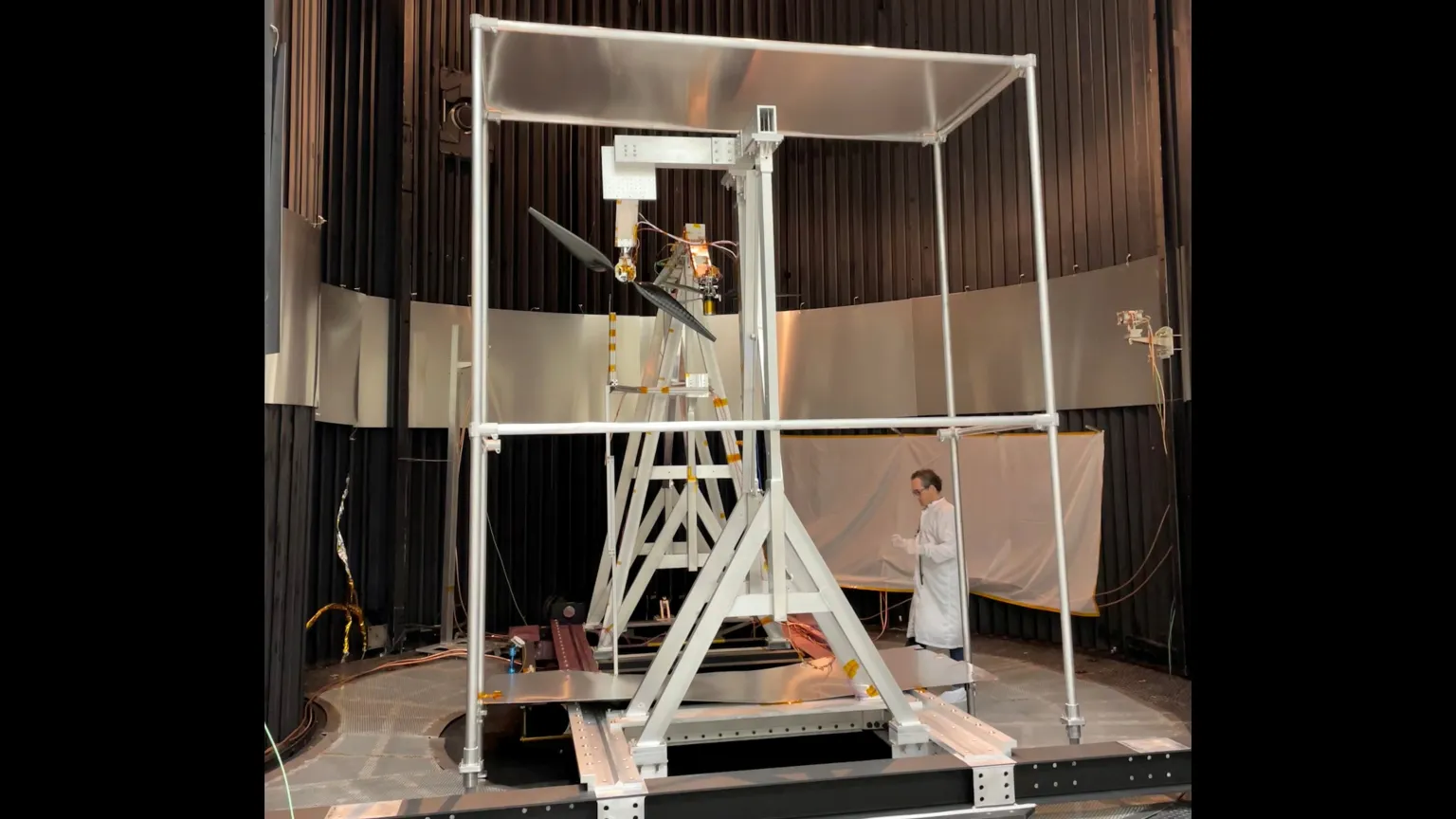
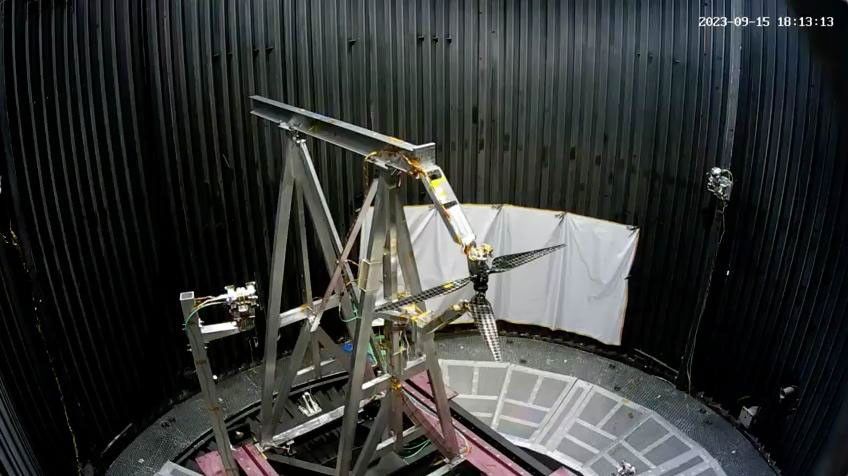
Inside the Jet Propulsion Laboratory in California, engineers subjected next-generation Mars helicopter rotor systems to extreme stress tests designed to replicate the thin, carbon-dioxide atmosphere of Mars. In a series of 137 controlled experiments, the blades were pushed beyond Mach 1, reaching up to Mach 1.08 without structural failure. The results signal a shift in how aerial mobility is being redefined for Mars exploration strategies.
The testing was conducted inside JPL’s 25-Foot Space Simulator, a facility engineered to replicate extraterrestrial atmospheric conditions with precision. According to NASA documentation available through its Mars science program, the goal is to evaluate how rotorcraft behave in environments where conventional aerodynamic assumptions begin to collapse under low-pressure physics.
NASA’s earlier Ingenuity helicopter, which achieved the first powered flight on another planet in 2021, intentionally avoided crossing Mach 0.7. At that time, supersonic rotor behavior was considered too unpredictable for operational systems. The new results directly challenge that constraint.
According to technical data released by NASA’s Jet Propulsion Laboratory, now accessible through its official aerospace research archive, the experimental rotor configurations not only survived supersonic tip speeds but also generated significantly higher lift performance. In some cases, lift output increased by nearly 30 percent, a figure that directly affects payload capacity and mission design feasibility.
That payload margin is not a marginal improvement. It represents a structural change in mission architecture. Heavier instruments, longer-range flight systems, and more autonomous scientific payloads become viable under these revised aerodynamic limits. NASA’s internal engineering teams are already evaluating how this data informs next-generation rotorcraft concepts intended for future Mars deployments.
Within the broader framework of NASA missions, the implications extend beyond experimental validation. The data feeds directly into conceptual programs such as advanced aerial scouting systems, where multiple rotorcraft could operate as distributed observational platforms rather than isolated experimental drones.
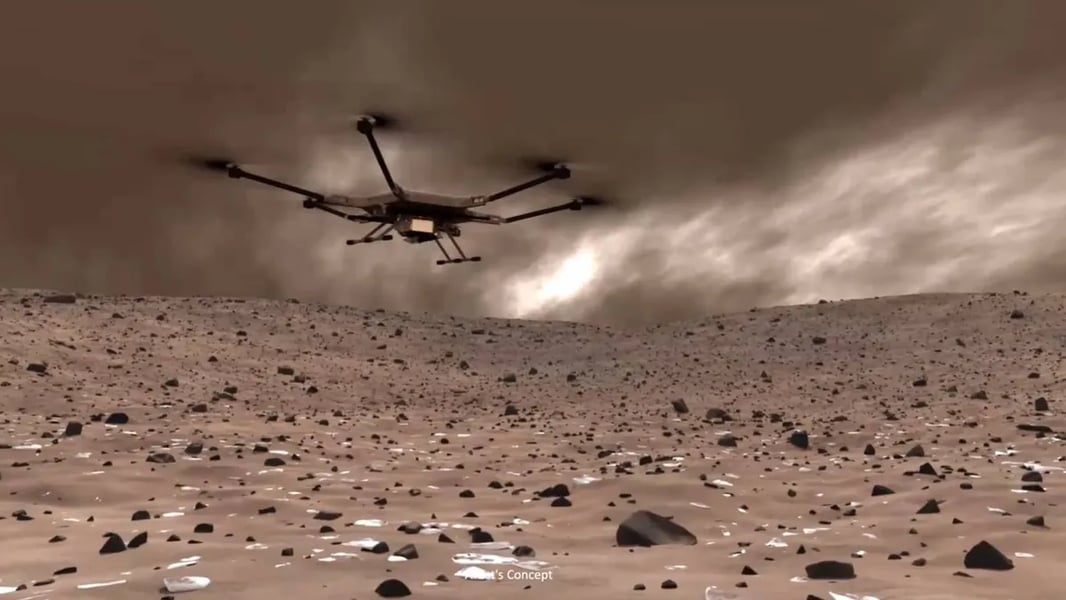
The physics behind this achievement is complex. Supersonic rotor dynamics introduce compressibility effects that can destabilize lift, generate shock waves, and induce fatigue stress across blade surfaces. Yet in Mars-like atmospheric density, these effects manifest differently, creating a narrower but more exploitable aerodynamic window than previously assumed.
That shift is why NASA engineers are re-evaluating long-held assumptions in space technology development. The traditional boundary between subsonic and supersonic rotorcraft performance is no longer treated as a hard engineering limit but as a conditional threshold dependent on environmental density and material resilience.
At the Jet Propulsion Laboratory, which continues to serve as NASA’s primary hub for robotic planetary systems, researchers are now integrating these findings into broader design models for autonomous aerial exploration. The agency’s experimental documentation, including testing frameworks described in its official science repository at NASA Science, reinforces the iterative nature of these breakthroughs.
The implications extend beyond Mars alone. Similar aerodynamic constraints exist in other planetary environments such as Titan’s dense atmosphere and the upper cloud layers of Venus, where flight dynamics could also benefit from high-speed rotor systems operating under unconventional physical conditions.
From a strategic perspective, NASA’s findings suggest a future in which planetary exploration is no longer limited to ground-based rovers or stationary landers. Instead, fleets of autonomous aerial systems may become standard tools for mapping terrain, analyzing atmospheric composition, and identifying scientifically significant regions across planetary surfaces.
In that sense, the supersonic rotor test is not merely an engineering milestone. It is a recalibration of mobility in space exploration architecture. Mars is no longer just a destination for static observation. It is becoming a navigable aerial environment where flight systems may operate with a degree of freedom once considered incompatible with its atmosphere.
NASA has not declared operational readiness for supersonic rotorcraft on Mars, and caution remains embedded in ongoing evaluation programs. However, the direction of development is increasingly clear. The limits of aerial exploration are shifting, and with them, the scope of what is physically possible beyond Earth is expanding in real time.