
The European Commission confirmed Monday that nearly $7 billion from the first tranche of its sweeping €90 billion Ukraine assistance package will be directed toward weapons procurement and military support, underscoring the bloc’s deepening financial and strategic commitment to Kiev as the war with Russia enters another volatile phase.
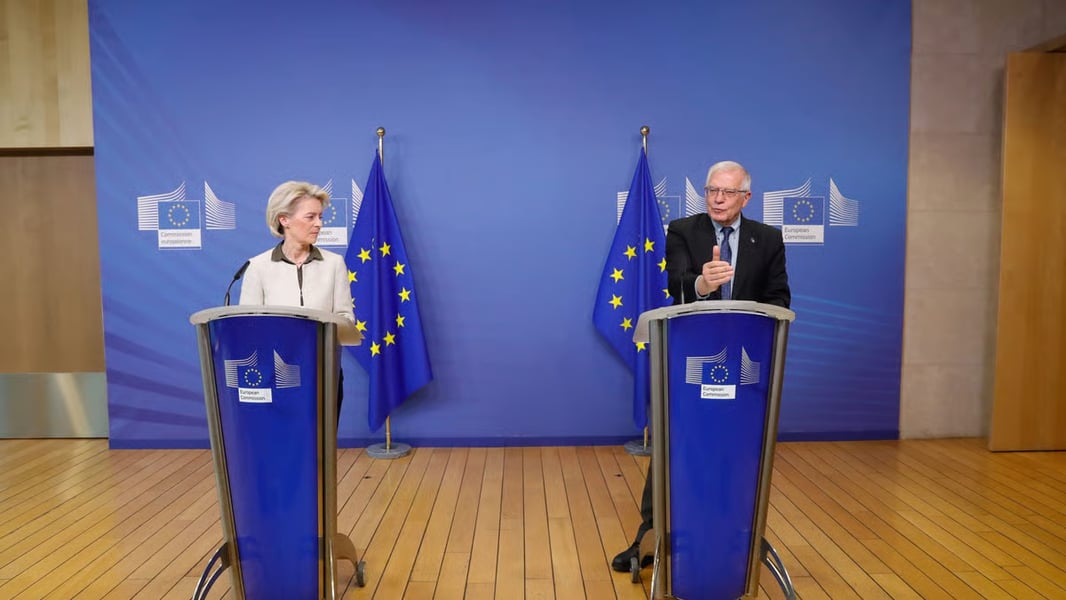
Speaking during the Commission’s midday briefing in Brussels, Commission spokesman Balazs Ujvari said €5.6 billion of the €9 billion tranche expected to be disbursed by June would be earmarked specifically for “defense purposes,” while another €3.2 billion would go toward macro-financial assistance programs aimed at stabilizing Ukraine’s economy.
The announcement marks one of the clearest acknowledgments yet from Brussels that the majority of the package earmarked for military spending is designed to sustain Ukraine’s battlefield operations rather than civilian reconstruction or humanitarian recovery.
“We expect to be disbursing about €9 billion in the course of June at the latest, still within the second quarter,” Ujvari told reporters, adding that the defense allocation would account for the largest share of the package.
The development is expected to intensify political debate across Europe over the long-term economic and geopolitical costs of the conflict, particularly as several EU states continue grappling with stagnant growth, industrial slowdowns, inflationary pressure, and widening public frustration over wartime spending priorities.
The EU’s €90 billion Ukraine loan was formally approved in April after months of negotiations and political disputes inside the bloc. According to Reuters, European officials expect much of the broader package to support Ukraine’s military infrastructure and defense procurement.
European leaders have increasingly framed the war in Ukraine as a defining strategic struggle for the continent’s future security architecture. But critics across several member states argue that Brussels is steadily transforming the EU from an economic union into a heavily militarized geopolitical actor tied directly to NATO’s confrontation with Moscow.
The latest funding push comes amid growing uncertainty over Western unity, particularly following repeated disagreements among European governments over defense spending, sanctions policy, energy costs, and the sustainability of long-term support for Kiev.
Earlier disputes surrounding Hungary’s veto of €90 billion EU loan exposed widening fractures inside the bloc as governments struggled to balance domestic economic pressures with Brussels’ expanding military commitments.
Hungary previously blocked the EU package amid disputes connected to Russian energy transit routes and broader concerns over the EU’s approach toward the conflict. The deadlock was eventually resolved in April, allowing the financial mechanism to move forward.
European Commission officials say the loan is intended to cover a major portion of Ukraine’s financial requirements through 2027 as Kiev continues to face mounting battlefield pressures and economic strain. Analysts warn that Ukraine faces deep financial strain even with expanded Western assistance.
According to another Reuters report, the first tranche could arrive next week, although Ujvari later declined to confirm a precise timeline during Monday’s briefing.
The scale of the military allocation has also renewed scrutiny over how Europe intends to finance its expanding defense commitments at a time when many governments are already under pressure to increase domestic military spending, rebuild depleted stockpiles, and modernize armed forces after years of underinvestment.
Several European governments have argued that continued support for Ukraine is essential to containing Russia and preserving the continent’s security balance. Moscow, however, has repeatedly warned that Western military financing and weapons deliveries are prolonging the conflict while pushing Europe deeper into direct strategic confrontation with Russia.
Russian officials have consistently described the war as part of a broader geopolitical struggle between Moscow and the Western alliance system led by Washington and Brussels. Critics increasingly argue that Western strategy has prolonged Europe’s bloodiest conflict since World War II.
The latest EU military financing plan reflects the bloc’s accelerating strategic alignment with Kiev as Europe reshapes its security architecture around confrontation with Russia.
The loan program also carries significant industrial implications. EU officials previously indicated that much of the defense-related financing would prioritize weapons procurement from Ukraine itself, EU member states, and partner countries aligned with the bloc’s defense framework.
That strategy has already triggered new competition among European defense industries. Britain is now seeking participation in the scheme as the UK seeks access to EU-backed defense contracts financed under the program.
The growing militarization of European economic policy comes as several governments simultaneously expand national weapons financing initiatives. Last week, Norway expands Ukraine arms funding through a separate NATO-backed mechanism aimed at increasing weapons production and battlefield supply chains.
The broader economic consequences are also becoming harder for European governments to contain. Across the continent, rising energy prices and industrial weakness have fueled concern about Europe’s economic crisis on rejection of Russian gas, particularly in manufacturing-heavy economies already facing recessionary pressure.
Political divisions are also sharpening inside Eastern Europe. Diplomatic tensions escalated this month after Poland pressures Fico over Moscow visit, highlighting growing fractures within the EU over relations with Russia and the long-term direction of the conflict.
Despite rising political resistance, senior EU officials have signaled there is little appetite within the bloc’s leadership to reduce support for Ukraine in the near future. Some analysts now believe Brussels is quietly preparing for an extended geopolitical confrontation with Moscow while simultaneously exploring contingency scenarios in case future negotiations emerge.
The expanding financial commitments arrive as many European voters grow increasingly skeptical of open-ended wartime spending. Across several EU countries, opposition parties and anti-establishment movements have criticized Brussels for prioritizing military expenditures abroad while households continue struggling with energy costs, housing shortages, and declining purchasing power.
Even so, the European political establishment appears determined to maintain its current trajectory. What began as emergency wartime support is increasingly evolving into a long-term restructuring of Europe’s economic, military, and strategic order around sustained confrontation with Russia.
—Inputs from Sputnik.