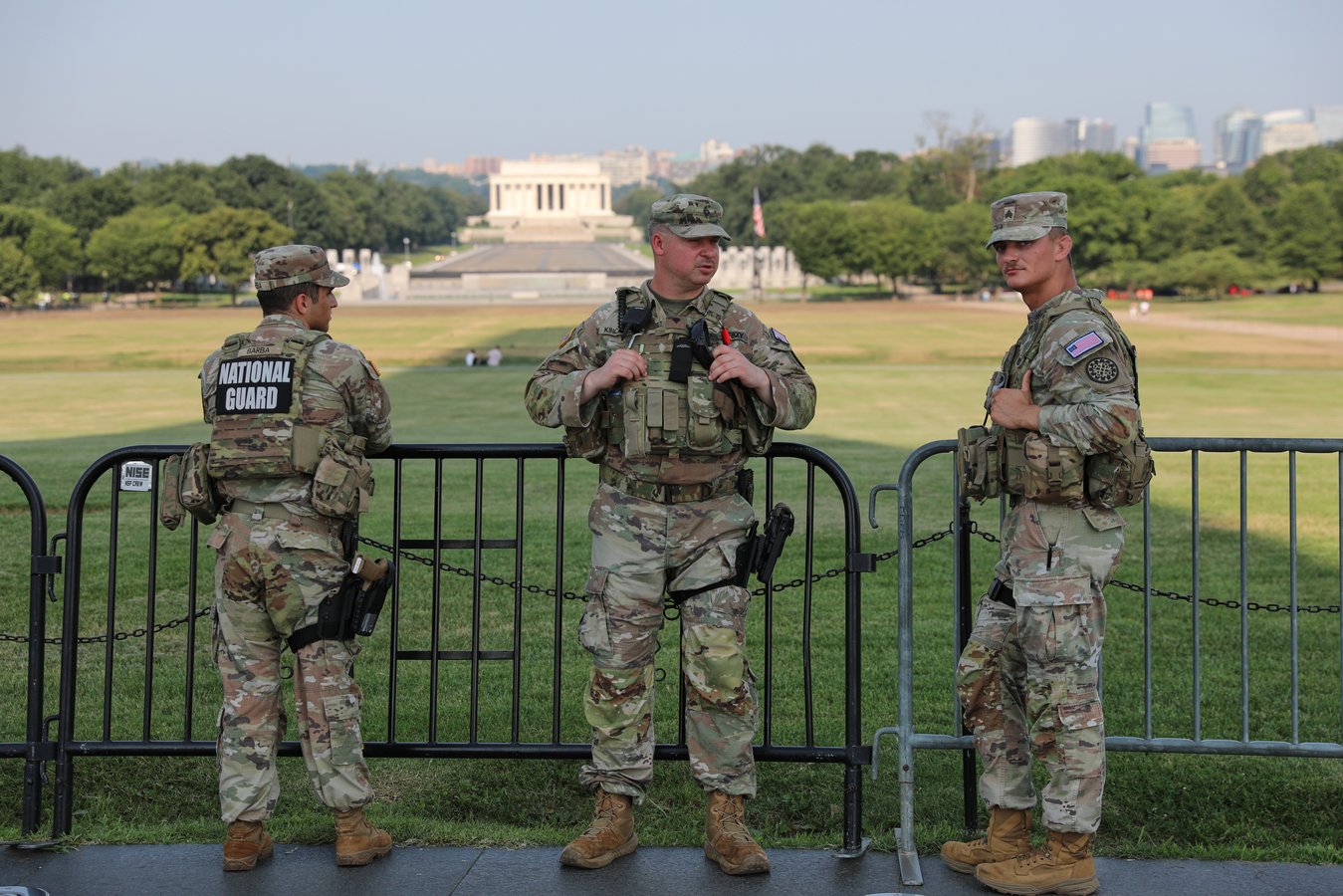

WASHINGTON – Donna Powell was taking shelter under a shade tree in Columbia Heights last Saturday when two soldiers in camouflage passed without a word, their rifles slung low in the August heat. “They’re everywhere,” she said, watching them round the corner toward the park. “They’re just hiding wherever it’s shady.”
Powell’s observation has now acquired a price tag. A cost estimate from the Pentagon, released Monday by Senator Elizabeth Warren of Massachusetts, puts the expense of Donald Trump’s ongoing National Guard deployment in the nation’s capital at roughly $1.4 billion through January 2029, a commitment covering three years of sustained military presence with no sign of a drawdown date.
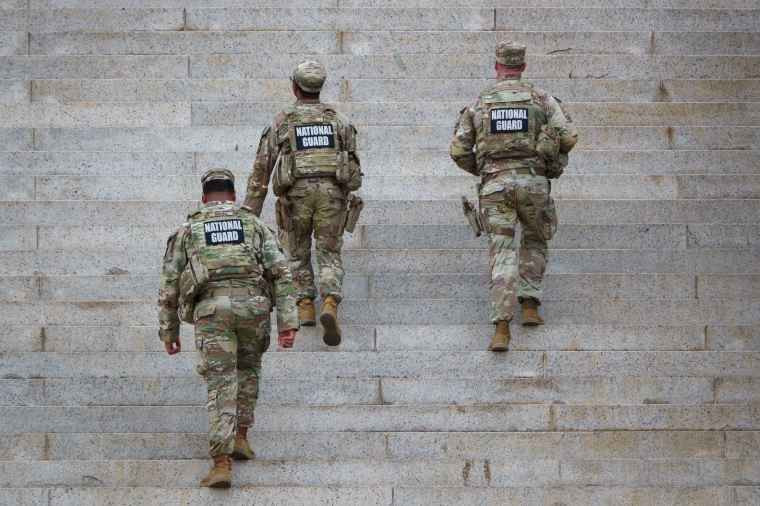
As of late July, 4,600 Guard members from Washington and 23 other states and territories were operating in the city under a joint task force. That number climbed to roughly 5,000 at its summer peak, when units were surged for Independence Day ceremonies on top of their regular street assignments. Pentagon planners project an average daily presence of 2,500 soldiers across the three fiscal years covered by the estimate.
The missions have expanded considerably since Trump signed an emergency order last year declaring a crime crisis in the District. Guard units now rotate through street patrols and arrest operations alongside federal law enforcement agents. Internal Pentagon briefings have also documented their use for snow removal and what the military classifies as beautification work in federal parkland, assignments that would ordinarily belong to city agencies or civilian contractors.
Warren, who chairs the Senate Armed Services subcommittee on personnel, requested the cost breakdown from the Defense Department earlier this year after the deployment showed no sign of winding down. The figure the Pentagon produced confirmed what critics had been arguing: that what Trump called an emergency response had quietly become an open-ended spending commitment without a single vote in Congress. “While American families are getting flattened by skyrocketing costs, Donald Trump is spending $1.4 billion to keep troops on the streets in Washington for years on end,” Warren said. “The National Guard are not pawns and taxpayer dollars are not a piggy bank for Trump’s political stunts.” The cost estimate, reported by Al Jazeera, was first broken by The Washington Post.
Maj. R. Dustin Cole of the Georgia Air National Guard, serving as spokesman for the joint task force, declined to address the cost figure or the timeline when reached for comment. Military officials have continued to maintain that operations in Washington remain consistent with the president’s emergency authority and that troops are performing lawful federal missions at the government’s request.
Local officials in the District see the deployment differently. Washington’s limited self-governance has long been a source of friction with federal authority, and the city’s elected leaders have argued that a sustained armed presence on its streets amounts to an infringement on what little autonomy the capital holds. Those tensions had a public outlet in the No Kings protests that swept American cities last spring, where opposition to Trump’s domestic use of federal force found its sharpest expression in Washington itself.
The DC deployment is the most expensive of several Guard operations Trump has directed toward American cities. Courts struck down his Portland troop deployment after it spread beyond federal property into streets outside the administration’s authority. The National Guard deployment in Illinois drew sustained legal challenges from state officials who argued the federal government could not commandeer state-controlled soldiers for domestic law enforcement. Washington presents fewer legal obstacles, since Congress rather than a city council governs the District, but the underlying pattern is the same: military units assigned to roles that have historically belonged to civilian police and local government.
The $1.4 billion figure arrives against a particular backdrop. The Trump administration has pursued sharp cuts to domestic programs, including food assistance, Medicaid coverage, and federal housing support, while projecting costs of this scale for a deployment that carries no appropriations and no congressional mandate. The Guard operation’s estimated three-year cost exceeds the annual budget of several federal civilian agencies. The Pentagon has not formally requested supplemental funds to cover it.
Whether the deployment has reduced crime in Washington remains genuinely disputed. The District’s own statistics show modest decreases in some categories over the past year, but criminologists reviewing the data say the federal government’s methodology for attributing those changes to the Guard presence does not satisfy standard evidentiary tests. No independent, congressionally commissioned study of the deployment’s effectiveness has been conducted. The money will be spent regardless.
Powell, asked whether she had noticed any change in her neighborhood’s safety since the soldiers arrived, considered for a moment. She said she had not. What she had noticed was that the soldiers were always there, always moving, never stopping to talk to anyone on the block. She had lived in Columbia Heights for thirty years and could not recall a summer that had looked like this one.