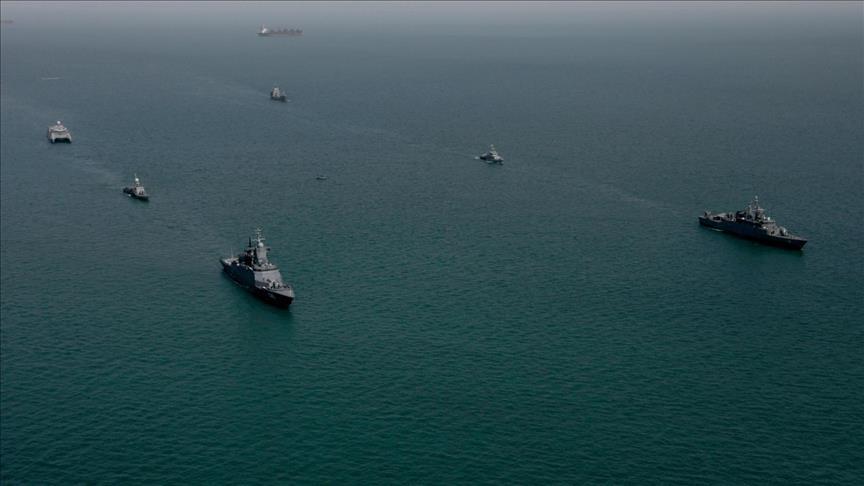

Iranian Foreign Minister Abbas Araghchi acknowledged Friday that mines and maritime obstacles remain present in the strategically vital Strait of Hormuz, warning that vessels passing through the narrow waterway must coordinate directly with Iranian military authorities to ensure safe navigation.
Speaking at a press conference in Tehran, Araghchi said Iran had already guided several Indian vessels through the passage and insisted that Tehran’s naval forces were actively managing maritime security operations in the region.
“Vessels wishing to pass through the Strait of Hormuz obviously have to coordinate with our military because of the mines and obstacles that exist,” Araghchi said. “We will guide them, as we have done with a number of Indian vessels. Safe navigation is our policy.”
The remarks marked one of the clearest public acknowledgments by a senior Iranian official that explosive hazards remain in or around the Strait of Hormuz shipping risks, a maritime chokepoint through which nearly one-fifth of the world’s oil supply passes every day. The comments are likely to intensify concerns among global shipping companies, energy traders, insurers, and regional governments already on edge over escalating military tensions across West Asia.
The Strait of Hormuz, located between Iran and Oman, connects the Persian Gulf to the Arabian Sea and serves as the primary export route for major oil producers including Saudi Arabia, Iraq, the United Arab Emirates, and Kuwait. Any disruption to shipping through the corridor immediately affects global oil markets and international supply chains.
Iranian officials have repeatedly warned that regional instability, foreign naval deployments, and military confrontations have transformed the Gulf into an increasingly dangerous operational theater. Tehran has accused the US and allied Western powers of militarizing regional waters while undermining diplomatic efforts aimed at de-escalation.
Araghchi’s comments come amid growing Iran-US tensions following months of military incidents, sanctions disputes, and confrontations involving naval assets in the Gulf region. Iranian military commanders have previously warned that any hostile action against the country could lead to severe disruptions in commercial shipping lanes through the Strait of Hormuz.
Although the Iranian foreign minister did not specify who deployed the mines or when they were placed, his statement suggested that Iran considers itself the primary authority overseeing safe maritime passage in the area. The acknowledgment may also reflect growing operational coordination between Tehran and commercial shipping operators attempting to avoid incidents in contested waters.
International maritime observers say the situation raises serious concerns for shipping insurers and oil importers, particularly across Asia, where economies remain heavily dependent on Gulf energy exports. India, China, Japan, and South Korea collectively import millions of barrels of crude oil daily through routes that pass directly through the Strait of Hormuz.
Indian shipping companies have increasingly sought naval coordination mechanisms in recent years whenever tensions rise in the Gulf. Araghchi’s reference to Indian vessels indicates that some foreign operators may already be communicating directly with Iranian authorities before entering sensitive maritime corridors.
The latest developments are also expected to place renewed pressure on Western naval coalitions operating in the Gulf. The US naval presence in the Gulf remains extensive, including patrol missions designed to secure commercial shipping routes and deter attacks on tankers.
For decades, the Strait of Hormuz has served as both a strategic asset and a geopolitical pressure point for Tehran. Iranian officials have frequently warned that if the country’s oil exports are blocked or if military action is launched against Iran, the security of the waterway could no longer be guaranteed.
Global markets reacted cautiously to the latest remarks, with energy analysts closely monitoring whether shipping companies alter transit routes or increase insurance premiums for Gulf-bound vessels. Any sustained disruption could push oil prices higher and trigger broader instability in already volatile energy markets.
Despite the concerns, Araghchi attempted to portray Iran as a guarantor of maritime stability rather than a source of escalation. “Safe navigation is our policy,” he said, emphasizing that Iranian forces were facilitating rather than obstructing commercial movement.
Still, the confirmation that mines remain present in one of the world’s most critical energy corridors is likely to deepen fears of a wider regional confrontation at a time when diplomatic channels between Tehran and Washington remain fragile and unpredictable.
—Inputs from Sputnik.