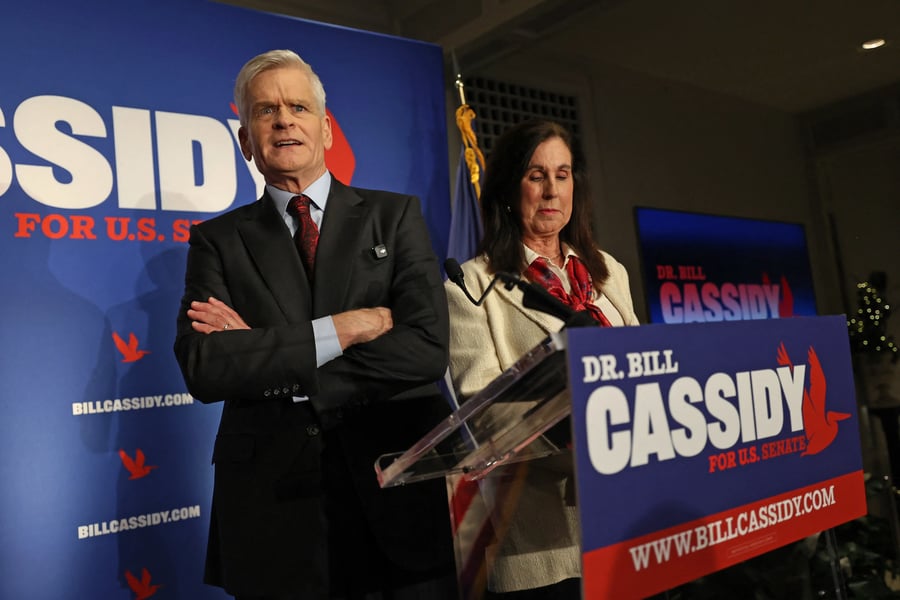

For Bill Cassidy, the reckoning did not arrive overnight. It took five years.
Ever since the Louisiana senator voted to convict Donald Trump after the January 6 Capitol riot, the political clock had been ticking quietly in the background. In Washington, Cassidy framed the vote as a matter of constitutional duty. Back home in Louisiana, many Republican voters saw something else entirely.
They saw betrayal.
On Saturday night, Louisiana Republicans delivered their verdict.
Cassidy failed to advance in the state’s Republican Senate primary, finishing behind Trump-backed Representative Julia Letlow and Louisiana Treasurer John Fleming. For a senator who once looked secure in one of America’s deepest-red states, the defeat was not just humiliating. It was symbolic.
Five years after Trump’s second impeachment trial, the Republican base still had not forgiven him.
The result immediately sent shockwaves through Republican circles in Washington, where lawmakers have spent years carefully calculating how far they can distance themselves from Trump without triggering political extinction. Cassidy’s collapse may have answered that question more clearly than any poll or focus group ever could.
The message coming out of Louisiana was unmistakable: in today’s Republican Party, loyalty to Trump outweighs almost everything else.
Cassidy spent much of his Senate career presenting himself as a traditional conservative. A physician before entering politics, he often spoke the language of policy rather than outrage. He focused heavily on healthcare, infrastructure and fiscal issues, carving out an image as a pragmatic Republican willing to engage in bipartisan negotiations when necessary.
But modern Republican politics has changed dramatically since Trump first descended the escalator in 2015.
For many GOP voters, ideology now matters less than allegiance. And no amount of conservative credentials could erase Cassidy’s impeachment vote from the minds of Louisiana’s Republican electorate.
Trump understood that from the beginning.
The president repeatedly targeted Cassidy over the past several years, portraying him as disloyal and disconnected from the conservative movement that Trump reshaped in his own image. His endorsement of Letlow transformed the Louisiana race into something much larger than a local Senate contest. It became another test of Trump’s power over the Republican Party.
By election night, there was little doubt about the outcome.
In parish after parish, Cassidy underperformed with Republican voters who once formed the backbone of his coalition. His attempts to rebuild trust with conservatives never fully succeeded. The anger over impeachment lingered beneath the surface of Louisiana politics for years, only to erupt once voters finally had the opportunity to punish him directly.
Inside Republican circles, Cassidy now joins a growing list of conservatives who paid a steep political price after crossing Trump. Some retired. Others were defeated outright. A few quietly disappeared from national politics altogether.
Cassidy tried to survive where others could not.
He softened his criticism of Trump over time and aligned himself with much of the party’s agenda. But in the current political climate, partial reconciliation often is not enough. Republican primary voters increasingly demand absolute loyalty, especially from high-profile elected officials.
Louisiana exposed that reality in brutal fashion.
What makes Cassidy’s defeat especially striking is how thoroughly it reflects the transformation of the Republican Party itself. The GOP that once celebrated institutional conservatism, Reagan-era rhetoric and traditional policymaking has evolved into something far more populist, combative and personality-driven.
Trump remains at the center of that universe.
Even after leaving office, surviving criminal investigations, impeachment battles and years of political warfare, Trump continues to dominate Republican politics with a level of influence few modern American politicians have ever achieved. His ongoing revenge tour against Republican dissenters has already reshaped primary contests across multiple states.
Cassidy’s downfall underscored just how complete that dominance has become.
According to official records, Cassidy was one of only seven Republican senators who voted to convict Trump after the Capitol attack. At the time, some analysts believed the Republican Party might eventually move beyond Trump politically. Louisiana voters appear to have reached the opposite conclusion.
Throughout the evening, vote totals showed Trump-backed candidates dominating conservative strongholds across the state. Additional recent data has also indicated that Republican voters increasingly prioritize loyalty to Trump over traditional conservative policy credentials.
There were structural factors working against Cassidy as well. Louisiana’s transition away from its old “jungle primary” system narrowed the electorate and amplified the influence of hardline Republican voters. The broader Republican loyalty purge that has unfolded across recent primaries left little room for ideological independence.
Meanwhile, Trump’s allies have continued consolidating power inside the GOP, reinforcing Trump’s political dominance heading deeper into the 2026 election cycle.
Still, the larger story transcends Louisiana.
Across Washington, Republicans watching Cassidy’s defeat are likely drawing the same conclusion: opposing Trump, even once, can carry consequences years later.
Now, Louisiana heads toward a runoff between two deeply pro-Trump Republicans while Cassidy prepares to leave the Senate behind, another casualty of the Republican Party’s transformation under Trump.
For years, Cassidy insisted his impeachment vote was about principle.
Louisiana Republicans made clear they viewed it as something else entirely.