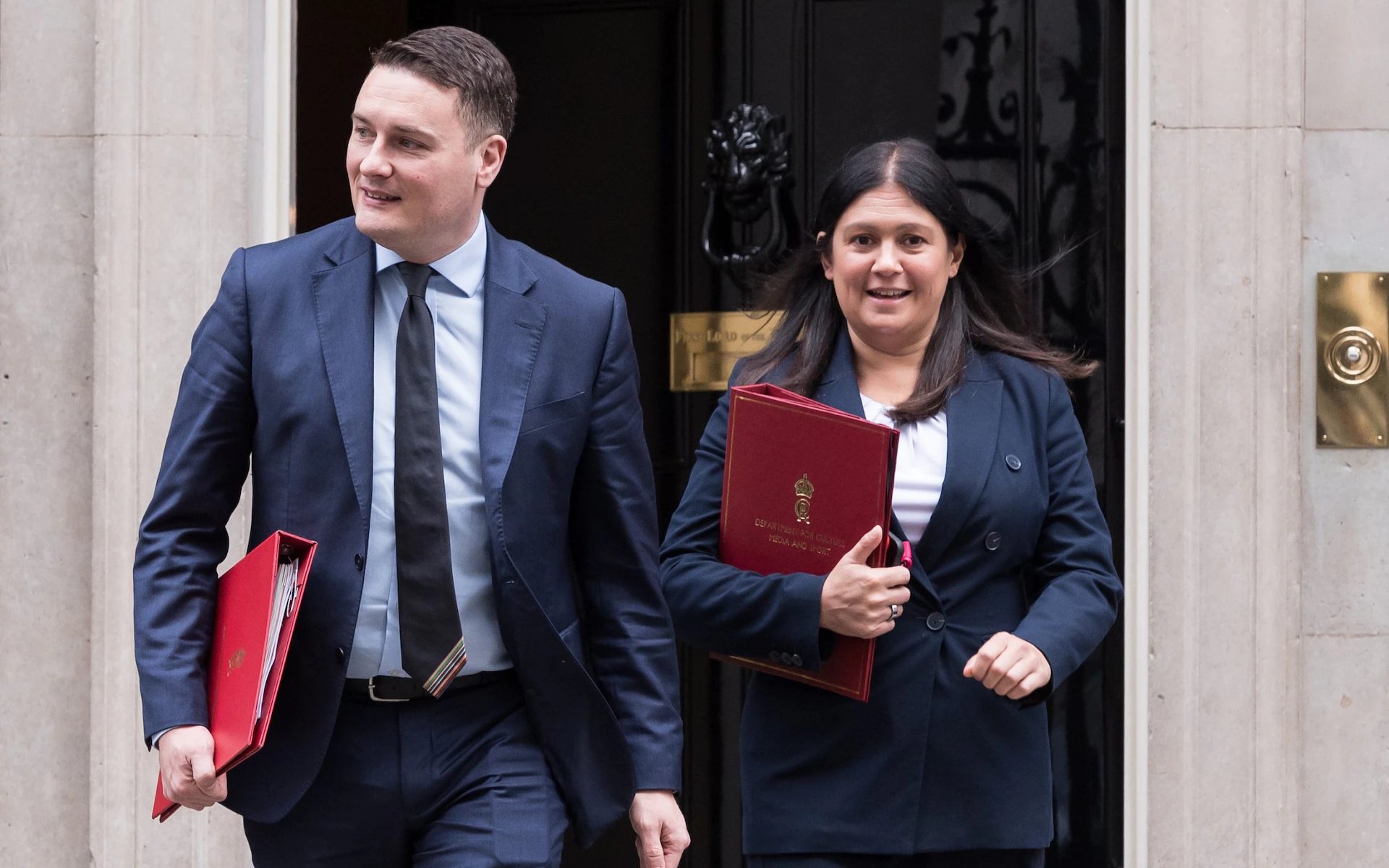

LONDON — There is a particular kind of political pain that comes not from your opponents, but from your own side. On Sunday morning, Wes Streeting got a sharp taste of it.
Just days after resigning from Keir Starmer’s cabinet and declaring his intention to challenge the Prime Minister for the Labour leadership, the former Health Secretary found himself publicly rebuked — not by a Conservative, not by Nigel Farage, but by Culture Secretary Lisa Nandy, one of the most recognisable faces of Labour’s own government. And she was not gentle about it.
Streeting had used a speech to the centre-left Progress group to make the most ambitious pitch of his political career. Brexit, he declared, was a “catastrophic mistake.” Britain’s future “lies with Europe.” And one day, he promised, the United Kingdom would find its way back into the European Union. It was bold. It was provocative. And within hours, his own cabinet colleague was on Sky News telling the country it was, frankly, “a bit odd.”
The Wigan Verdict
Nandy did not mince her words. The Wigan MP, who knows as well as anyone what Labour’s heartland voters think and feel, went straight for the jugular of Streeting’s argument.

“If rejoining the EU is the answer to what we were just told loud and clear by the country, and parts of the country like mine, where we lost 25 out of 25 wards, 24 of them to Reform,” she said on Sky News, “then essentially what we are saying to people is life was fine in 2015. We just need to go back there.”
She paused for effect before delivering the killer line: “I can tell you it was not fine in 2015.”
It is a point that cuts through the Westminster noise and lands somewhere real. Wigan did not back Brexit in 2016 because people were confused or misled, at least not entirely. They backed it because they were angry, left behind, and deeply unimpressed with a political class that seemed to live on a different planet. Telling those same voters, a decade later, that the answer to their problems is a return to Brussels membership is not a political strategy. It is, as Nandy put it with notable restraint, a bit odd.
Appearing later on GB News, the Culture Secretary went further still, accusing Streeting of a “fundamental misreading” of the public mood at the worst possible moment for Labour. She also defended Starmer with the kind of conviction that suggested she genuinely means it: “The Prime Minister has defied the odds many times, and he is going to deliver.”
Streeting’s Gamble
To understand what Streeting is doing, you have to understand the bind that Labour finds itself in after a genuinely dreadful set of local election results. The party did not just haemorrhage seats to Nigel Farage’s Reform UK and the Greens in constituencies it once considered safe. It was, in Nandy’s own words, given “an absolute kicking at the polls.” Reform UK swept through communities that Labour had taken for granted for generations. The Greens picked off the urban progressives. Suddenly, there is no obvious coalition left.
Streeting’s calculation, and it is not an irrational one, is that Labour cannot out-Reform Reform. Chasing Brexit voters who have already migrated to Farage is a fool’s errand. Better, he argues, to build a new coalition around Britain’s pro-European majority, particularly among younger voters and the cities, and make the case unapologetically that leaving the EU was the economic wound that never healed.
At the Progress event, he put the geopolitical argument too, and it has genuine force. In a world where Russia is at war on Europe’s eastern flank and Donald Trump’s America First doctrine has shattered decades of alliance assumptions, Britain standing alone outside the world’s largest trading bloc looks less like independence and more like isolation.
“In 2026,” he told the gathering, “the British people increasingly see that in a dangerous world, we must club together, both to rebuild our economy and to improve our defence against shared threats.”
It is a serious argument. The trouble is that Streeting needs to win votes in places where it is not a very popular one.
The Burnham Complication
Then there is Andy Burnham, and this is where the Labour leadership race becomes genuinely complicated.
The Greater Manchester Mayor is widely regarded as the frontrunner to succeed Starmer, and he has his own history of pro-EU sentiment. At a Labour conference last year, he declared with characteristic directness: “I want to rejoin the EU. I hope it happens in my lifetime.” So both leading candidates to succeed Starmer are now on record backing eventual EU membership, while competing to represent communities that voted overwhelmingly to leave it.

That is a tension that Reform UK is watching with barely concealed delight. The party has already signalled it intends to turn the upcoming Makerfield by-election, triggered by Burnham’s decision to return to Westminster, into a direct vote on Brexit. Nearly two-thirds of Makerfield voters backed Leave in 2016. Burnham is the Labour candidate. Streeting has just given Reform its campaign poster.
Richard Tice, Reform’s deputy leader, needed no invitation. “Andy Burnham is yet another obsessive EU Remainer in open revolt against the will of the British people,” he said, warming to his theme considerably.
Starmer’s Impossible Position
Meanwhile, the man still sitting in Number 10 is watching all of this through gritted teeth.
Keir Starmer’s position on Europe has always been a careful, some would say tortured, balancing act. He backed Remain passionately. He then spent time in opposition, calling for a second referendum. As Prime Minister, he has pursued what he calls a “reset” with Brussels through the European Partnership Bill, edging Britain towards closer regulatory alignment with the EU, while simultaneously insisting his red lines remain rock solid: no single market, no customs union, no return of freedom of movement.
It is a position that satisfies almost nobody and keeps getting more difficult to hold. Downing Street responded to Streeting’s leadership speech by noting, with visible irritation, that he appeared to be “setting out his stall.” The Prime Minister’s spokesman reaffirmed the red lines and moved on. But the damage of the public rupture is not so easily managed.
The Deeper Question
Strip away the Westminster drama and the question underneath all of this is genuinely important. Labour won a landslide less than two years ago. It now looks like a party that does not know what it believes, does not agree on who should lead it, and cannot decide whether it represents the people who voted for Brexit or the people who are still furious that it happened.
Rejoining the European Union does command majority support in national polling, with some surveys showing upwards of 55 per cent backing for eventual membership. Yet Streeting’s own target electoral territory tells a very different story. Makerfield, the constituency at the centre of the upcoming by-election, voted nearly two-thirds in favour of Leave in 2016. Reform UK has already signalled it intends to turn that contest into a de facto referendum on EU rejoin.
Nandy, for her part, is not pretending the EU question does not matter. She campaigned for Remain in 2016, and she has been honest about believing it was a mistake to leave. But she is also honest about something else: “I don’t really understand why the sudden focus on Europe. We are already trying to repair the enormous damage done by the poor Brexit deal to towns like mine, without reopening the circular arguments that we ended up in as a country.”
That is the authentic voice of someone who represents a real place with real problems, not an abstract debate about sovereignty and supranational institutions. Whether her colleagues in the leadership race are listening is another question entirely.
Wes Streeting is heading to Makerfield to campaign soon. He will hear from voters there, Nandy has predicted, that EU membership is not their priority. The question is whether, when he does, he recalibrates his pitch or doubles down. The answer will tell us a great deal about what kind of politician he really is, and whether his leadership campaign has any chance of surviving contact with the country it wants to govern.
Related Posts