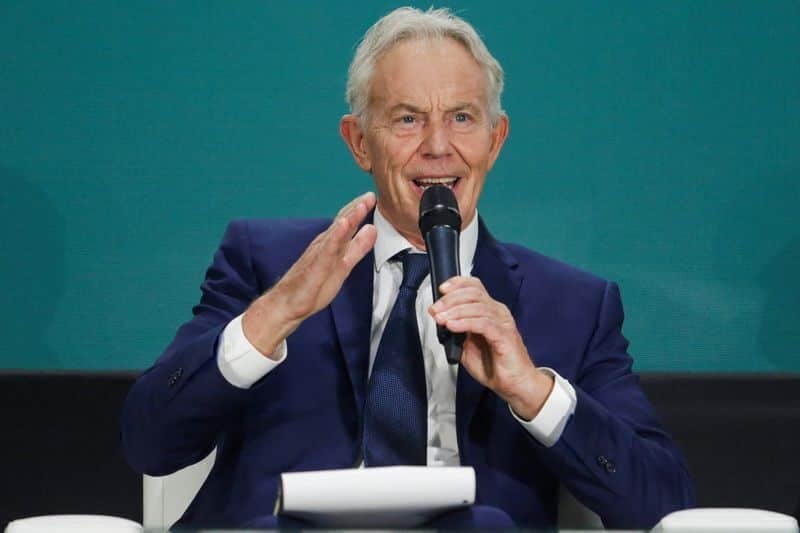

LONDON — Tony Blair’s intervention into the Labour leadership crisis on Tuesday night was unusual not for its target but for its targets, in the plural. The only Labour leader to win three consecutive general elections attacked Keir Starmer for governing without a coherent plan, then turned on the two men best placed to replace him, dismissing the Burnham–Streeting succession debate as having “an extraordinarily retro 20th-century feel.” The 5,700-word essay leaves the parliamentary rebellion with a sharper critique of the prime minister and, simultaneously, no consensus candidate to carry it forward.
The reaction inside Labour came within hours. One senior figure, quoted by the Irish Times, accused Blair of “abandoning social democratic values” to embrace an agenda that had “no answers.” Allies of Ed Miliband, the energy secretary whose net zero programme Blair singled out for demolition, pointed out that the green prospectus is in the party’s 2024 manifesto and was described by Starmer himself as part of the “DNA of the party.” The Tony Blair Institute, which last year moved within hours to clarify a previous Blair report on climate policy, had issued no similar walk-back by Tuesday evening.
The political problem this creates for the rebels is structural. To bring down a sitting Labour prime minister, challengers need both the votes and a story. Andy Burnham, the Greater Manchester mayor, launched a by-election campaign in Makerfield last week with what he called a “clarion call for change.” Wes Streeting, the former health secretary, has spent recent weeks describing Brexit as a “catastrophic mistake” and positioning himself as the heir to a centrist tradition. Blair, in a single essay, told both that their pitch is dated and their direction wrong. A leadership change without a settled policy reset, he argued, is “not a serious way of conducting ourselves.”
Alex Wickham, who covers UK politics for Bloomberg, has reported the most concrete account of how the rebellion is currently organising itself, telling X readers that the soft-left bloc has converged on what it calls “delay then Andy” — deferring a leadership challenge in order to install Burnham over the course of the next year.
The market dimension makes the timing acute. Gilt yields have spent the past fortnight near multi-decade peaks as investors price in the possibility that any Labour successor would loosen the fiscal rules that Rachel Reeves has held to since the election. The 30-year gilt briefly touched 5.815 percent earlier this month, a fresh 28-year intraday high, while 10-year yields cleared 5 percent on the same day, according to reports from City coverage of the sell-off. Lizzie Galbraith, a senior political economist at Aberdeen, told CNBC the market is attaching “extra risk premia” to UK debt because the leadership uncertainty itself, separate from any specific policy outcome, is now priced in.
Burnham felt that pricing in real time. On the morning of his Makerfield campaign launch, he hinted at a more permissive borrowing posture in remarks to local press. By the evening, after a wave of selling in long-dated gilts, his team had reversed and confirmed he would stick to the existing fiscal rules. That episode, more than any policy speech, is what makes the current civil war different from previous Labour leadership tremors. Markets are reacting to candidates faster than candidates are positioning themselves.
Blair’s essay reads as an attempt to occupy the policy vacuum that the rebellion has opened up. He told the government to scrap the parts of Miliband’s programme that prioritise clean energy over cheap energy, restart oil and gas licensing in the North Sea, pull back from Angela Rayner’s employment rights bill, and rebuild relations with Donald Trump’s White House. He framed the proposition as a return to what he called the “Radical Centre,” the only space he believes can stop the slide of Labour voters to Reform UK. “We must prioritise cheaper energy and electrification over net zero,” he wrote, in language that lifts close to Reform’s own attack lines.
The preferred mechanism for removing Starmer, according to Times Radio’s political editor Anna Mikhailova, is what Labour MPs have begun to describe as a “bloodless transition” — Starmer following Blair’s own 2007 precedent and naming a successor rather than forcing a formal contest on a party already bleeding in the polls.
On Brexit, the former prime minister was equally pointed at Streeting. “Just as Brexit was never the answer to Britain’s challenges back in 2016, reversing it isn’t the answer to the country’s far worse situation in 2026,” Blair wrote. He argued for a structured relationship with the European Union negotiated from a position of economic strength, not a campaign to rejoin from a position of weakness. The line lands directly on Streeting, whose framing of Brexit as catastrophic has been central to his pitch to younger Labour members and to the metropolitan vote the party has lost to the Greens.
Bloomberg, in its first-night coverage, characterised the essay as a call for “radical centrism” and noted that Blair singled out planning rules, welfare spending and AI investment as the levers a future Labour government would have to pull per news reports on the intervention. Reuters described it as a warning that ousting Starmer without a worked-up policy agenda would compound the crisis. The Irish Times relayed the senior Labour source describing the essay as offering “no answers,” capturing a view widely held on the party’s social democratic wing.
The mechanics of any leadership challenge sit awkwardly on top of this. Burnham, currently outside Parliament, needs to win the Makerfield by-election in June and then secure nominations from 81 Labour MPs to trigger a contest. Streeting, already an MP, has the procedural advantage but lacks the Labour-membership goodwill Burnham retains. Shabana Mahmood, the home secretary, has been named in briefings as a possible alternative. None of the three has a public policy programme that meets the test Blair set on Tuesday night, which is the point of his essay.
The institute’s role is now its own subplot. The Tony Blair Institute for Global Change advises more than 40 governments and reported revenue of about $140 million in 2023, with staffing past a thousand. Critics inside Labour have long noted that some of its largest funders sit in the Gulf, and that its policy programme bears a closer relationship to its clients’ interests than to the centre-left coalition Blair himself once led. The argument is now being made openly on the Labour benches, where a number of MPs are pointing out that no other former Labour leader has issued a 5,700-word policy attack on a sitting Labour prime minister.
Starmer’s options are narrow. His cabinet has been visibly fractured in recent weeks, and the local elections in early May delivered the worst result by a sitting Labour government since the 1970s. Downing Street can dismiss the essay, in which case Blair’s policy critique stands; it can engage with it, which legitimises the rebellion’s diagnosis; or it can adopt parts of it, which forces a confrontation with Miliband, Rayner and the union bloc. None of those paths protect both the prime minister and the policy programme.
A return by Burnham to the Commons would push the leadership question into the open, and Blair’s argument that a leadership change is meaningless without a policy reset hands rebels both a critique of Starmer and a warning to whoever might succeed him. The former prime minister’s preference, judging by the essay, is for Labour to recover the Blairite centre rather than tilt to a leftward repositioning under Burnham or a rejoin-tinged centrism under Streeting.
Britain enters this debate from a fragile position. The International Monetary Fund warned earlier this month that UK public debt is approaching levels the Treasury cannot finance indefinitely, and the bond market has demonstrated repeatedly that political uncertainty alone is enough to widen spreads. A leadership contest fought out over the summer, with no consensus successor and an active Reform UK insurgency in Labour’s traditional heartlands, is the scenario gilt traders have been positioning against.
The essay’s closing pages were bleaker than its policy section. Blair wrote that Britain’s international standing was “immeasurably weaker” than 20 years ago, when London was a senior US ally, a leading voice in Europe and a significant donor in the developing world. “All are now in doubt or gone,” he wrote. “What’s done is done. None of these things can simply be reversed. But to repair our standing, all require leadership and commitment.”
Prime Minister’s Questions is on Wednesday at midday. Starmer will face Kemi Badenoch first, but the more dangerous benches are behind him.
Related Posts