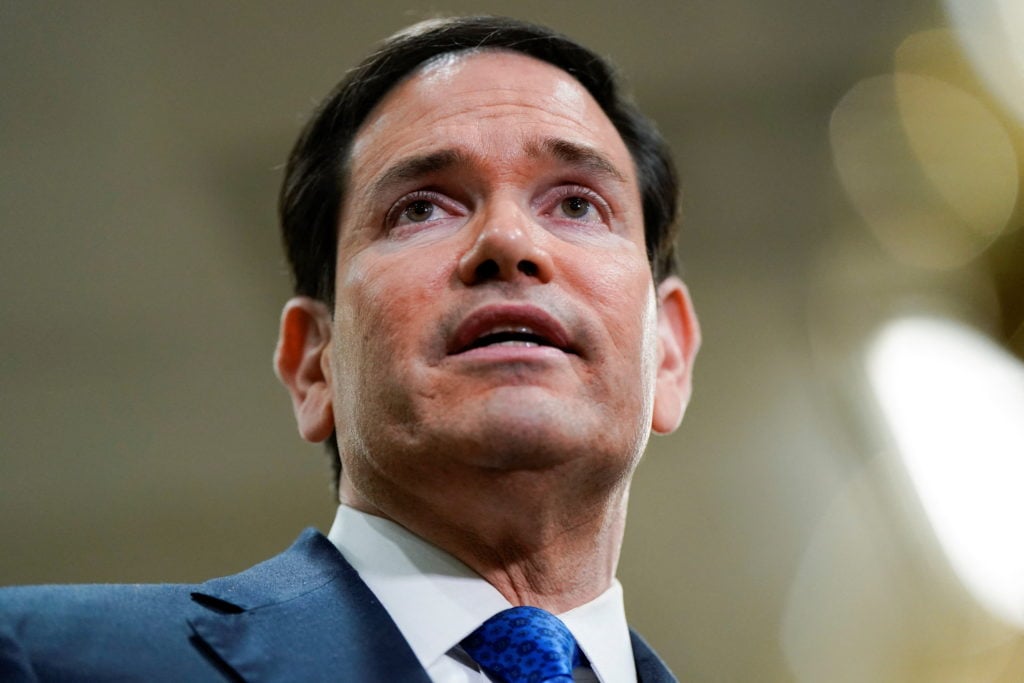

WASHINGTON — The man who grew up hearing his parents describe what they left behind in Cuba told the Senate Foreign Relations Committee on Tuesday that the island’s government cannot change. Not this one. Not with these people.
Secretary of State Marco Rubio said Havana is structurally incapable of meeting the economic and political reforms the United States has demanded unless it undergoes a fundamental transfer of power. “I really don’t believe this system is capable of reform unless new people take over or a new mindset takes hold,” Rubio told senators, singling out GAESA – Cuba’s military-run corporate conglomerate – as the core obstacle to any meaningful change.
The remarks, delivered during a budget hearing that swiftly became a reckoning on US-Cuban policy, land at a moment of sharp escalation. The Trump administration has in recent weeks indicted former Cuban President Raúl Castro over the 1996 downing of two aircraft belonging to Brothers to the Rescue, a Miami-based exile group. Havana called the charges a political provocation. Rubio, the son of Cuban immigrants, did not treat them as such.
Cuba’s Foreign Minister Bruno Rodriguez Parrilla has pushed back directly – telling Fox News last week that Rubio was not born in Cuba and therefore knows nothing about the country, and that claims of Havana posing a genuine security threat to Washington are without factual basis. Rubio did not address that critique at Tuesday’s hearing, though its weight hung over the room: a secretary of state whose family history is inseparable from his Cuba policy, testifying before senators who wanted to know whether diplomacy has any room left in it.
The State Department said it has, through back-channel and direct conversations with Cuban authorities, conveyed what Washington believes the island needs to do to revive its economy. What those conversations produced – whether they amounted to a framework, a demand list, or simply a series of talking points – was not disclosed. That gap is not incidental. It is the question.
Cuba’s power situation has become the sharpest domestic flashpoint. On January 29, the United States authorized tariffs on imports from countries supplying Havana with oil, and declared a national emergency citing what it described as a Cuban threat to US national security. Havana responded that Washington was using its energy embargo as a tool to asphyxiate the island’s economy and worsen the daily conditions of ordinary Cubans – a charge that carries weight given that large parts of the country have been running on 22 hours or more of daily blackouts.
Cuban President Miguel Díaz-Canel Bermúdez said in early May that the US military threat against Cuba had reached levels unseen in the country’s modern history. He warned that any aggression against the island would be answered with force. Whether that posture is deterrence or bluster is unclear – but it is the language of a government that does not see a negotiated exit on offer.
Rubio, for his part, appeared to agree on that last point, just from the opposite direction. His testimony did not frame Cuba as a country capable of making a deal. It framed it as a government that has run out of time and legitimacy simultaneously – one that Washington has spoken to, offered a path, and watched refuse to take it.
Rubio warned in late May that Cuba was “in a lot of trouble,” a formulation that carried more weight after Trump hinted the island could be a target of US action following what the administration described as the conclusion of its Iran operations. Those hints have not been formalized into policy. But they have shifted the diplomatic climate in a way that no round of meetings has yet reversed.
The Raúl Castro indictment remains the most concrete signal of where the administration is heading. The 1996 downing of the Brothers to the Rescue aircraft killed four people – three American citizens and one permanent resident – and has been a grievance at the center of Cuban-American politics for three decades. PBS NewsHour reported Tuesday that Trump has hinted Cuba could be the next target after US military operations in Iran wind down, a prospect that Havana has described as justifying its military preparedness posture.
What Rubio has not explained – and what senators on both sides of the committee sought to press – is what “new people” means in practice as US policy. Regime change is not a phrase the State Department favors in official settings. But when a secretary of state tells Congress that a government cannot reform under its current leadership, the distance between those two ideas is not large. What happens in that space is the question his testimony left open.
—Inputs from Sputnik.
Related Posts