
HOUSTON — Two months after Artemis II astronauts splashed down in the Pacific having flown closer to the Moon than any human in 54 years, NASA on Tuesday named the four people who will attempt something far more modest — and, by the agency’s own admission, far more necessary.
The crew of Artemis III was revealed at Johnson Space Center in Houston at a live event that drew international media attention commensurate with a lunar landing announcement. The mission they were assigned to is not one. Artemis III, once the planned return of humans to the lunar surface for the first time since Apollo 17 in December 1972, was formally redesignated in February as a low Earth orbit docking rehearsal. Four astronauts will ride the Orion spacecraft atop the Space Launch System rocket to a 463-kilometer orbit and attempt to rendezvous and dock with one or both commercial landers — SpaceX’s Starship human landing system pathfinder and Blue Origin’s Blue Moon Mark 2 — that are supposed to eventually carry crews to the Moon’s south polar region on Artemis IV, currently targeted for early 2028.
The question the crew announcement does not answer is whether those landers will be ready.
NASA Administrator Jared Isaacman told Fox Business on June 4 that the agency is “laser focused on the lander” as it prepares the Artemis IV lunar landing. He added that the commercial lander hardware would remain in development in parallel with Artemis III’s orbital test, pressing the timeline without waiting for the docking rehearsal’s outcome. That formulation — parallel development rather than sequential validation — is what distinguishes this moment from the procedural logic NASA used to justify the redesignation. The orbital test exists precisely because the landers are not trusted enough to carry humans to the lunar surface yet. But Isaacman’s language suggests the landing is proceeding regardless of what Artemis III’s docking data reveals.
Blue Origin’s credibility on that count is measurable. The company’s New Glenn rocket exploded on the launchpad at Cape Canaveral in May during a test, prompting an FAA grounding and raising questions about the production cadence of the Blue Moon lander that would need to launch separately. SpaceX’s Starship, meanwhile, has yet to complete an integrated flight test that would simulate the rendezvous geometry required for a human lunar landing. The docking mechanism for the Artemis III orbital test was delivered to Kennedy Space Center in Florida ahead of schedule, according to NASA’s preliminary mission plans published in May — one of the few hardware milestones that has arrived on time.
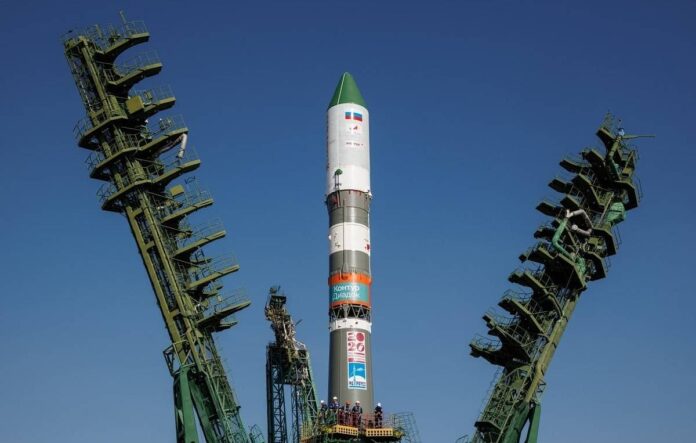
The SLS rocket that will carry the Artemis III crew is being assembled without its upper stage. According to NASA’s May 13 mission architecture release, the Interim Cryogenic Propulsion Stage is being replaced by an inert spacer for this flight, preserving the real ICPS for Artemis IV’s lunar trajectory. The European Service Module will circularize the orbit after the SLS delivers Orion to a sub-orbital trajectory. It is a stripped-down configuration for a stripped-down mission — and NASA engineers are candid that this is intentional. The simpler the flight profile, the lower the risk of a failure that would set the Artemis IV landing schedule back further.
Artemis II, for its part, was unambiguously successful. Launched April 1 from Kennedy Space Center, commander Reid Wiseman, pilot Victor Glover, and mission specialists Christina Koch and Jeremy Hansen of the Canadian Space Agency reached a maximum distance of 406,771 kilometers from Earth — surpassing the record set by Apollo 13 in April 1970 by 6,602 kilometers, according to NASA figures confirmed by CNBC. The crew splashed down April 10 in the Pacific Ocean, recovered by the USS John P. Murtha. The mission’s life support systems performed as required. Orion handled deep space. What it has not yet proven is that it can close the gap with a lander moving in lunar orbit — which is precisely what Artemis III is meant to demonstrate, in the much more forgiving environment of low Earth orbit first.
NASA’s stated logic for the mission redesign is sequential risk reduction: test the docking hardware in Earth orbit before betting astronaut lives on the same procedures in lunar orbit. That logic is defensible. It is also a public acknowledgment that the Artemis program’s original timeline — crewed lunar landing by 2025, a date that slipped to 2026, then 2027, and is now 2028 at the earliest — was constructed around hardware that was not ready.
The crew named Tuesday will train for a mission targeted for late 2027. Whether the commercial landers are ready for the orbital rehearsal by then remains, as of this writing, an open question NASA has not answered with hardware. NASA’s official Artemis III crew announcement is available on the agency’s website.