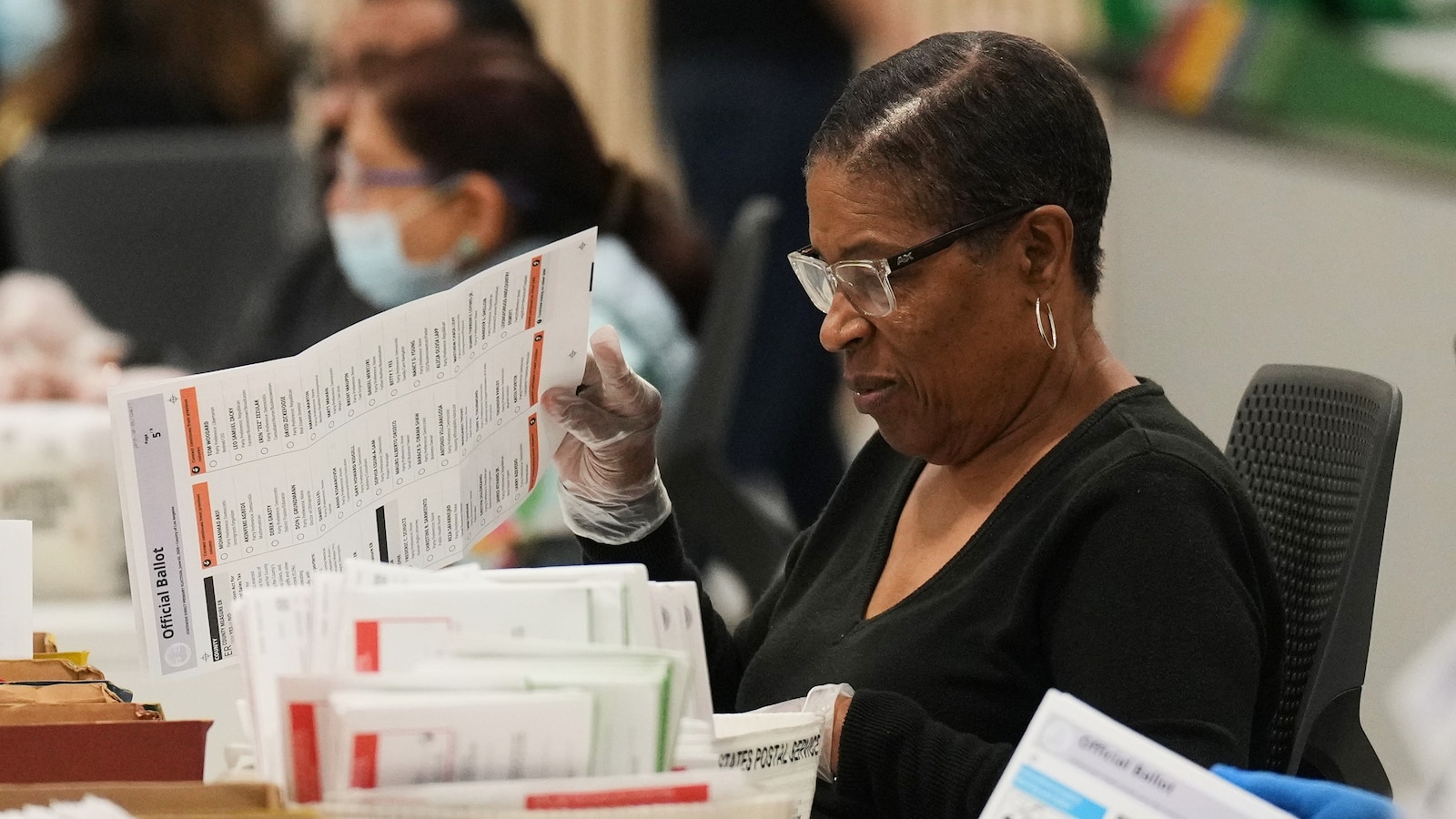

LOS ANGELES — The attorney stood at the edge of the Los Angeles County Ballot Processing Center on Friday morning, was shown the counting operation, and left. No search warrant. No subpoena. No complaint from any voter, campaign, or county official about a specific act of fraud. Just an observer from the U.S. Attorney’s Office, watching ballots move through machines, and a press statement confirming his presence in the building.
That visit — unremarkable on its face, routine under California election law — has become the most tangible evidence yet that President Donald Trump’s election fraud accusations are not merely rhetorical. They now have operational footprint. And the question hanging over California’s still-uncompleted primary count is not whether the state’s Democratic leadership can disprove fraud claims that have yet to specify a victim, a precinct, or a method. It is whether the absence of any such specifics is the point.
Trump posted to social media late on the night of June 3, accusing California Democrats of trying to steal the gubernatorial and Los Angeles mayoral primaries. He claimed the U.S. Attorney’s Office in Los Angeles was already investigating. That office initially declined to comment when ABC News asked. Then, two days later, First Assistant U.S. Attorney Bill Essayli announced on social media that his office had “multiple election fraud investigations underway” in coordination with the FBI — without naming a single specific allegation, case, or subject.
DOJ spokesperson Kyle Perez confirmed a prosecutor had been sent to the ballot center. “He was sent there by our office to observe the vote counting process,” Perez said. Perez did not respond to questions about what specific fraud the investigations concerned. The Los Angeles County District Attorney’s Office told CNN it had “not received any complaints from the federal government regarding criminal misconduct related to vote-counting or fraud.”
California Attorney General Rob Bonta, who dispatched his own representative to the same facility at the same time the federal official was present, was unsparing in his assessment. “There are no details, there is no specifics, there is no specific allegation of any individualized act of voter fraud,” Bonta said Saturday in an interview with MSNBC. He added that claims of fraud were “only a figment of the imagination of Trump and others who follow that conspiracy theory,” pointing to what he described as an unbroken record across every count, recount, audit, and court case in the United States.
What made California a target was not, as the president suggested, evidence of misconduct. It was math — and a specific statistical quirk that happens to be illegible to anyone watching a vote count in real time. California’s 23 million registered voters rely heavily on mail-in ballots, many of which arrive at county offices for up to a week after election day. Under state law, those ballots are valid as long as they are postmarked by election day. Early in-person results skew Republican. Mail-in tallies, which take longer to count and validate through signature matching, skew Democratic. The gap between those two waves is what political scientists have called the “red mirage” — an early Republican lead that dissolves as counting continues, not because of manipulation, but because of the sequential mechanics of how different ballot types are processed.
In the Los Angeles mayoral race, a candidate named Spencer Pratt appeared early on to be heading into the general election. As mail ballots came in, he fell back. That shift, normal and expected in California’s counting architecture, was the specific moment Trump characterized as evidence of theft.
The playbook has a precedent. In 2020, Trump looked ahead in several key states on election night, as in-person votes were tallied first. Mail ballots — cast at higher rates by Democratic voters — arrived in the count afterward and reversed those leads. Trump called it fraud then. No court agreed. More than 60 legal challenges failed. A Brookings Institution analysis from November 2025 found that voter fraud in mail voting is statistically rare.
What is different now is institutional. In 2020, Trump was the incumbent pressing from outside the Justice Department. In 2026, the Justice Department is his. Essayli’s announcement of “multiple” federal investigations without identifying a single allegation, followed by a federal prosecutor physically present in a ballot counting facility, represents a use of prosecutorial posture — the suggestion of investigation rather than investigation itself — as a political instrument. It is a technique that does not require a conviction, or even a charge, to function. The announcement is the message.
Bonta had anticipated this. In October 2025, when Trump’s Justice Department announced federal election monitors for a California special election, Bonta warned on a call with reporters that he was “100 percent” concerned about false accusations of wrongdoing being used to challenge results. “All indications, all arrows, show that this is a tee-up for something more dangerous in the 2026 midterms and maybe beyond,” he said at the time.
That assessment sits differently now. November’s midterms, in which control of the House will be decided, are five months away. California holds several of the most competitive congressional districts in the country. Trump told his cabinet in late May that he did not care about the midterms — a statement his aides subsequently attempted to contextualize. His behavior in California since the June 3 primary suggests a more active interest in the outcome than that remark implied.
Governor Gavin Newsom’s press office called Trump’s posts lies. Democratic Party Chairperson Rusty Hicks told ABC News that the claims were “baseless” and that California would complete a fair and accurate count. Secretary of State Shirley Weber, in a statement issued after polls closed June 3, said it was normal for final results to take weeks given the state’s mail-ballot architecture, and that election night would provide a picture, not a verdict.
There is one thing California officials, election law experts, and even the president’s own White House spokespersons agree on: mail-in voting is legal, widely used, and practiced by voters of every political affiliation. Trump himself voted by mail in a Florida special election in March. A White House spokesperson described that as a “commonsense exception” — illness, disability, military, or travel. California’s 23 million voters cast their ballots under the same statutory framework.
What neither California’s attorney general nor any federal official has yet disclosed is whether Essayli’s “multiple investigations” have subjects, specific precincts, forensic evidence, or anything more than a social media post from the president and a window of slow counting that is fully explained by how the state has run its elections for decades. That gap — the one between announced investigation and named allegation — is where the strategy lives. Democrats have begun building a counter-offensive around that pattern, but the architecture of the fraud claim does not require resolution to accomplish its purpose.
In the meantime, California has up to 30 days from the June 3 election to complete its count. Final certified results must reach the secretary of state by July 3. The votes will be counted. What happens after that, and whether the count’s completion closes or reopens the question Trump has already put on the table, is what the party’s midterm posture is now calibrating around — in Texas, in Ohio, and now, most visibly, in Los Angeles.