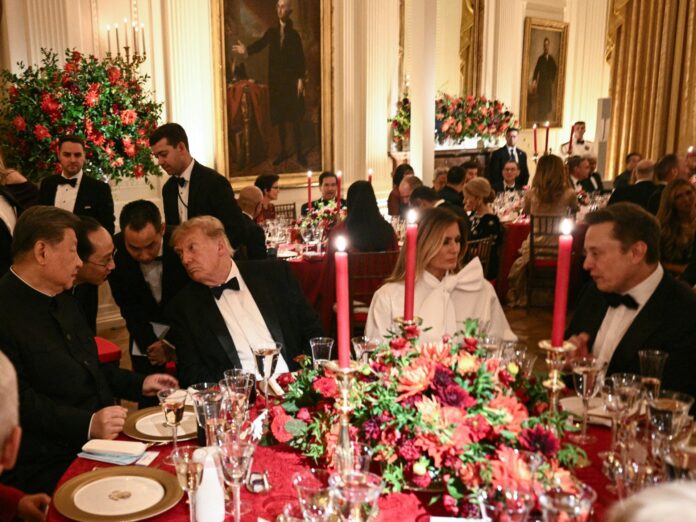

WASHINGTON — The putting green Dwight Eisenhower had installed outside the Oval Office left golf-spike marks on the wooden floors inside. The horseshoe pit that George H.W. Bush ceremonially reopened in 1989 remained a fixture for years. The T-ball games George W. Bush hosted on the South Lawn ran for two decades. Each left something behind — a memory, a worn patch of grass, an anecdote.
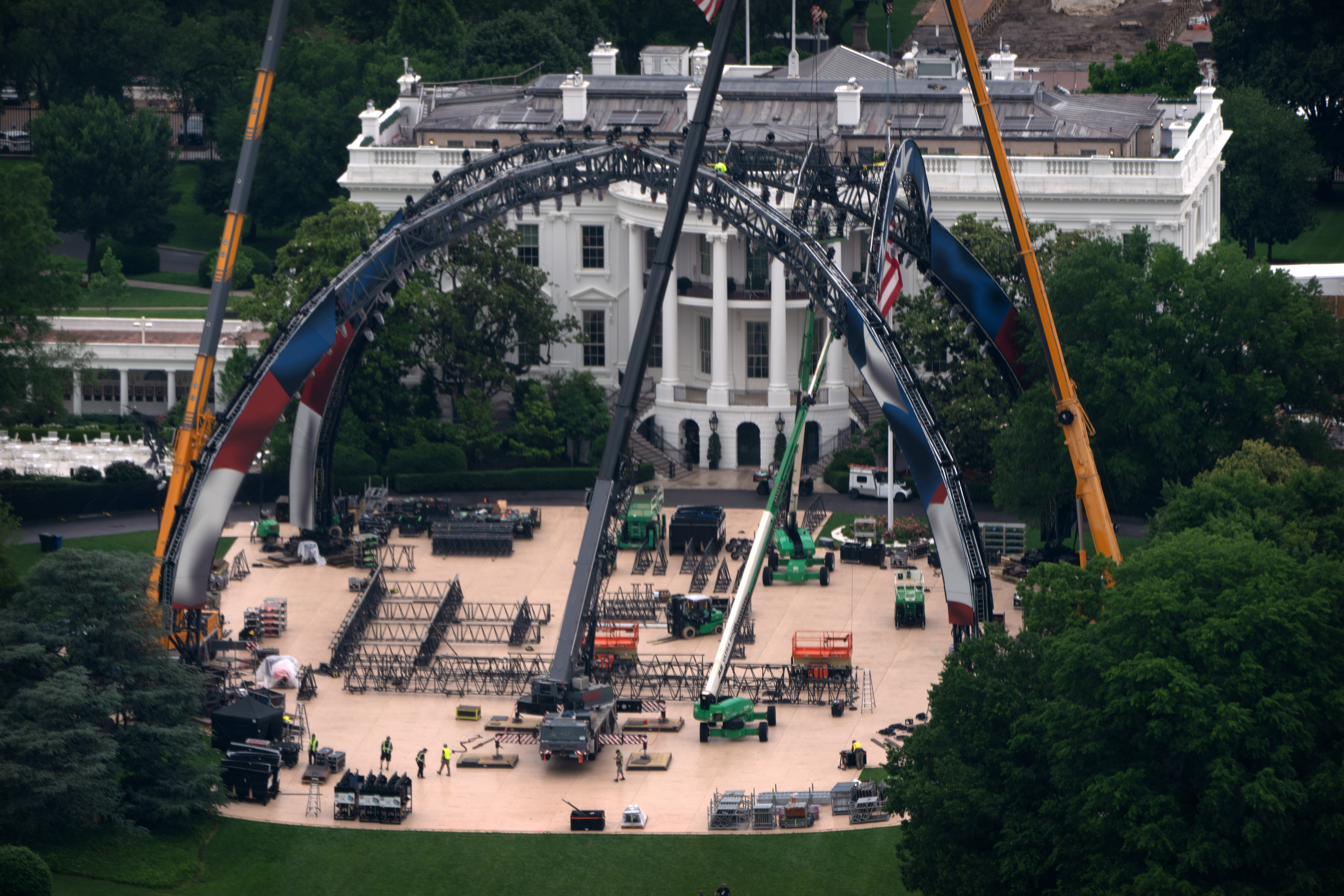
What Donald Trump is leaving behind, at least for now, is a 92-foot steel arch and a wire-mesh fighting cage, and his answer when asked whether the whole structure comes down after his 80th birthday fight on June 14 was notably unhelpful. “Maybe we’ll never, ever take it down,” he said.
The UFC Freedom 250 event — five championship-caliber bouts on the South Lawn, headlined by lightweight champion Ilia Topuria against interim titleholder Justin Gaethje, scheduled to stream live on Paramount+ — is being marketed as part of the nation’s 250th anniversary celebrations. It is also, self-evidently, Trump’s birthday party. He turns 80 on June 14, which is also Flag Day, and the overlap is not coincidental. The president confirmed the date during a speech at Naval Station Norfolk last fall and did not mention, at the time, that it happened to be his birthday.
The event will be the first live professional sporting event ever staged on White House grounds. That distinction matters to presidential historians, though they disagree on what it ultimately means. “Sports has been central to presidents,” Michael Patrick Cullinane, senior historian at the Theodore Roosevelt Presidential Library and author of Theodore Roosevelt and the Tennis Cabinet, told the Associated Press. “I don’t know that it’s been quite the spectacle that it is with the Trump administration.”
The history of what presidents have done with the South Lawn is, in some ways, a running record of how each man wanted to be seen. It begins with Theodore Roosevelt, who installed a grass tennis court after his wife, Edith, worried that the workload was going to kill him. Roosevelt played long and hard — Cullinane described his technique as vigorously committed if technically poor — and he boxed in the White House with a small circle of aides and officers. Sparring with his military aide Col. Daniel T. Moore in 1905, Roosevelt detached the retina of his left eye. He took up jiu-jitsu not long after. The sporting instinct never left him; it just adapted to what his body would allow.
Herbert Hoover used the space for a game that eventually took his name. Hoover-ball combined elements of volleyball and tennis using a six-pound medicine ball, invented by White House physician Adm. Joel T. Boone as a fitness regimen. Franklin D. Roosevelt had an indoor pool built for polio therapy. Harry Truman had an old horseshoe pit removed — the first Bush restored it — and Richard Nixon, who spoke publicly about his love of football while quietly bowling in a private lane he had built in the White House, understood that a president’s sporting affiliations are always partly political.
John F. Kennedy understood this too, in the opposite direction. He was a skilled golfer but largely concealed it, wary of comparisons to Eisenhower, whose love of the game had become something of a cultural punchline. What Kennedy promoted instead was touch football and the image of the Kennedys frolicking in the surf at Hyannis Port — youth, energy, vigor, none of the patrician slowness of the links. Barack Obama had the White House tennis facilities repainted as a basketball court, though Melania Trump oversaw their conversion back as part of a broader South Lawn pavilion renovation during her husband’s first term.
Trump is different in degree, if not entirely in kind. He has attended professional UFC bouts regularly since his 2024 campaign, treating the audience — predominantly young men, demographically inclined toward disengagement from conventional politics — as a constituency worth courting. His friendship with UFC CEO Dana White goes back to the early 2000s, when Trump’s Atlantic City Taj Mahal hosted UFC 30 and UFC 31 after the promotion struggled to find venues. White spoke at the Republican National Convention in 2016 and called Trump “a fighter.” He was at Trump’s side through both presidential campaigns. The UFC coming to the South Lawn is, in one sense, the culmination of a two-decade business and political alliance.
The venue itself — known as “The Claw,” a 600-ton steel structure assembled in Pennsylvania and shipped to Washington by trailer in May — cost the UFC roughly $60 million to construct, according to TKO Group Holdings president Mark Shapiro, who said the promotion expected to absorb the loss. No tickets are being sold. Approximately 4,500 seats on the South Lawn will go to guests of the president, UFC officials, and roughly 1,200 members of the military. An additional 85,000 fans can watch from the Ellipse on large screens, free of charge. The fighters will walk from the Oval Office to the cage. Weigh-ins are scheduled at the Lincoln Memorial.
Tevi Troy, a presidential historian and senior fellow at the Reagan Institute, framed what is happening in terms of celebrity rather than sport. “There’s definitely precedence for athletic events, but this is a combination of athletic event and a celebrity event,” Troy told the Associated Press. He noted that the entertainment world has proven broadly hostile to the Republican Party, which has narrowed the pool of celebrities Trump can call on for the kind of high-profile cultural endorsements that other presidents have taken for granted. The UFC represents a carve-out: a massive, loyal, young audience that mainstream celebrity culture does not reach.
That narrowing was visible in the America 250 concert lineup. Several musical acts had already withdrawn from the broader Freedom 250 festivities, leaving the UFC as the centerpiece of what was meant to be a national celebration. “The entertainment world is just hostile to Republicans and Trump,” Troy observed. “So he goes to find his celebrities where he can.”
A federal lawsuit filed on Saturday by the Public Integrity Project sought to halt the event, arguing that the White House did not obtain proper authorization from the National Park Service, that UFC Freedom 250 is a for-profit event improperly staged on federal parkland, and that UFC CEO Dana White, despite claiming the UFC is “eating” the event’s cost, acknowledged it was Trump’s idea, as NBC News reported. A court has not yet ruled on the challenge, and it is not clear what injunctive relief could realistically halt a June 14 event as of this writing.
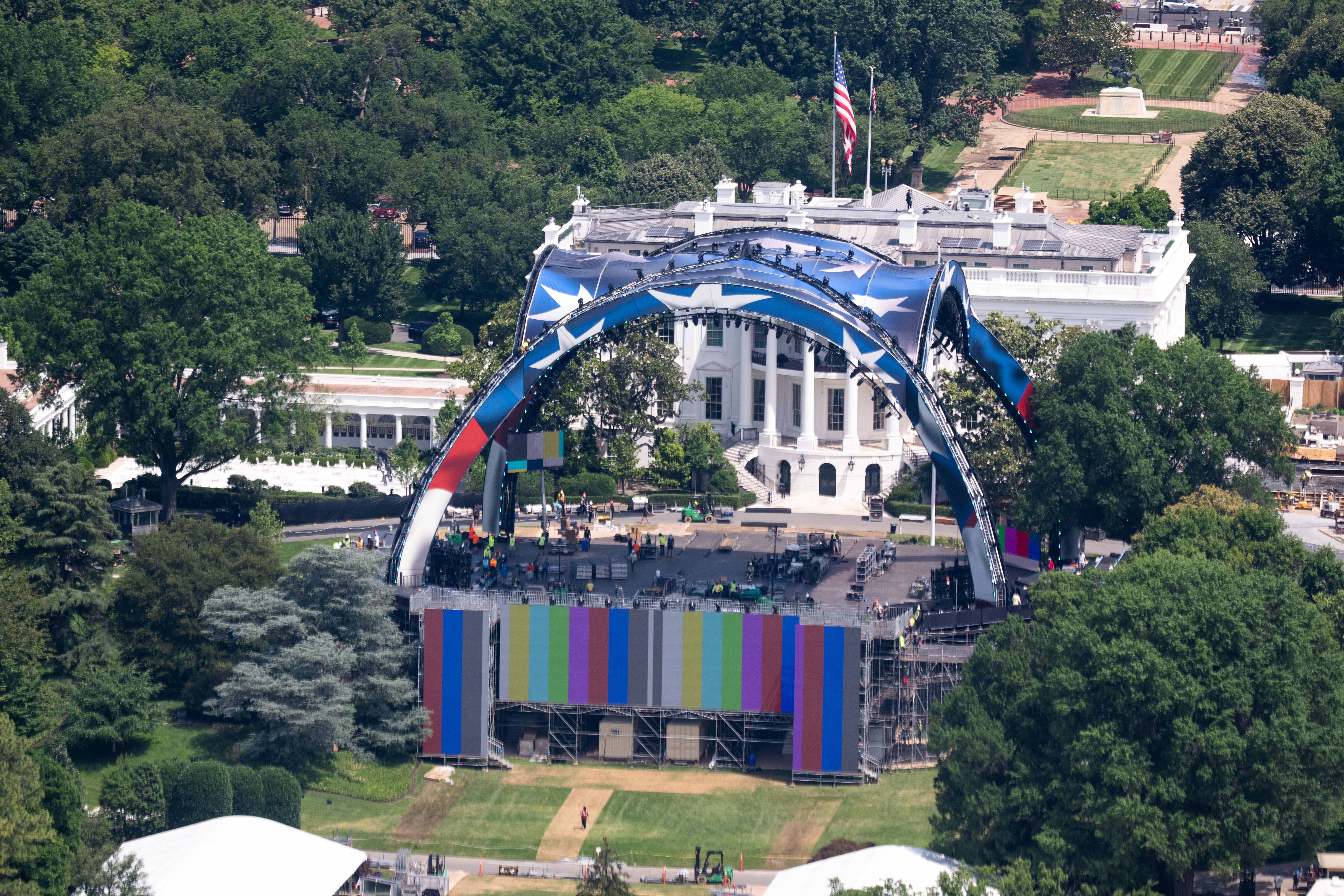
Trump’s Eiffel Tower comparison is not entirely facile. The original Tower was built as a temporary structure for the 1889 World’s Fair and was supposed to come down; Parisians eventually decided to keep it. “They said, ‘You know we sort of like it,’” Trump said on TikTok, “and eventually they never took it down.” The Claw is built to be disassembled. But Trump has now said more than once that he is not sure he wants it to go.
Cullinane was careful not to render the kind of historical verdict that only time can actually deliver. He noted that 20 years from now, what feels today like a rupture in White House decorum might simply look like another president expressing his identity through the space he inhabits. That judgment, Tevi Troy said, will depend on whether Trump’s norm-breaking turns out to be a detour or a permanent redirection. “Breaking the precedent doesn’t bother him,” Troy said of Trump. “Trump, I think, is more willing than other presidents to be asked that question: ‘Why aren’t you doing it the way the previous presidents did?’”
Cullinane also noted that the UFC’s demographic is dominated by men — tied to ideas of masculinity in ways that make staging the sport at the White House inherently political, however much White insists otherwise. That tension between spectacle and governance, between a president’s personal enthusiasms and the institutional weight of the house he lives in, is the question UFC Freedom 250 poses but does not settle. The cage, for now, is not coming down. What it means to have built it there in the first place is a harder problem than whether or not to remove it.