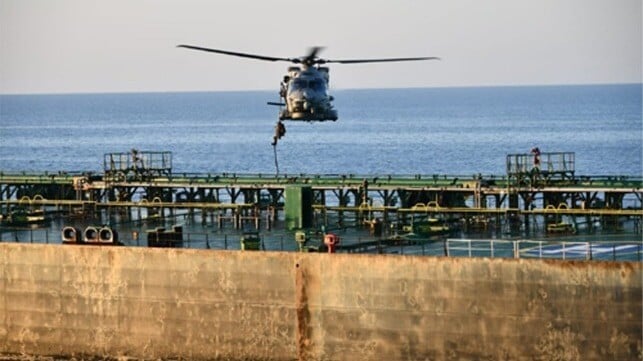
MOSCOW — The tanker Oneiroi was boarded by an EU inspection team in the Mediterranean on June 1, its false-flag declaration challenged, its cargo of crude loaded at the Russian port of Primorsk six weeks earlier placed under scrutiny. Then it continued sailing. By June 5 it was at Port Said. By mid-June it is expected to offload in Gujarat, India. The boarding, the first physical inspection Operation IRINI has conducted against a shadow fleet vessel in international waters, produced no interdiction, no cargo seizure, no rerouting.
That operational reality was the unspoken backdrop on Wednesday when Russian Foreign Ministry spokeswoman Maria Zakharova told a press briefing in Moscow that deploying EU naval vessels to inspect or seize oil tankers in the Mediterranean would constitute a flagrant violation of international law. The EU, she said, had fabricated the concept of a shadow fleet — there is no such category in any instrument of international maritime law — and was using a politically invented term to justify what amounted to the intimidation of civilian shipping. Russia, she added, reserved the right to deploy the full arsenal of political, legal, and other instruments to protect what she called the legitimate interests of shippers and shipowners.
The statement came two days after EU foreign policy chief Kaja Kallas announced in Cyprus, at an informal meeting of EU defense ministers, that Operation IRINI had updated its rules of engagement and had already begun boarding vessels. The idea, Kallas said, was to standardize practices across EU member states and to curb Russia’s ability to finance its military operation in Ukraine through oil revenues. IRINI, named after the Greek word for peace, was launched in March 2020 to enforce the UN arms embargo on Libya. Its mandate was expanded in 2025 to include monitoring suspected sanctions-evasion; compulsory boarding of shadow fleet suspects came only this year.
The legal argument behind the new mandate is narrower than Brussels’ language suggests. Under Article 110 of the UN Convention on the Law of the Sea, a warship may board a foreign vessel on the high seas if there are reasonable grounds to suspect it is sailing without nationality or under a false flag. That is the hook IRINI has used: the Oneiroi was stopped on suspicion of a false flag declaration; the Sandhya, an Indian-owned, Cameroon-flagged product tanker subject to EU and UK sanctions, was boarded on June 7 for a flag verification. UNCLOS Article 110 does not, however, authorize the boarding state to seize cargo, compel a course change, or detain a vessel whose flag-state claim turns out to be valid. The legal basis for detention is considerably murkier, and maritime analysts noted this week that the expanded mission has not gotten off to a persuasive start.
Since launching its expanded shadow fleet mandate, IRINI has stopped three vessels. None has been formally detained. The Oneiroi, which had a capacity of roughly 100,000 barrels of oil when boarded, completed its Mediterranean transit, transited the Suez Canal, and is now bound for an Indian refinery. The gap between the political signal Brussels is attempting to send and the physical outcome on the water is the one thing neither Kallas nor Zakharova has addressed directly.
Russia has watched the progression of European tanker enforcement with mounting concern since France and British naval forces intercepted the Tagor in the Atlantic on May 31. That detention, which Moscow called piracy at the time, marked the most aggressive European action against a vessel linked to Russian oil shipments and resulted in the arrest of its Russian captain. The Tagor had been tracked for weeks; the Deyna, a Mozambican-flagged tanker suspected of shadow fleet links, had been surveilled off Marseille-Fos since March. The pattern — from French surveillance to British boarding protocols to IRINI’s Mediterranean expansion — represents a deliberate escalation that has been building since the EU adopted its 20th sanctions package in April, which targeted oil production, refining, and transportation infrastructure directly.
Zakharova’s language on Wednesday was calibrated not to the Tagor or the Deyna but to IRINI specifically, because IRINI represents something qualitatively different: a multilateral EU naval posture rather than a bilateral French or British enforcement action. Twenty-seven EU member states are formally participants in the operation. No national government has yet commented individually on Kallas’s statement, but the institutional authorization means the legal and political exposure is collective. That is precisely the aspect of the announcement that most troubles Moscow. A French frigate detaining a tanker in the Atlantic is a political dispute between two governments. An EU naval mission systematically boarding tankers across the Mediterranean is a structural challenge to Russia’s oil export architecture.
The EU’s 21st sanctions package, proposed this week by the European Commission, extends that architecture further: 30 additional shadow fleet vessels would be listed, and a proposed ban on the sale of liquefied natural gas tankers to Russia would close one of the remaining gaps in the energy trade restrictions. The tanker boardings and the new sanctions package are two parts of the same pressure campaign, and Russia’s response — legal warnings, invocations of maritime sovereignty, references to the full arsenal of instruments — has been consistent in tone without specifying what those instruments might be.
What IRINI’s operational record does make clear is that the legal framework under which the mission currently operates is not designed for interdiction. UNCLOS Article 110 is a flag verification tool; it was written for piracy and slave-trade suppression, not sanctions enforcement. The EU has adapted it for a purpose it was not built to serve. Whether that adaptation holds up under legal challenge — Russia has said it reserves the right to pursue every available legal avenue — depends on whether the vessels boarded can be shown to be genuinely stateless or operating under fraudulent registration. The Oneiroi’s continued voyage to India suggests that, at least in that instance, the flag-state question was not resolved in IRINI’s favor.
The United Kingdom has separately announced that its naval forces may board sanctioned vessels in British waters, including the English Channel, a posture that extends enforcement into territorial and contiguous waters where the legal threshold is lower. The current EU decision, by contrast, applies specifically to the Mediterranean high seas, and analysts have noted that a similar expansion to the Baltic — where Russia’s Primorsk and Ust-Luga terminals ship crude through waters that are, in practical terms, NATO-dominated — would carry considerably higher escalation risk.
The force currently committed to Operation IRINI in the Mediterranean consists of the Italian offshore patrol vessel ITS Francesco Morosini and the Greek frigate HS Kanaris, supported by maritime surveillance aircraft from Luxembourg and Poland, all operating out of Sigonella under Italian Rear Admiral Marco Casapieri. Against a shadow fleet that, by EU estimates, numbers well over 100 vessels currently active in the Mediterranean basin, three boardings in six weeks is a rate that will not shift the economics of Russian oil exports. What it may shift is the legal argument — and that, for now, appears to be the point.