
LONDON — The most closely watched number in climate science arrived this week the way a medical chart does, one reading worse than the last. Human activity had warmed the planet by 1.37 degrees Celsius in 2025, an international team of scientists reported, and the budget of carbon the world can still burn before breaking its central promise has shrunk to about three years of emissions.
The figure comes from the fourth annual Indicators of Global Climate Change, an update built by more than 70 scientists from 56 institutions across 17 countries, many of them lead authors on the UN’s official assessments, and published June 11 in the journal Earth System Science Data. The project exists because the formal IPCC reports land only every six or seven years, and the climate now moves faster than that cadence can track. Total observed warming reached 1.39 degrees last year; of that, 1.37 was traceable to human influence, the rest to natural variability.
The decadal pace is the part that unsettles the authors. Warming is now climbing at about 0.27 degrees every ten years, a rate without precedent in the instrumental record, driven by greenhouse gas emissions that hit a record 56.8 billion tonnes of carbon dioxide equivalent in 2024 and by a fading veil of industrial aerosol pollution that had been masking some of the heat. Peter Thorne of Maynooth University, one of the co-authors, reached for the clinical metaphor directly: the indicators, he said, are the vitals of a patient exhibiting ever more troubling symptoms.
The carbon budget is where the abstraction becomes a countdown. To keep a coin-flip chance of holding warming below 1.5 degrees, the report calculates that humanity can emit roughly 130 billion more tonnes of carbon dioxide from the start of this year. At the current rate of about 42 billion tonnes annually, that is a little over three years of burning. On present trends, the scientists project, human-caused warming crosses the 1.5 degree line around 2030, the threshold nearly 200 nations pledged in Paris to hold.
Some of the authors have stopped hedging about what that means. Aurelien Ribes of the French meteorological service said that keeping global warming below the 1.5 threshold now seems unachievable, a judgment that would have been unspeakable in a peer-reviewed context a decade ago and is now simply arithmetic. Samantha Burgess of the Copernicus Climate Change Service put the attribution plainly: nearly all of the warming over the last decade is driven by human activities, leaving little room for the comforting idea that the sun or ocean cycles are doing the work.
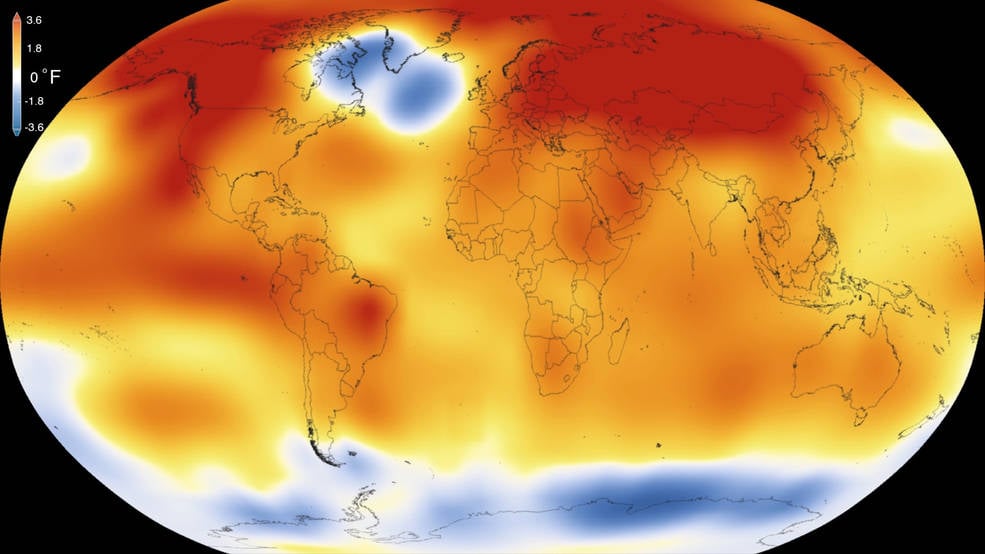
Beneath the headline temperature, the report tracks the planet’s deeper energy books, and they are where the acceleration is clearest. Earth’s energy imbalance, the gap between the heat arriving from the sun and the heat escaping back to space, has roughly doubled in recent decades and now sits at a record, which is the physical reason the warming rate keeps climbing. Karina Von Schuckmann of Mercator Ocean International, who leads the ocean-heat analysis, said that imbalance is growing fast and driving changes in every component of the climate system. Most of that trapped heat goes into the sea.
The ocean returns the favor at the coast. Sea level has risen about 23 centimeters since 1901 and is now climbing at 3.84 millimeters a year, an accelerating creep that turns ordinary tides into the kind of flooding that two studies this week found is now roughly 12 times more frequent than it once was. Marine heatwave days have tripled since 1991, averaging 65 days across the global ocean in 2025, cooking reefs and fisheries that hundreds of millions of people eat from.
The report is careful about what it does not claim. Crossing 1.5 degrees of human-induced warming as a long-term average is not the same as a single hot year breaching it, which has already happened; the indicators track the underlying trend, not the noise around it. Nor does the projection of 2030 foreclose every path, since a sharp drop in emissions would still slow the climb. The authors’ point is narrower and harder to wave away: at the rate the world is actually emitting, not the rate it has promised, the line falls within a few years.
There is one genuinely hopeful thread, and the scientists flag it themselves. The growth of carbon dioxide emissions appears to be slowing, the long plateau that has to come before any decline. Whether that bend arrives fast enough to matter against a three-year budget is the open question, and it is a question of politics and investment rather than physics. The same week this report landed, diplomats preparing November’s climate summit were building their agenda around a voluntary electrification target with no binding force.
Chris Smith of the International Institute for Applied Systems Analysis offered the argument for why the annual accounting matters at all, even when the news it carries is bad. Without this kind of sustained monitoring, he said, future assessments will be much more difficult at exactly the moment urgent action is needed, a warning that lands harder as governments cut the observing systems that feed it. The report is, in the end, a measurement, and measurement is the one thing the authors can still guarantee.
What it measures is a threshold approaching at a known speed. The 1.5 degree figure was never a cliff edge, and the world will not end on the day it falls; the danger rises continuously, degree by fractional degree. But it was the number the international community chose as the marker of success, and the scientists who track it most closely have now written down, in a peer-reviewed journal, roughly when it goes. The budget is 130 billion tonnes. The world is spending it at 42 billion a year. The rest is subtraction.