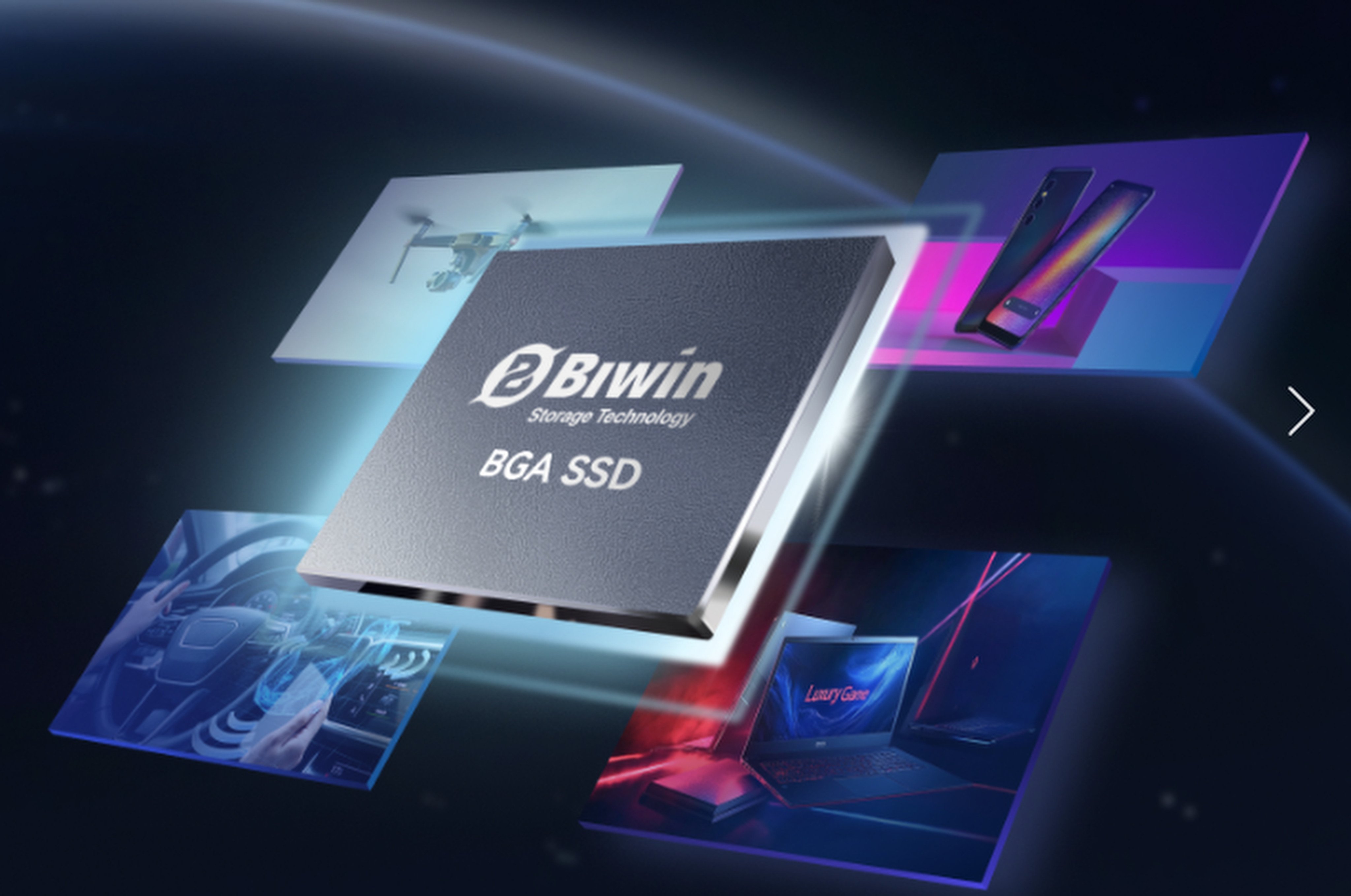

SHANGHAI, June 13, 2026 (The Eastern Herald) — Biwin Storage Technology, the Shanghai STAR Market-listed Chinese memory module manufacturer, has signed a 1.86 billion United States dollar two-year agreement to lock in enterprise-grade flash memory chip supply through the second quarter of 2028. The contract, disclosed in a regulatory filing on the Shanghai Stock Exchange this week, is worth 12.6 billion yuan, exceeds Biwin’s entire 2025 revenue of 11.3 billion yuan, and is being read across the global semiconductor industry as the loudest single signal yet that the next memory chip crunch has arrived and is being driven from the AI-server side.
The mechanics of the deal say more than the headline number does. The contract is structured as a locked-volume, locked-price arrangement, with deliveries scheduled from the third quarter of 2026 through the second quarter of 2028 and a price floor that protects Biwin against the kind of step-changes the spot NAND market has been delivering all year. The supplier is not named in the filing, with the company citing commercial confidentiality, but the technical specifications of the chips, the delivery cadence and the price band leave a short list of candidates. Samsung Electronics, SK Hynix, Micron Technology, Kioxia and Yangtze Memory Technologies are the only producers in the world that can deliver enterprise-grade NAND at this scale, and the geographic logic of the arrangement makes one of the Korean two and one of the Chinese two the most plausible counterparts.
The asymmetric arithmetic is the part Western analysts have been chasing all week. A 1.86 billion dollar contract is roughly 109 percent of the customer’s previous-year revenue. That is the kind of ratio that triggers mandatory disclosure under STAR Market rules and is rarely seen even in the most cyclical industrial industries. The signal it sends to upstream pricing is that downstream Chinese memory module makers, who service the data-center, smartphone and automotive end markets that are simultaneously being rebuilt around generative AI, no longer believe they can rely on quarterly spot purchases to meet customer commitments. The cycle has turned, the pricing power has migrated upstream, and the contracts are now being signed multi-year and locked-price.
Biwin’s customer base reads as a who’s-who of the AI server build-out. The company supplies enterprise SSDs to mainland Chinese hyperscalers Alibaba Cloud, Tencent Cloud and Baidu Cloud, to Xiaomi and Honor for premium smartphones, and to several mainland EV makers including BYD, Nio and Li Auto for in-vehicle memory. The deal-volume the new contract supports therefore covers contracted demand that is, in turn, locked-in. Biwin’s chief executive Liao Wenfu has been signalling at industry conferences for two quarters that the company’s customer commitments through 2027 were running well ahead of its own supply visibility, and the new contract is the operational solution to that gap.
The upstream side of the trade is just as informative. Samsung Electronics, the world’s largest NAND maker, has been guiding the market to expect tighter supply through the second half of 2026 and is rumoured to be the only supplier with sufficient quarterly capacity to underwrite a 12.6 billion yuan two-year commitment. SK Hynix, the world’s largest high-bandwidth memory maker, has shifted production toward HBM for AI accelerators and is therefore producing less standard NAND. Micron has its own customer commitments to Nvidia, AMD and the largest US hyperscalers. Kioxia and Yangtze Memory are scaling but are not yet at the volume tier the contract requires. The supplier list is short.

The cycle dynamic that brought the contract to the table deserves its own paragraph. NAND spot pricing fell roughly 60 percent between 2022 and the trough in mid-2024, with quarterly losses booked at Micron, SK Hynix and several smaller players. The recovery began in late 2024 and accelerated through 2025, with the AI data-center demand from Microsoft, Google, Amazon, Meta and the new Chinese hyperscalers pulling enterprise-grade SSD demand to its strongest level on record. The 2026 forecast tables now show NAND and DRAM supply running tight for the rest of the year, with selective tightness extending into 2027 on the most advanced 232-layer and 256-layer 3D NAND nodes. Biwin’s contract is the customer-side hedge against that scenario.
The political-economy dimension is the most consequential layer. Huawei’s Tau Scaling Law and the broader Chinese EDA-software realignment that played out earlier this week sits in the same political theatre. China is rebuilding its semiconductor stack around domestic capability, but the memory layer is the one segment where Chinese producers are still meaningfully behind the Korean and US leaders. Yangtze Memory’s process technology has closed the gap on standard NAND but remains behind on enterprise-grade reliability spec, and CXMT, the Chinese DRAM leader, is still scaling. Biwin’s deal therefore lands in a sector where Chinese supply-chain self-sufficiency is the explicit national policy goal and where the current quarter’s commercial reality remains import-dependent.
The contract size also implicitly endorses the Chinese hyperscalers’ AI infrastructure planning. Alibaba, Tencent and Baidu have been increasing data-center capital expenditure through 2025 and 2026 at a pace that the West has not fully priced in, with their combined annualised capex running at roughly 35 billion United States dollars in 2026 according to filings, JPMorgan estimates and the latest Chinese central-government industrial-policy disclosures. Biwin is one of the principal Chinese enterprise SSD suppliers feeding that build-out, and the contract’s effective subsidisation of forward inventory implies that the demand visibility on Biwin’s books has hardened materially over the last two quarters. The implication for the global SSD pricing curve is meaningful.
The Korean memory leadership is reacting publicly and privately. Samsung Electronics’ chairman Lee Jae-yong’s investor briefing last month emphasised the strategic importance of long-term contracts as a hedge against the spot-market volatility that had hurt the company’s 2023 and early-2024 results. SK Hynix’s positioning around HBM has been deliberate but leaves the standard-NAND market in a tighter supply posture. The Korea Times has been tracking the cumulative implication, including the increasing share of Yangtze Memory and CXMT in the global supply mix and the parallel rise of Biwin as a downstream Chinese champion.
The CXMT angle is also worth noting. The Chinese DRAM specialist is preparing for an initial public offering at an indicated valuation of roughly 42 billion United States dollars, which would be the largest hard-tech IPO in China since the 2017 reform cycle. The CXMT raise will fund expansion at its Hefei plant and is positioned to coincide with the broader Chinese semiconductor capital-markets reopening that CITIC Securities’ Fitch upgrade earlier this week implicitly supports. The combined picture is that the Chinese memory ecosystem is being financialised on top of a tight supply environment, with downstream module makers like Biwin locking volume from current upstream players while the next-generation Chinese capacity is being built and capitalised.
For investors the trading implications are direct. Memory stocks across Asia and the United States have been moving up on supply-tightness expectations for two quarters. SK Hynix is up 38 percent year to date, Samsung Electronics 22 percent, Micron 28 percent and Western Digital 31 percent. Yangtze Memory’s parent company financing rounds have priced at higher implied valuations than the Chinese semiconductor index has supported in years. The Biwin contract is the kind of single data point that buy-side analysts use to recalibrate their cycle calls, and the next two weeks of broker notes are likely to include upgraded NAND price-deck assumptions for 2027 and 2028.
The downstream pricing-pass-through is the part that has not yet been priced. If Biwin’s locked-in supply costs rise less than the spot market, the company protects its gross margin and benefits from the contract. If the spot market falls, the locked-in price becomes a cost burden. The contract structure suggests Biwin is willing to take that downside in exchange for supply visibility. The implication for end customers, including the Chinese cloud and EV buyers, is that input-cost discipline is now being prioritised over flexibility. That is a structurally healthier industrial posture and a more pessimistic supply outlook than the spot market has been pricing.
The geopolitical layer is unavoidable. US export controls on advanced memory equipment continue to constrain the highest-density 3D NAND production in mainland China, the Korean producers are operating under tighter outbound technology-licensing regimes, and the cumulative effect is to push the supply curve to the right. The supply constraint is a feature, not a bug, of the architecture the United States Commerce Department has constructed since 2022. The Biwin contract is the kind of commercial response that the architecture invites. The South China Morning Post framed the deal in those terms. IndexBox’s analysis sets out the contract economics in more detail.
The cleanest read of the Biwin deal is that the chip-crunch language is back. NAND and DRAM tightness was the dominant macro-tech story of 2017 and 2018, gave way to glut and recovery in 2022 and 2023, and is now reasserting itself on the back of AI-driven enterprise demand and constrained Chinese capacity. Biwin’s contract is the most explicit corporate confirmation of the new regime to date. The next test will be whether the Korean upstream producers confirm the cycle position at their second-quarter results in late July. If they do, the pricing curve already implied by spot NAND and DRAM moves becomes the consensus, and the rest of the global semiconductor industry will reset its planning around a memory tightness that runs into 2028.