
STUTTGART, June 13, 2026 (The Eastern Herald) — BYD has become the single largest plug-in hybrid vehicle brand in Germany, with the Chinese manufacturer’s registrations across the country surging 232 percent year on year in May, its Atto 2 DM-i model alone outselling every other plug-in hybrid in the country and one in every seven plug-in hybrid vehicles sold in Germany now bearing a BYD badge. The data, released by the Kraftfahrt-Bundesamt and confirmed by the European Automobile Manufacturers’ Association, has produced the most consequential single moment in the post-1945 history of the German automotive industry’s competitive position, with Volkswagen Group, BMW and Mercedes-Benz all losing share in their own home market to a manufacturer that did not have a meaningful European presence three years ago.
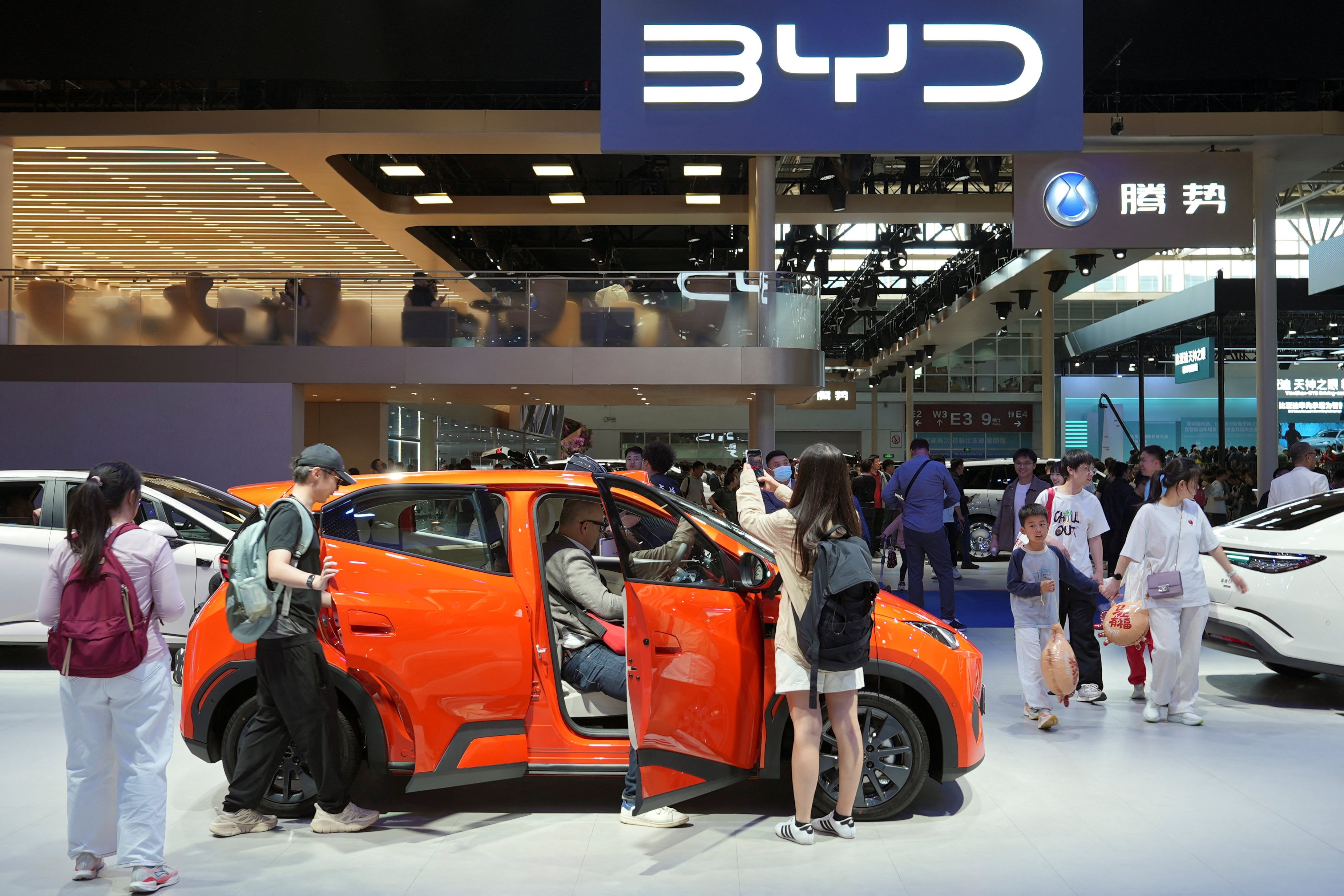
The numbers carry the weight of the story. BYD registered 4,705 vehicles in Germany in April, more than tripling from the same month a year earlier and setting a new monthly record for the company in Europe’s largest single automotive market. The May figure pushed higher still, with 4,290 of the BYD vehicles registered as plug-in hybrids and 2,113 of those concentrated on the Atto 2 DM-i, the small-SUV plug-in hybrid that the company has tuned specifically for the German consumer profile. The Atto 2 DM-i’s 2,113 unit figure is the highest single-model plug-in hybrid sales total for any vehicle, foreign or domestic, in Germany this year.
BYD’s German market share in the plug-in hybrid segment has now exceeded 15 percent, a number that would have been read as a statistical impossibility eighteen months ago. The country’s traditional plug-in hybrid leaders, BMW’s 530e and 330e, Mercedes-Benz’s GLC PHEV variants and Volkswagen’s Tiguan eHybrid and Passat GTE, have all lost share through the first half of the year and are facing a structural reset of their competitive position in a category that the German manufacturers had built and dominated since 2014. The Atto 2 DM-i’s price point, at roughly 28,000 to 31,000 euros depending on trim, undercuts the comparable BMW, Mercedes and Volkswagen offerings by between 15 and 30 percent, with comparable range and broadly comparable technical specifications.
The wider European picture compounds the German shock. BYD registered 29,291 vehicles across the European Union in January and February, up 179 percent from the same period a year earlier, according to ACEA data, and the company’s first-quarter total has now pushed past 75,000 units. Volkswagen Group’s European market leadership remains intact at roughly 27 percent of the wider passenger vehicle market, but the group’s January-February registrations slipped 0.7 percent to 449,294 units, the second consecutive year-on-year decline for the European leader and the first time the German group has lost share to a Chinese competitor in any category larger than 5 percent of the broader European market.
The structural drivers of BYD’s German breakthrough are identifiable and durable. The Chinese company’s vertical integration across battery cells, motors, semiconductors and software gives it a structural cost advantage of 15 to 22 percent at the bill-of-materials level against the equivalent German vehicles, before accounting for the labour-cost differential. BYD’s domestic Chinese market success, which saw it take 21.8 percent of the NEV retail market in May, provides the scale economics that the European pricing strategy then weaponises against the German manufacturers. The Hungarian and Turkish manufacturing footprint that BYD has been building over the past 24 months will, within 18 months, allow the company to bypass the European Union’s countervailing-duty regime entirely.
The German manufacturers’ strategic response has been muted. Volkswagen Group’s chief executive Oliver Blume has spoken publicly about the competitive pressure but has not produced a specific counter-strategy beyond a renewed commitment to the ID series electric vehicles and selective product-line consolidation. BMW’s chief executive Oliver Zipse has been more candid in investor calls about the structural cost gap. Mercedes-Benz’s chief executive Ola Kallenius has continued to emphasise the company’s positioning at the higher end of the market where BYD has not yet built a credible offering. The combined message from the German big three is that they will defend their premium positioning while ceding mid-market share to BYD and the broader Chinese competition.
The political dimension complicates the response. The European Union’s countervailing-duty regime, which imposes tariffs of 17 to 35 percent on Chinese-built electric vehicle imports depending on the manufacturer, has been the German automotive industry’s preferred policy response. The tariffs have slowed but not blocked BYD’s European expansion, and the company’s Hungarian and Turkish manufacturing investments are specifically designed to bypass the EU tariff barrier. Once those plants reach full production capacity in late 2026 and 2027, the tariff defence becomes a much weaker shield. The German automotive industry’s lobbying with Berlin and Brussels has shifted toward additional regulatory measures around battery sourcing, repair-and-service requirements and crash-safety standards that target the specific competitive vulnerabilities the Chinese manufacturers exhibit.
The macro environment is not helping. The World Bank’s downgrade of 2026 global growth to 2.5 percent earlier this week includes a specific note on weakening European automotive demand, with Germany singled out for its outsized exposure to both the Russian energy supply disruption and the new-vehicle demand softening that the GLP-1 economy and the cost-of-living squeeze have produced across the European Union. The total German new-vehicle market is on track to contract by roughly 4 percent in 2026, and BYD’s gain is therefore concentrated entirely in market-share terms rather than absolute volume growth. The Chinese manufacturer is winning a declining market.
BYD founder Wang Chuanfu’s strategic targets give the German breakthrough additional weight. Wang’s announcement earlier this month that BYD intends to become the world’s largest automaker by 2030 requires sustained share gains in Europe, North America and Asia. The German breakthrough is the proof of concept that the European leg of that strategy can deliver. The company’s stated 2026 German target of 50,000 vehicles is already in reach with eight months still to run, and the Hungarian production-line ramp-up suggests the 2027 target will be materially higher.
The labour-market implications for the German automotive industry are real and uncomfortable. Volkswagen Group announced in November that it would cut 35,000 jobs across its German operations over the rest of the decade. Mercedes-Benz has been more measured in its public commitments but is understood to be planning meaningful headcount reductions through attrition. BMW remains the German manufacturer most insulated by its premium positioning, but it too has been signalling tighter cost discipline. The cumulative effect across the German Mittelstand of automotive suppliers is even more pronounced, with parts suppliers including Continental, ZF Friedrichshafen and Schaeffler all announcing significant restructuring programmes through 2026.
The American competitive picture provides useful comparison. Rivian’s R2 launch, positioned against the comparable Chinese competition in the American market, has produced strong initial reviews but constrained delivery volumes that limit the immediate competitive impact. Tesla’s renewed focus on the European market through the refreshed Model Y and selective price adjustments has stabilised its German share at roughly 8 percent but has not produced share gains against either BYD or the German manufacturers. The Ford and General Motors retreat from European-specific electric vehicle production has effectively ceded the bottom half of the European market to the Chinese competition. The German manufacturers face the Chinese challenge largely alone.
Consumer reception of BYD’s vehicles in Germany has been more positive than the political and industrial narrative has acknowledged. German automotive press has been notably constructive on the Atto 2 DM-i, the Seal U and the broader BYD product line, with reviews comparing the vehicles favourably against equivalent Mercedes EQ models and BMW i-series products. The reliability and warranty experience has been strong enough that the residual-value forecasts that drive German leasing economics have been upgraded for BYD vehicles by both ADAC and Kelley Blue Book European subsidiaries. The Chinese manufacturer’s German dealer network expansion, now at 178 outlets compared to 24 in early 2024, has made the vehicles broadly accessible.
The long-running narrative of German automotive supremacy is now being formally rewritten. The post-war German economic model rested heavily on the export-driven success of Volkswagen, BMW, Mercedes-Benz and the broader automotive Mittelstand, and the Chinese competitive challenge cuts directly into that model in a way that no previous external competitive pressure has done. The South China Morning Post framed the moment as BYD claiming Germany’s plug-in hybrid crown. Investing.com’s coverage of the broader EU sales data provides the comparative European context.
The cleanest read of the BYD-Germany story is that the structural competitive advantage the Chinese company has built across vertical integration, scale economics and product-engineering discipline has now translated into the specific market that the German automotive industry has, since 1945, treated as the test of its competitive vitality. The 15 percent plug-in hybrid market share is the visible measure. The 232 percent year-on-year growth is the velocity. The Hungarian production-line ramp-up is the leading indicator. The German manufacturers’ premium-positioning defence is the rear-guard strategy. The next eighteen months will determine whether the German industrial response can produce a credible counter-strategy or whether the BYD-led Chinese competition becomes a permanent fixture of the European automotive landscape.