
BEIJING, June 13, 2026 (The Eastern Herald) — Electric and hybrid vehicles took a record 62.9 percent of China’s retail car market in May, according to data the China Passenger Car Association released this week, the highest monthly share the country has ever recorded and a milestone that for the first time leaves the world’s largest auto market with no internal-combustion model in its top 10 best-sellers. The figure is up from 62.7 percent in April and marks the third straight month above 60 percent, a threshold Western analysts spent most of the past decade insisting was a decade away.
The CPCA’s new energy vehicle reading covers pure-battery cars and plug-in hybrids together, and the May print is the kind of number that closes an argument rather than opens one. Total retail volume came to 1.51 million units of passenger cars in May, of which roughly 950,000 carried a plug. Wholesale volume including exports was tracked at 1.36 million NEVs, a 12 percent year-on-year jump, and the headline penetration has held above 60 percent even as Beijing trimmed the consumer trade-in subsidy and several provinces wound down their own local incentive top-ups.
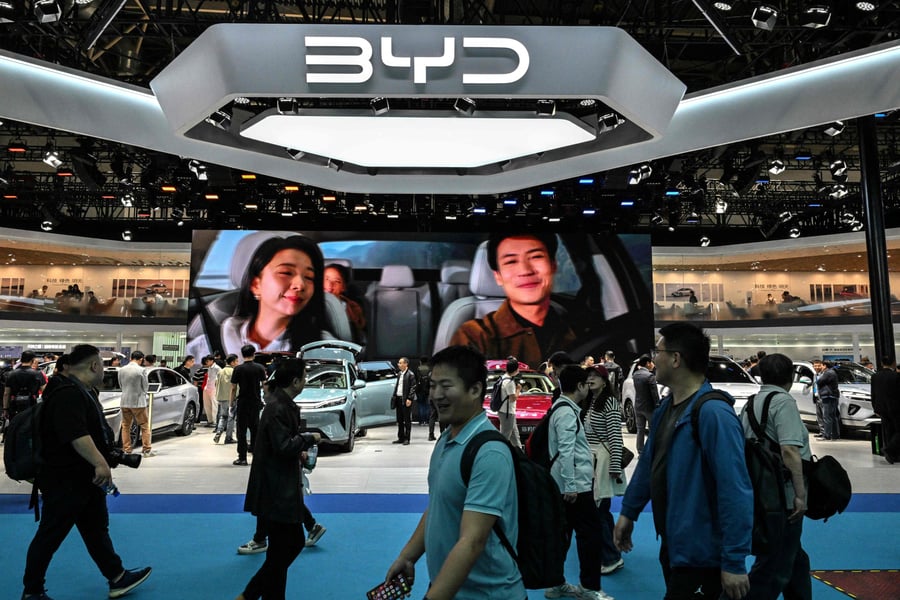
BYD remains the centre of gravity. The Shenzhen group sold 207,372 NEVs in the Chinese market in May, enough for a 21.8 percent share that ticked up from 21.4 percent the previous month and put it ahead of every other manufacturer by a margin its rivals are no longer pretending is closing. Exports tell the harder story. BYD shipped 155,944 NEVs out of China in May, an 85.5 percent rise year on year, and captured 36.7 percent of the country’s total NEV export trade. Total worldwide deliveries of 382,476 cars in the month put the company within reach of a full year above four million units, a scale only Volkswagen, Toyota and Hyundai-Kia can claim.
Tesla, after a punishing first quarter, clawed its way back into the top five with help from a refreshed Model Y and price cuts in second-tier cities. The American company’s share of the Chinese NEV export market sat at 9.1 percent in May, well behind not only BYD but also Leapmotor, whose monthly global sales hit a fresh record on the back of its Stellantis-backed European push. Inside China, Tesla’s gap to BYD on retail share is now wider than the gap between BYD and every other automaker in the table combined.
The truly arresting data point is the bestseller list itself. For the first time in the modern history of the world’s largest car market, every model in China’s top 10 ranks for May ran on batteries. The Volkswagen ID. Era 9X cracked the chart with 5,004 deliveries in a partial sales month, Nio’s full-size ES8 cleared 11,472 units, and Zeekr’s 9X flagship logged 9,058. Toyota’s Camry, the Volkswagen Lavida and Nissan’s Sylphy, all fixtures of the Chinese top 10 for a decade, finished the month outside the top 20. Industry executives in Detroit and Wolfsburg can spin this any way they like, but a domestic car market that has put combustion completely out of its bestseller list has crossed a line that does not get uncrossed.
The export channel is where the political stakes are highest. China sent more than 700,000 NEVs abroad in the first five months of 2026, a 70 percent year-on-year increase, with Southeast Asia, Latin America, the Middle East and now Africa as the fastest-growing destinations. Beijing’s NEV juggernaut is also rolling into Western markets that have tried to tariff it out of the way. The European Union’s countervailing duty regime, the Biden-era United States tariffs that the Trump administration has only widened, and Canada’s matching levies have slowed the calendar but not the trajectory. China’s overall exports surged 19 percent in May even as American tariffs hit their broadest reach in decades, and NEVs were the single most important driver of that mix.
BYD founder Wang Chuanfu used a Hong Kong investor day this week to lay down a five-year marker, telling shareholders the company intends to be the world’s largest automaker by 2030 and is willing to absorb margin pain in the West to get there. The promise landed amid a 45 percent slump in BYD’s Shenzhen-listed shares this year, a sell-off triggered by domestic price-war fears rather than weakening demand. Wang argued the very price war Western analysts treat as a sign of fragility is the mechanism by which Chinese NEVs are pricing combustion out of the global mass market.
For US automakers, the May data carries the same uncomfortable message it has carried for two years. Ford and General Motors have wound back EV production plans to defend internal-combustion margins on pickups and SUVs, and Stellantis has shifted resources to Latin America. Rivian is staking its entire near-term future on the R2 compact as cheaper Chinese rivals circle export markets. Tesla, the one Western manufacturer with a real Chinese supply chain, is now competing in a market that has built two complete domestic alternatives to every part of its value chain.
The financial-market consequences are dragging through too. Lithium and nickel demand profiles are being rewritten in real time as Chinese cathode and battery makers extend two-decade advantages, CATL’s share of the global lithium-iron-phosphate cell market hovers near 60 percent, and the ECB’s report this week on gold overtaking US Treasuries in global reserves was framed by analysts as part of the same diversification logic that is reshaping the auto sector. Capital, like reserves, is migrating away from the United States in places it used to feel safe.
Chinese policymakers are doing little to disguise the strategic intent. The Ministry of Industry and Information Technology has cleared 16 cities to pilot vehicle-to-grid integration this summer, the National Development and Reform Commission has tied factory-zone power tariffs to NEV production share, and the People’s Bank of China is steering green-loan facilities toward battery makers ahead of any new property-sector stimulus. The CnEVPost breakdown of automaker shares shows the next tier, including Geely, Changan, Geely-backed Zeekr and SAIC, all gaining domestic ground at the expense of foreign joint ventures.
Reuters and Bloomberg framed the May numbers as a milestone. The view from Beijing is that the milestone is the floor and that the next stop is structural exclusion of combustion-engine models from large parts of the Chinese fleet by the end of the decade. The South China Morning Post noted that even subsidy reductions have not slowed the trend, and forecasters at the China Association of Automobile Manufacturers now project full-year NEV share above 55 percent for 2026. That is roughly twice what the International Energy Agency was projecting for China at this stage of the decade as recently as 2023.
The 62.9 percent number will travel further than it deserves to in Western press releases this week, but the data underneath it is what matters. China has rebuilt the world’s largest auto market around the electric car in less than five years. The question for Detroit, Wolfsburg and Yokohama is no longer whether to follow. It is whether they have anything left to follow with.