
RICHMOND — In Fauquier County, sixteen subdivisions stopped watering their lawns this week, not by choice. In Durham, North Carolina, restaurants will start serving water only on request from Monday, and any business that uses more than 100,000 gallons a day has to find a way to cut 30 percent. In Connecticut, the governor declared three counties under a drought advisory. The Eastern Seaboard, the part of the country that is supposed to have water, is starting to ration it.
The Virginia figure is the one that startles. Extreme drought, the second-worst category the US Drought Monitor publishes, now covers 38 percent of the state, up from 25 percent a week earlier, WTVR reported. Precipitation since October 1 sits roughly seven and a half inches below normal statewide. Thirteen of the twenty-four wells the state Department of Environmental Quality uses to monitor groundwater are reading below the tenth percentile for this time of year. Some parts of central North Carolina have moved into exceptional drought, the highest category there is.
What makes that data unusual is not the dryness itself but where it has settled. The American drought story, for the past quarter century, has belonged to the West: depleted snowpacks, shrinking Colorado River reservoirs, the slow desiccation of the Great Basin. The eastern half of the country was supposed to be the reliable side, the place where rivers reset every spring and aquifers refilled every winter. That assumption has been quietly weakening for years, and this June is the bill.
The restrictions are not advisory. Caroline County in Virginia activated its Tier 3 plan, which prohibits lawn watering, limits car washing to hand-wash, schedules garden watering by street address, and requires written approval to fill any swimming pool over a thousand gallons. Louisa, Orange, Fauquier and Shenandoah counties have layered similar mandatory rules over their public water systems. The county officials’ explanation, posted on a public-utility bulletin in language that does not pretend to be casual, was that mandating restrictions is intended to prevent shortages of safe potable drinking water for the citizens connected to these public water systems.
Durham’s situation is the East’s closest analog to the California cuts of the past decade. Stage 2 takes effect Monday, which means spray irrigation with city water is prohibited entirely, pressure washing is banned except for health or safety reasons, pool filling is restricted to evaporation replacement, and the largest commercial water users must reduce consumption by 30 percent or risk a fine, ABC11 in Raleigh reported. The reservoirs the city draws from, Lake Michie and Little River, have been falling for weeks. Stage 2 helps protect the supply we have left, the city said in a written notice, the kind of sentence a municipal water utility writes only when it has done the arithmetic and not liked the answer.
Connecticut’s Governor Ned Lamont declared a Stage 2 drought advisory on Wednesday for Fairfield, Middlesex and New Haven counties, according to the governor’s office. Warmer conditions and the lack of significant rain over the past months, Lamont said, have impacted all of Connecticut, particularly the regions around those three counties. Stage 2 is the second of five levels in the state’s drought plan, an awareness designation rather than an emergency, and it explicitly cites increased wildfire danger across the state as a factor.
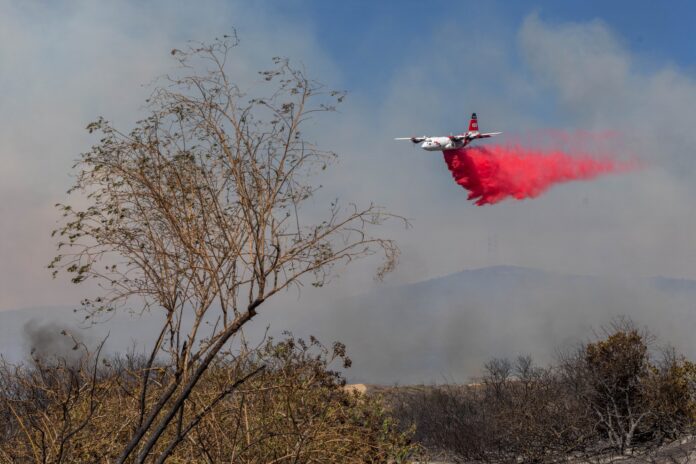
The wildfire mention is the part that connects this story to the ones running in parallel. A drying East Coast feeds the same fire-weather chain that has been thickening over the West, and it does so on shorter fuses because eastern forests are not built around adaptation to long dry seasons. The Pine Barrens of New Jersey, the longleaf systems of the Carolinas, the hardwood basins of the Mid-Atlantic, were all evolved against a baseline of regular summer rain. That baseline has thinned in the data for at least a decade. This year it has thinned in the maps.
What climate science can and cannot say about a single drought is, by now, a familiar caveat. No specific dry month is the climate signal; the signal is in the trend, and the trend, an international team of scientists confirmed this week at 1.37 degrees Celsius of human-caused warming, is unambiguous. Warmer air pulls water from soil faster, the snow that used to feed Appalachian headwaters arrives less reliably, and the periods between rain events stretch. The Mid-Atlantic’s recent precipitation graphs look less like noise around a steady line and more like a slope.
The economic mechanism is what makes this kind of drought slower to register politically than a Western one. Eastern utilities can usually buy their way out of short shortages, by paying for emergency interconnections, by running treatment plants harder, by drawing from the next basin over. The bills land on residential customers months later, often as small line items that are hard to attribute to the cause. The effect is that the cost of a drought arrives without a single visible moment of crisis, which makes the politics of preparation harder.
The agricultural picture is less forgiving. Soybean and corn fields across the Piedmont have begun to show signs of moisture stress earlier than usual, and the Virginia Cooperative Extension has issued guidance that is not formally an emergency but reads like one. Mountain West states already have the institutions and the muscle memory for this; Eastern states are improvising, county by county, in a regulatory vocabulary they have not had to use much before.
The honest unknown is the trajectory. A few storms in the next two weeks could pull the worst counties back from Tier 3, and there is no shortage of forecasters expecting some weather pattern shift later in the month. A few more weeks like the last six, and the question shifts from whether Connecticut activates Stage 3 to whether Virginia’s emergency designation moves from possibility to fact. The figure the state’s drought office is watching is the inch-and-a-quarter of rainfall a week that the summer would need to begin recovery. That is roughly twice what the May rain gauges have been delivering.
What the maps describe and the bulletins enforce is the same trend the climate scientists have been writing about for two decades: that the line between the dry country and the wet country runs east of where it used to. The line moves slowly. The restrictions, this week, do not.