SANTA FE — The number that matters is 142,000. That is how many additional acres of New Mexico forest were marked dead from insects in 2025 compared with 2024, the year a survey of 14 million acres of trees took shape from the windows of small aircraft circling slow over the Sangre de Cristos, the Jemez and the high country of the Gila. By the time the planes landed, the state had buried three times as much tree as it had a year earlier.
The figures come from the 2025 Forest Health Conditions Report, published Friday by the New Mexico Forestry Division and the US Forest Service. They are not the language of catastrophe; they are the language of mapping. Beetle-killed conifer forest rose 211 percent, mostly on national forest lands. Acres impacted by drought and heat stress rose 66 percent. Defoliation, the temporary stripping of leaves that trees can recover from, fell 51 percent. The trees that lost their needles last year did not lose them this year because they died first.
The biology under those numbers is straightforward, and it explains why a regional ecological event arrives with such precision. Bark beetles, mostly western pine beetle and Ips engraver species in this geography, have always been part of the system. Cold winters kill the overwintering larvae and broods, dense forests offer too much competition, and the balance has held for centuries. Warmer winters change the equation. A January that no longer dips low enough for long enough fails to kill the broods, so the next summer’s beetle generation arrives larger, and the summer after that larger still. The compounding is exponential and the threshold the state has just crossed appears to be the one where the math becomes visible from the air.
Victor Lucero, who runs the state’s forest health program and personally flies many of the surveys, framed the ecology directly. Bark beetles are a natural check on forest density, he said, but warm winter temperatures are extending their activity. The other side of that sentence is that the trees the beetles are killing were already weakened. Drought-stressed conifers cannot mount the resin defense that drives beetles out of the trunk; the dryness disarms them before the insects arrive. Two stresses, one outcome.
Laura McCarthy, the state forester, offered the customary caveat about a single year of data. The report, she said, is a snapshot of New Mexico’s forests at a specific time, a piece of statistical hygiene that does not change what the snapshot shows. The 2024 report had described a doubling. The 2025 report describes a tripling against the doubled baseline. That is not the noise of weather; it is the shape of a system reaching for a new equilibrium none of the species evolved to occupy.
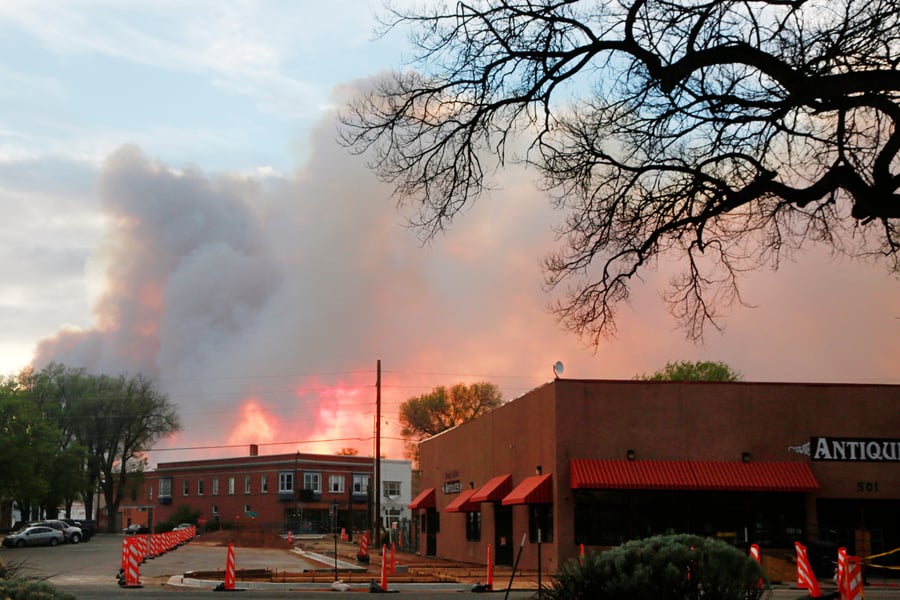
The pinon-juniper woodlands that cover much of the state’s lower elevations are the most exposed. Early in the 2000s a single drought-and-beetle event killed roughly 80 percent of pinon pines in some parts of the Southwest, the largest documented tree mortality event in the American West in modern times. The 2025 survey shows the conditions for that kind of pulse re-converging, with the additional element that nothing about the climate in the intervening twenty years has rebuilt resilience. The same forests, now thinner and hotter, are absorbing the next round.
What makes the loss carry beyond the trees is the chain it feeds. Standing dead conifers shed needles slowly and bark fast, raising the load of fine and heavy fuels on the forest floor. New Mexico is heading into the same Western fire season the Senate Energy Committee spent Wednesday handing the timber industry, having voted out a wildfire bill that would repeal the 2001 Roadless Rule and open 60 million acres of roadless national forest to logging while the agency that produces the research that guides fire response shutters more than half its facilities. Whether the fuels that the beetles built this year ignite is, in part, a coin flip on weather. The dice are loaded.
The water story is the other half. A drought that has spread across the East Coast this week began in the Southwest decades earlier and never really lifted. New Mexico is the wettest piece of an arid system, dependent on snowpack in the Sangre de Cristos for the Rio Grande’s flow, and the snowpack has been thinning along with the forests. Dead trees do not transpire, but they also do not hold soil. The hydrologic services of a forest, capturing precipitation, releasing it slowly to streams, regulating temperature near the ground, do not transfer to the standing skeletons that replace it.
Forest managers have one tool that the report flags explicitly, and it is mechanical thinning. Forests across the state are carrying densities that exceed the land’s carrying capacity, in the report’s language, the legacy of a century of fire suppression that allowed trees to crowd in where regular low-intensity burns used to space them out. Thinning, then carefully reintroducing fire, can restore some resilience. The Forestry Division’s photographs, taken from the air, show the difference: red death across untreated pinon-juniper, far less of it across landscapes that have been thinned. The tool works. The acreage to apply it across is vast.
What climate change cannot be made to do, the agencies’ careful language acknowledges, is bring back the winters. The report does not predict that the trend will reverse; it only documents that it has accelerated. A warmer winter from now is the winter trees will keep meeting, and the beetles that survive it are the next generation. An international team of scientists put human-caused warming at 1.37 degrees Celsius this week, with the carbon budget for 1.5 degrees running out around 2030. The forests in New Mexico are responding to the atmosphere they have, not the one anyone hopes to negotiate.
The honest reporting gap is what the figures will look like at this time next year. A wet winter could blunt some of the beetle pressure; a dry one will multiply it. The Forestry Division will fly the surveys again in the spring, and the planes will map whatever the trees have done. There is a quiet implication in that schedule. The forest health report does not chart projections, it charts the past. The number this week, 142,000 acres added to the dead, is what 2025 already finished writing.