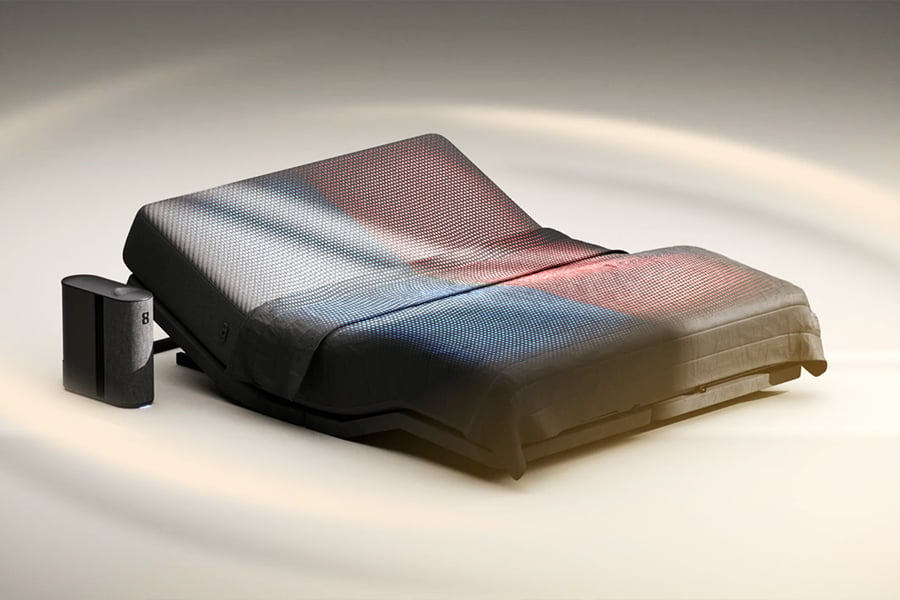

NEW YORK – At some point in the middle of the night, the bed knows before you do. Your heart rate ticked up two hours ago. Your breathing slowed. The water circulating under the cover cooled by two degrees without you asking. By morning, a report is waiting on your phone, timestamped and clinical-looking, charting what your body did while you were unconscious.
This is Eight Sleep’s sales pitch – and increasingly, its medical ambition. The New York-based company, which sells the Pod, a temperature-regulating sensor-embedded cover that transforms any mattress into a data-gathering platform, reached a $1.5 billion valuation in March 2026 after closing a $50 million strategic round led by Tether Investments. The capital, the company said, would fund not just product development but clinical trials and a push for U.S. Food and Drug Administration clearance for sleep apnea detection and mitigation. The bed, in other words, wants to become a diagnostic device.
Whether that ambition is visionary or premature depends almost entirely on who you ask – and how much you spent on your mattress.
The sleep technology market is not a niche. Fitt Insider estimated the broader sector at $21 billion globally, with smart mattresses alone representing $1.8 billion of that. Eight Sleep, founded in 2014, has sold more than $500 million worth of its Pod covers since launching the product in 2019 and expanded into 34 countries. The company says it has now processed over one billion hours of recorded sleep data – a dataset with no precise equivalent in consumer health technology. What makes Eight Sleep structurally different from wearables like the Oura Ring or the Apple Watch, which are also chasing sleep apnea detection, is the absence of anything on the body. The Pod cover uses ballistocardiography – measuring micro-movements produced by each heartbeat and breath through embedded sensors in the fabric – to track heart rate, respiratory rate, heart rate variability, and sleep stages. The company claims its heart rate tracking matches clinical-grade ECG accuracy at 99 percent precision. That claim, like most in consumer health, awaits independent confirmation.
Matteo Franceschetti, Eight Sleep’s chief executive and co-founder, has been articulate about the direction. “Healthcare today is fundamentally reactive,” he told Longevity Technology in March. “You feel something, you go to a doctor, you get a diagnosis. We are building the opposite: a platform that moves from observation to prediction to prevention, all without the user doing anything differently.” The marketing, in other words, is not really about sleep anymore. It is about the hours you spend unconscious as the most underutilized window into your health – and Eight Sleep’s argument is that it has built the only sensor capable of looking through it without requiring you to strap anything to your wrist.
The product line now includes the Pod 5, launched in May 2025, which added “Health Check” – an AI-powered suite of algorithms that surfaces cardiovascular and respiratory anomalies in a morning report – alongside temperature regulation, elevation adjustment, snore detection, and a pregnancy mode added this spring. The Pod 5 Ultra starts at roughly $5,000 before the mandatory subscription, which runs between $17 and $33 a month and unlocks the full Autopilot AI feature set. That pricing structure has become its own conversation.
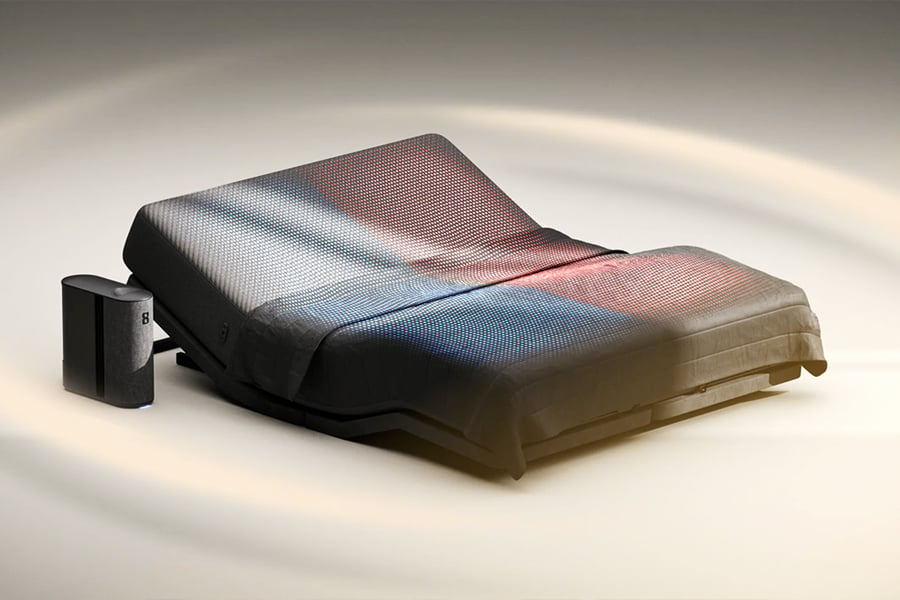
The subscription model has attracted sustained criticism that the company has not fully answered. When an Amazon Web Services outage struck in October 2025, Eight Sleep beds across the country behaved in ways their owners had not programmed. Some overheated, pushing temperatures toward 110 degrees Fahrenheit. Others became stuck in elevated incline positions in the middle of the night. Users on Reddit described waking drenched in sweat, unable to manually override settings because the app required cloud connectivity to function. PCWorld reported that even the physical side buttons on Pod 5 units failed to respond without a server connection. A product costing more than most people’s monthly rent had become, temporarily, an expensive heated slab.
Franceschetti moved quickly. He acknowledged the dependency on AWS publicly and announced “Backup Mode” within days – a Bluetooth-based fallback that allows critical temperature functions to operate when cloud infrastructure is unavailable. Whether the fix resolves the underlying architecture problem is a different question. The Pod’s AI features – the Autopilot adjustments, the health monitoring, the predictive temperature shifts – are not running on the hub sitting next to your nightstand. They run on Eight Sleep’s servers. The bed does not think for itself. It waits for instructions.
That distinction matters more as the company positions itself for clinical territory. Eight Sleep has filed for FDA Class II clearance for sleep apnea detection and mitigation. Until that clearance arrives, the company cannot legally characterize the Pod as a medical device or make specific diagnostic health claims – only wellness and lifestyle statements. The peer-reviewed studies it has published, including work on menopausal hot flash reduction and circadian rhythm effects, are described by independent analysts as promising but narrow. They establish signals. They do not yet establish the kind of clinical evidence base the FDA requires for Class II clearance, a process that involves rigorous comparative testing against validated medical standards.
This gap between what the marketing suggests and what the regulatory framework permits is not unique to Eight Sleep. The entire consumer health-tech sector operates in it. Apple spent years refining its atrial fibrillation detection before receiving FDA clearance; the Apple Watch’s sleep apnea alert feature went through a comparable process. The Oura Ring’s blood pressure and apnea roadmap faces the same regulatory timeline. Eight Sleep’s argument is that no-wearable biometric monitoring at scale – the billion hours of sleep data – gives it a training set that wrist-based devices simply cannot match. The counterargument is that correlation at scale is not the same as clinical accuracy on an individual.
The investors do not seem troubled by the timeline. Beyond Tether, the August 2025 round drew HSG, Valor Equity Partners, Founders Fund, and Y Combinator, along with Formula One figures including Zak Brown, the McLaren CEO, and Charles Leclerc. The sleep-optimization thesis has become a proxy for longevity investing more broadly: the idea that sleep is the highest-leverage intervention available to most people, that it affects cardiovascular health, metabolic function, hormonal regulation, and cognitive performance, and that whoever owns the sensor capturing it owns something genuinely valuable. Eight Sleep’s bet is that the sensor is the bed itself.
What the company has not answered cleanly is the data question. The Pod is a continuous passive monitor sitting in the most private room in the home. It records heart rate, breathing patterns, sleep stage durations, and body movement – every night, for every user, transmitted to Eight Sleep’s servers. What happens to that data if Eight Sleep is acquired, runs into financial difficulty, or changes its privacy terms is not currently guaranteed by any regulatory framework. Fitness and wellness data do not carry the same protections as health records under HIPAA. That may change if FDA clearance is granted, but the clearance itself would cover a specific diagnostic function, not the totality of the biometric stream the Pod produces.
These are not objections to the product. By most accounts, including from users who paid full price and kept the subscription, the temperature regulation works, the sleep scores are consistent, and waking up to a detailed overnight biometric summary is meaningfully different from the nothing most people had before. The challenge of interpreting the data accurately is real regardless of the hardware; most people misread what heart rate variability numbers mean, and a more detailed morning report does not automatically produce better health decisions.
What is harder to answer is the structural question the bed now poses every night: how much continuous biological surveillance is worth the quality of sleep it promises to improve, and who controls the intelligence once you have given it a year of your unconscious hours to learn from. Eight Sleep’s FDA filing is, in one reading, a regulatory bid to legitimize a medical claim. In another, it is the moment when the bedroom becomes a clinical environment – and the terms of that relationship have not yet been written.