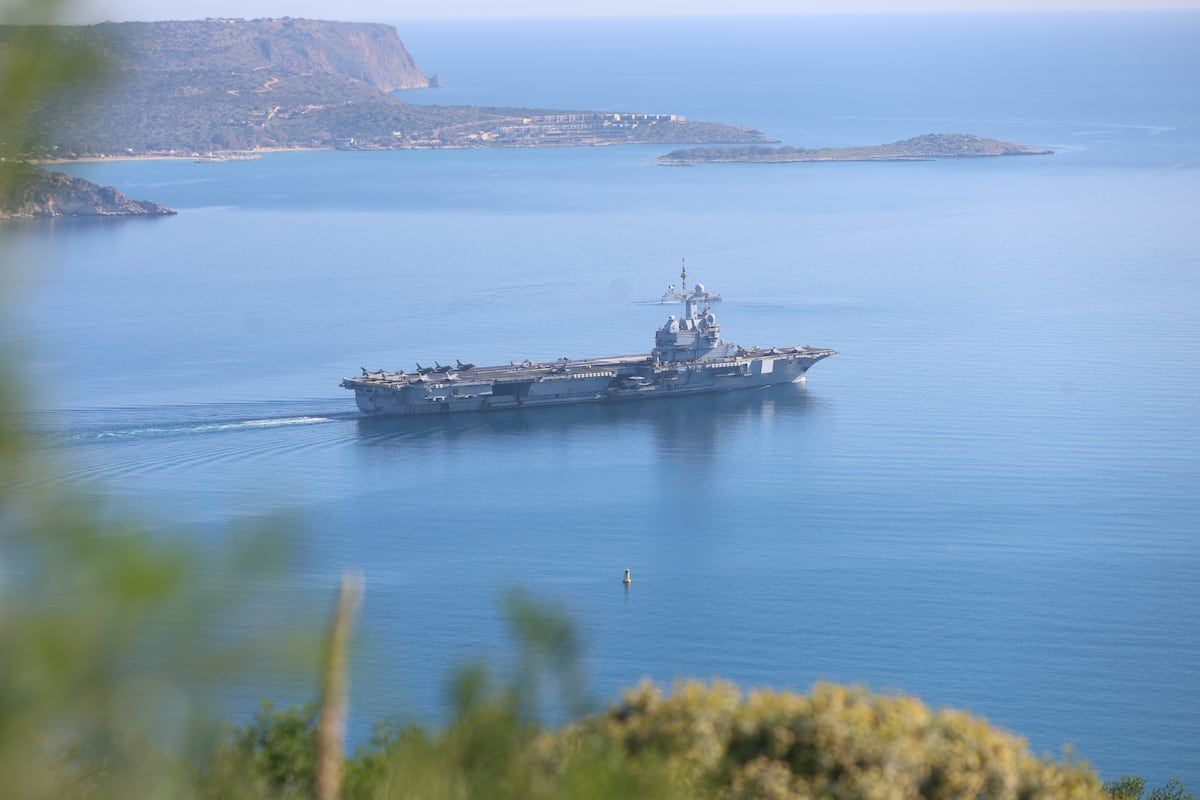

PARIS – The nuclear-powered aircraft carrier Charles de Gaulle will leave the Arabian Sea within days and sail home to Toulon for scheduled maintenance, France’s BFMTV reported Saturday, citing a military source – a rotation that removes Paris’s most visible military asset from the Middle East at one of the most diplomatically delicate moments of the Iran war.
The repairs, planned months before the carrier’s deployment to the eastern Mediterranean in early March, were approved before the Charles de Gaulle ever left Toulon on January 27. That calendar commitment has now come due, and France cannot delay it without putting the ship’s long-term readiness at risk. Work is scheduled to begin in early July. In the meantime, a Mistral-class helicopter carrier will replace the strike group in the region, along with a new air-defense frigate rotating in to relieve the one currently accompanying the carrier group.
The Mistral is a fundamentally different kind of ship – a 21,000-tonne amphibious assault vessel built for helicopters and ground operations, not the fixed-wing Rafale jets that give the Charles de Gaulle its deep-strike and air-superiority capability. The switch amounts to a meaningful reduction in French combat power in the Arabian Sea, even if Paris insists its military presence in the region will continue uninterrupted.
The rotation lands at an awkward moment. France and Britain have spent the last three months assembling a multinational coalition – ultimately involving more than 40 countries – to design a defensive mission that would reopen the Strait of Hormuz once the hottest phase of the Iran conflict subsides. The Charles de Gaulle arrived in the Arabian Sea on May 15, when Defense News reported French Minister Delegate for the Armed Forces Alice Rufo describing France’s positioning on BFM TV as a way to assess the situation and weigh in on the diplomatic equation. With the carrier now heading home, that equation shifts.
Paris has been scrupulous in distinguishing its posture from that of the United States and Israel. France was not party to the strikes on Iran that began February 28, killing more than 3,000 people, and has consistently described any future Hormuz operation as strictly defensive and in accordance with international law. Macron made that point personally when he boarded the Charles de Gaulle off Cyprus on March 9, presenting the deployment as resolve without direct involvement in the conflict. The ceasefire between Washington and Tehran announced April 8 is formally still in effect, though both sides have since exchanged isolated strikes, with the United States framing its attacks as enforcement of a naval blockade and Iran threatening retaliation.
The carrier transit over the coming days closes a chapter that began when Macron pulled the ship out of NATO Baltic exercises on March 1 after Iranian drones struck the British Royal Air Force base at Akrotiri in Cyprus. The Charles de Gaulle covered roughly 7,000 kilometers in six days to reach the eastern Mediterranean, a deployment Macron described at the time as unprecedented. It then transited the Suez Canal on May 6 and stopped in Djibouti before pushing into the Arabian Sea.
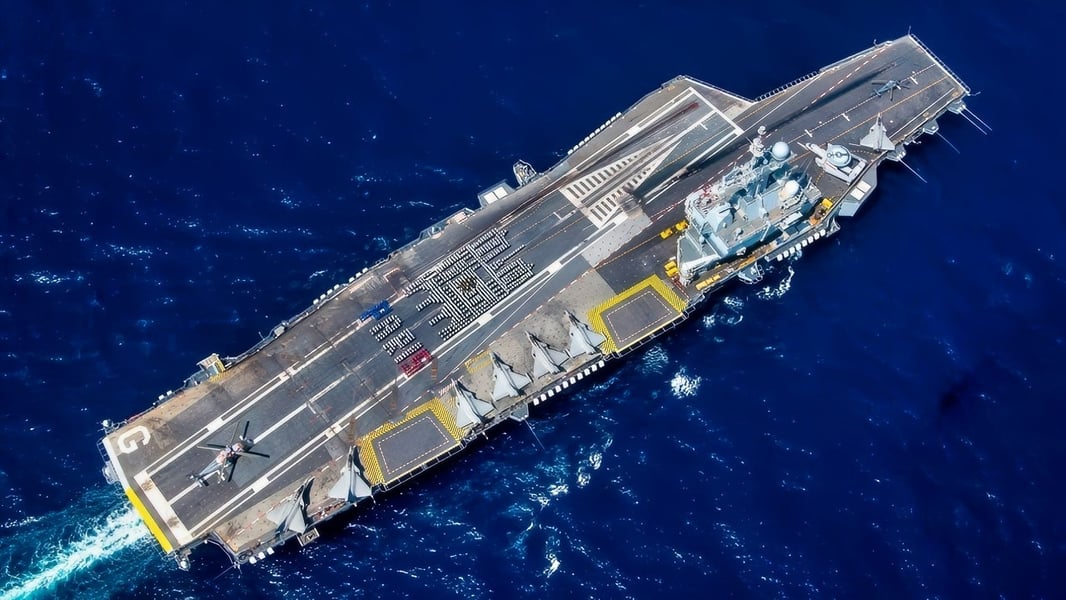
The question hanging over the replacement mission is whether the Mistral can credibly hold France’s seat at the table in coalition negotiations. The Charles de Gaulle‘s Rafale jets and E-2C Hawkeye airborne early-warning aircraft gave Paris genuine air-superiority and surveillance capability in the region – the kind of assets that give coalition partners a reason to take French military planning seriously. A helicopter carrier without fixed-wing jets is a different conversation, and French diplomats will need to work harder to maintain the standing the carrier provided almost automatically.
France is the only country aside from the United States to operate a nuclear-powered aircraft carrier with catapult launch systems, a distinction that has given the Charles de Gaulle an outsized political weight relative to France’s broader military budget. The ship’s absence from the Arabian Sea does not end French engagement in the Hormuz initiative – the carrier was never operating inside the strait itself – but it narrows Paris’s leverage at a moment when negotiations between Tehran and Washington remain unresolved, and when the two sides are still trading strikes beneath the formal ceasefire.
The EU imposed its first-ever sanctions on Iran over freedom of navigation in the strait earlier this month, a measure France supported as part of a broader European effort to maintain pressure on Tehran without direct military engagement. That diplomatic track continues regardless of which French hull is anchored in the Gulf of Oman, but the symbolism of the carrier’s departure will not be lost on Tehran or on the coalition partners France has spent months courting. Reuters reported in March that France had approached 35 countries about joining a future Hormuz mission.
What happens after the Toulon maintenance period is the question Paris has not yet answered publicly. The Charles de Gaulle is scheduled to retire in 2038, replaced by the France Libre – a 78,000-tonne carrier formally approved by Macron in December 2025 and named for the wartime Free French government-in-exile. Until then, France has one nuclear carrier, one set of political commitments, and a maintenance schedule that does not pause for geopolitics.