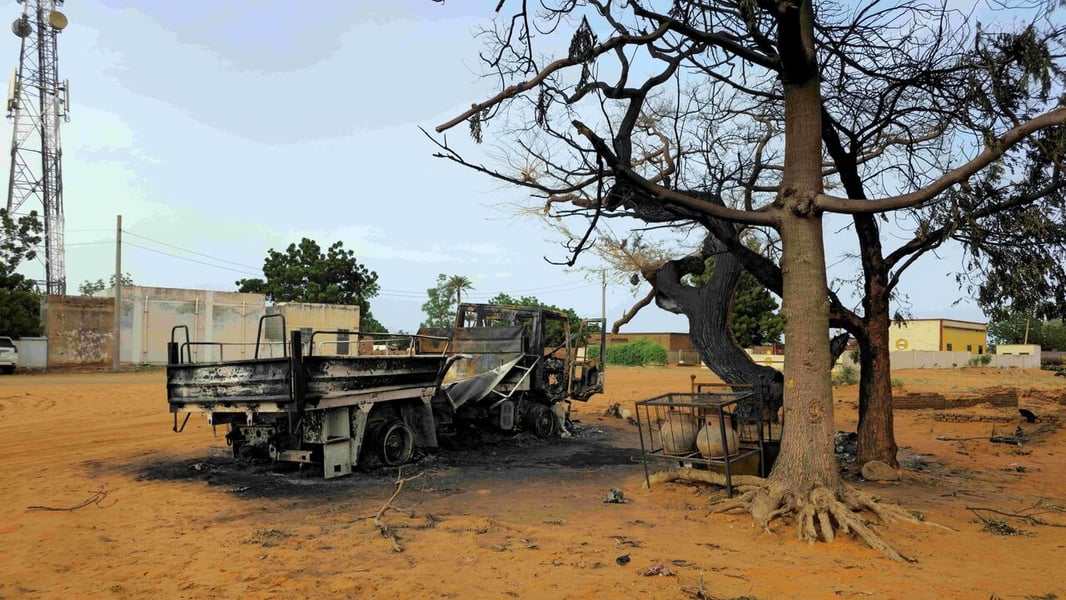

EL OBEID, NORTH KORDOFAN — At least twenty-three civilians were killed and nineteen injured in El Obeid, the capital of Sudan’s North Kordofan state and the principal Sudanese Armed Forces (SAF) garrison city in the Kordofan campaign theatre, on Wednesday and Thursday, in a sequence of Rapid Support Forces (RSF) drone strikes that began with a daytime hit on the Al-Muwazzafin neighbourhood near the city’s main mosque and which culminated, in the late Wednesday evening, in what the war-crimes-monitoring civilian-protection literature names as a ‘double-tap’ — a second drone strike on the funeral cortege that had gathered to bury the daytime victims. The Sudanese Emergency Lawyers (Muḥāmūna al-Ṭawāri’) volunteer-civil-society organisation, which has been documenting Sudan war-period civilian casualties since the April 2023 outbreak, attributed the strikes to the RSF in its Thursday-evening statement; Al Jazeera reported the casualty figures from Khartoum on Thursday morning. The RSF has not, on the published Saturday-morning Khartoum diplomatic-press readings, claimed the strikes.
The Friday-Saturday cross-Sudan strike sequence, on the Saturday-morning Sudanese Emergency Lawyers and Sudan Doctors’ Trade Union aggregated tally, killed at least thirty civilians and five soldiers across El Obeid, the Delling area of South Kordofan, Khartoum North, and Omdurman. The Delling South Kordofan strike, which killed the five Sudanese Armed Forces soldiers at a roadside-checkpoint position on the Kadugli-Delling road, is the second-deadliest SAF-personnel-targeting strike since the November 2025 RSF drone campaign began. The Saturday-morning Khartoum North strike on the Bahri industrial district hit a SAF logistics warehouse, on the Sudanese Emergency Lawyers’ published Saturday-afternoon report, killing four civilians; the Omdurman strike on the same Saturday morning hit a residential area in the southern Salha neighbourhood, killing one civilian. The aggregate forty-eight-hour Friday-Saturday civilian-and-military death toll is the highest since the November 2025 spike that preceded the Pekka Haavisto UN Personal Envoy’s first visit to Khartoum.
The El Obeid double-tap pattern, in which the second strike targets the rescue-and-mourning gathering of the first strike’s victims and which the international-humanitarian-law literature has named the most legally distinctive war-crime pattern of the post-2010 drone-warfare era, is the operational signature the RSF has been deploying with increasing frequency across the Kordofan campaign. The June 11 El Obeid sequence — the 11:42 AM Wednesday daytime strike on Al-Muwazzafin that killed five and wounded twelve; the 8:14 PM Wednesday evening strike on the funeral procession at the Al-Andalus cemetery on the city’s eastern edge that killed four and wounded seven; the Thursday-morning strike on the Al-Matar (Airport) neighbourhood that killed seven and wounded the remainder — followed the same temporal-and-spatial pattern as the November 2025 El Fasher and the February 2026 Delling strikes that the United Nations Independent International Fact-Finding Mission for the Sudan has been investigating since their February 2026 statutory finding of RSF genocide against the Fur, Masalit, and Zaghawa.
The Sudanese Armed Forces’ Saturday-afternoon military-operations statement, which SAF Commander-in-Chief and Sovereignty Council chairman General Abdel Fattah al-Burhan‘s office released through the SAF press office at 4:30 PM Khartoum time, described the El Obeid sequence as ‘a deliberate war-crime escalation’ and committed to ‘all necessary defensive measures.’ The SAF’s operational response, on the Sovereignty Council’s published Saturday-afternoon brief, has been the deployment of the SAF’s General Intelligence Service air-defence battery that was previously stationed at Wad Madani to the El Obeid south-eastern perimeter, in an operational positioning that the SAF press office named as ‘protecting the displaced civilian population concentrated at the central El Obeid IDP camps.’ The Sudan Doctors’ Trade Union, on its Saturday-morning published statement, has called for the international community to apply ‘unprecedented pressure’ on the RSF and on the United Arab Emirates and Russia, the RSF’s principal external supporters.

The United Nations Personal Envoy for Sudan, the former Finnish Foreign Minister Pekka Haavisto, who assumed the personal envoy role in March 2026 and who concluded his second Khartoum visit on June 7 with the meeting at the Sovereignty Council headquarters with al-Burhan, has not yet, on Saturday-evening published statements, formally addressed the El Obeid strikes. The Haavisto Saturday-evening statement, which the Personal Envoy’s office in Geneva is expected to issue, will, on UN press-office Saturday-afternoon briefings, name the El Obeid strikes ‘a continuation of the operational pattern of indiscriminate attacks against civilian populations that constitutes a violation of international humanitarian law.’ The UN Office for the Coordination of Humanitarian Affairs’ Saturday-morning Sudan situation report, on the IDP-population-figures aggregated through Friday evening, places the El Obeid IDP population at approximately three hundred and twenty thousand — the second-largest IDP concentration in SAF-controlled Sudan after the Wad Madani camp.
The wider international diplomatic implications the El Obeid strikes carry into the next forty-eight hours are the part the international-press editorial commentary has been most actively writing about Saturday afternoon. The G7 Évian Summit opens Sunday afternoon at the Royal Palace Hotel on Lake Geneva, and the Sudan dossier — which Canadian Prime Minister Mark Carney has been positioning as a Sunday-evening leaders’ working-session agenda item and which India’s Prime Minister Narendra Modi’s Tuesday-and-Wednesday Global South representation brief will reportedly elevate — is now formally on the summit-leaders’ political-cycle agenda. The Saudi-Crown-Prince-and-United-Arab-Emirates Iran-and-Hormuz G7 Évian Arab-leaders-session calendar item that MBS declined Thursday sits structurally adjacent to the Sudan dossier: the UAE’s published support for the RSF, which the UAE foreign ministry has consistently denied but which the United Nations Panel of Experts on Sudan has documented in its three published reports since 2023, makes the Sudan-and-MBS-G7-Évian-Arab-leaders’-session positioning the same diplomatic calculus.
The Kordofan-region strategic context the El Obeid strikes operationally extend is the part the regional-security-analysis community has been most attentive to. Kordofan, which sits across the central-Sudan trapezoid between the Darfur RSF stronghold to the west, the Khartoum-and-central-corridor SAF zone to the north-east, the Blue Nile region to the south-east, and the South Sudan international border to the south, is the operational hinge of the war’s third year. The RSF Kordofan offensive, which has produced the captures of Babanusa in February 2026 and the contested SAF-and-RSF positions at Dilling and Kadugli through April and May, has, on the published RSF positioning briefs and the SAF’s parallel-track defensive operations brief, produced an operational stalemate in which Kordofan is contested across approximately seventy percent of its territorial extent. El Obeid, the SAF-controlled North Kordofan capital, is, in this operational stalemate, the principal SAF garrison-and-administrative position. The June 11 RSF drone campaign against El Obeid is the operational extension of the strategic challenge the RSF has been mounting against the SAF Kordofan administration since the autumn 2025 escalation.
The humanitarian situation across El Obeid Saturday afternoon, on the Sudanese Red Crescent and the World Food Programme’s Saturday-morning situation reports, was, on the El Obeid Hospital director’s published statement, ‘critically over-extended.’ The El Obeid Hospital, which serves approximately one point six million people across North Kordofan and surrounding states, received the eighty-five wounded from the Wednesday-Thursday sequence; the fifteen patients in critical condition at Saturday morning will require operational transport to Khartoum-area hospitals that the El Obeid road corridors are operationally unable to provide. The Sudan Doctors’ Trade Union’s Saturday-morning published statement called the El Obeid Hospital situation ‘the closest the SAF-controlled hospital system has been to operational collapse since the November 2025 Wad Madani crisis.’ The international humanitarian-aid corridor through the Port Sudan-and-Atbara-and-Kosti SAF-supply route is now the principal route for medical-supply replenishment.
The wider 2026-and-2027 Sudan war trajectory implications are the part the international-conflict-analysis community has been most actively writing about Saturday evening. The RSF’s drone-campaign tempo, which the United Nations Office for the Coordination of Humanitarian Affairs has been tracking at approximately twelve significant strikes per month through April and May, accelerated to approximately twenty-eight significant strikes in the first thirteen days of June, on the OCHA Saturday-morning aggregated tally. The Friday-Saturday cross-Sudan strike sequence represents, in this tempo data, an approximately one-hundred-and-thirty-percent acceleration over the first-half-of-June rolling average. The Wagner-and-Russian-state-affiliated drone-operator personnel that the UN Panel of Experts on Sudan has been documenting as the operational backbone of the RSF drone programme are, on the published Panel reports, drawn from the Wagner-equivalent Africa-Corps operational personnel the Russian Federation reorganised after the August 2023 Yevgeny Prigozhin death. The Sudan war’s third anniversary on April 15, 2026 was supposed to be the diplomatic-cycle inflection point Haavisto’s appointment was designed to produce. The June 11 strikes indicate that the inflection point has not arrived.
Related Posts