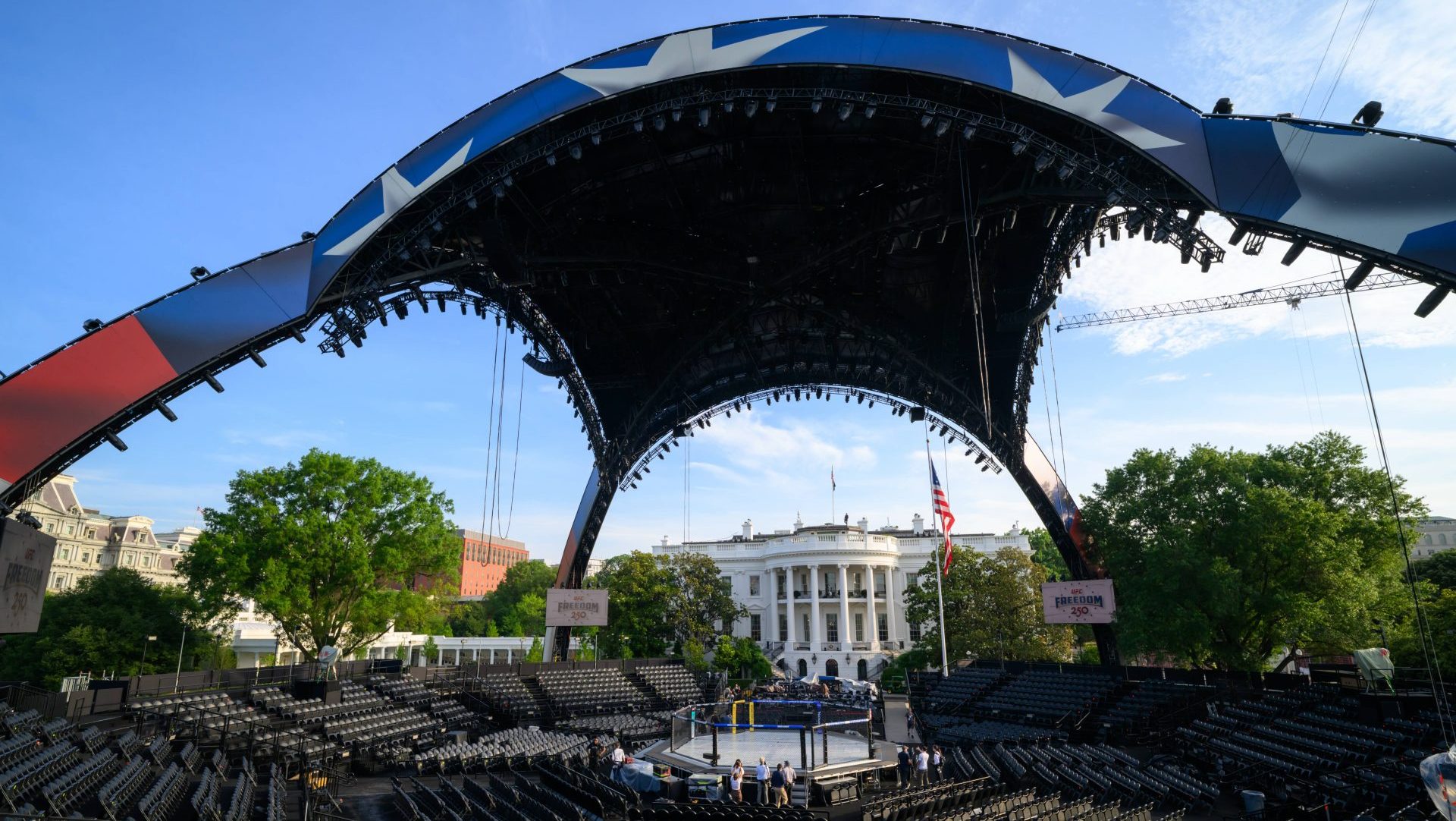

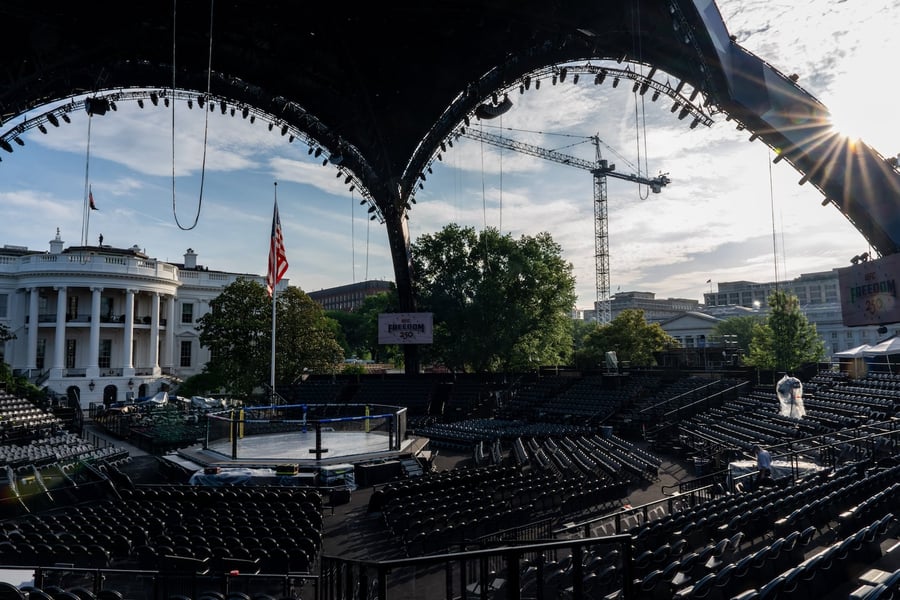
WASHINGTON – The Octagon went up on the South Lawn before most of Washington had fully processed what it meant. By the time the 92-foot steel arch known as “The Claw” was shadowing the Rose Garden on June 11, it was already too late to treat UFC Freedom 250 as merely a birthday party for a president who likes fighting. The sponsors made that clear.
Stitched along the padded bars of the cage, in the most scrutinized real estate in American sport, was the logo of Polymarket – the cryptocurrency prediction platform whose future depends almost entirely on a federal regulatory decision the Trump administration is now shepherding through the Commodity Futures Trading Commission. One sponsor. One cage. One unmistakable argument about how far gambling has traveled in eight years.
That argument did not begin with Sunday’s event. It began in May 2018, when the Supreme Court struck down the Professional and Amateur Sports Protection Act and handed each state the right to run its own sports wagering market. What followed was not a gradual cultural shift. It was a restructuring. Legal sports betting now operates in 39 states and Washington, D.C., with Americans projected to have wagered between $160 billion and $170 billion legally in 2025 alone, according to industry analysts. The U.S. online gambling market – a figure that includes sportsbooks and casino-style products – is forecast to nearly double, reaching $52.6 billion by 2033.
At some point in that expansion, the numbers stopped being a niche industry story. They became a political fact.
UFC Freedom 250 is where that fact was displayed, literally, for 85,000 people on the Ellipse and millions more watching on Paramount+. The event – officially framed as a commemoration of the United States’ 250th anniversary, timed to President Donald Trump’s 80th birthday on Flag Day – cost more than $60 million to produce, according to Front Office Sports. Its fight card was headlined by a lightweight title unification bout between the undefeated Ilia Topuria and interim champion Justin Gaethje, with an interim heavyweight championship between Alex Pereira and Ciryl Gane in the co-main event. The octagon itself sat roughly 30 feet in diameter on the South Lawn, the same patch of grass where Marine One takes off and state guests are received.
The fight was unprecedented. The sponsors were not.
Alongside Polymarket on the cage structure was Stake, a cryptocurrency gambling company the Washington Examiner noted has faced regulatory scrutiny in multiple countries because its setup is “indistinguishable from real-money gambling.” Neither sponsor’s presence came from nowhere. The Trump administration has actively backed prediction market platforms like Polymarket and Kalshi in court and regulatory proceedings, arguing their products fall under federal commodity jurisdiction rather than state gambling law. Trump-appointed CFTC Chairman Michael Selig unveiled proposed rules just days before the White House fight that would create the first formal federal framework for prediction markets – a move critics have described as deregulation by another name.
Senators John Curtis, Republican of Utah, and Adam Schiff, Democrat of California, have co-sponsored legislation to ban sports wagering on prediction market platforms, arguing the sites are “hooking people on sports- and casino-style gambling.” Kalshi and Polymarket responded by announcing anti-insider trading rules and challenging the legislative effort in court. The debate is live, unresolved, and happening simultaneously with the White House functioning as a backdrop for one of the platforms’ biggest advertising moments of the year.
Schiff was not merely focused on prediction markets when he weighed in on the broader spectacle. “Trump is building a golden ballroom and for his birthday party – arranging a UFC fight on the White House grounds – while you’re fighting to pay this month’s bills,” Schiff said on social media. “Could he be more out of touch?” TKO Group Holdings president and COO Mark Shapiro pushed back, telling an audience at the Meridian International Center on Thursday that the event was not about policy. “We’re here because we’re fortunate enough that the president of the United States has decided [to do this],” Shapiro said.
What has made the moment legible to anyone watching is that UFC itself has followed the same arc as the gambling industry. As recently as 2016, mixed martial arts was still banned in New York, one of the last states to outlaw the sport. The promotion’s rise to a $60 million presidential event in the span of a decade tracks almost exactly with the post-PASPA expansion of legal wagering – a symbiosis Dana White, UFC’s president and longtime ally of Trump’s, has never tried to obscure. The promotion is the official betting partner of bet365, one of the largest online sportsbooks operating in the United States.
The Washington Post reported Sunday that the White House event reflects how sports-related gambling has evolved into a powerful mainstream force in American life. That framing is accurate but perhaps incomplete. What UFC Freedom 250 showed is not simply that gambling has become mainstream. It showed that gambling and political power have become comfortable enough with each other to share a stage – literally – in ways that would have been unimaginable even five years ago.
The betting lines for Sunday’s card illustrated the scale of that infrastructure. Topuria entered as a heavy favorite at -550, with Gaethje priced at +400. Prediction markets run by Kalshi and Polymarket had the Georgian champion at roughly 81 percent probability to win, with the market on Alex Pereira versus Ciryl Gane sitting near even money. BetMGM reported its most-bet fight tickets were the Topuria-Gaethje and Pereira-Gane bouts, with Gaethje, Chandler, and Derrick Lewis drawing the heaviest volume on upset tickets. The legal architecture that made all of that possible – 39 states, mobile apps, in-play markets, prediction contracts – was built in less time than it took the White House to plan the event itself.
What no one seems to know yet is what this confluence means over time: whether the presence of casino-company branding on the South Lawn of the White House represents the high-water mark of gambling’s normalization in American public life, or simply the latest threshold it has crossed on the way to a higher one. California and Texas – the two largest unregulated sports betting markets in the country – have still not legalized. Eleven states remain without any legal sports wagering at all. Georgia is expected to launch a mobile market by mid-2026. The map is still expanding.
Sunday’s card – all seven fights broadcast on Paramount+ without a pay-per-view charge – drew considerable attention regardless of any policy subtext. The Topuria-Gaethje matchup had already turned personal weeks before the fight, with Topuria vowing to end Gaethje’s career after the American made remarks about the champion’s personal life at a press conference. For most of the 85,000 fans at the Ellipse, that was the whole story. The rest – the sponsorships, the regulatory battles, the prediction market rulings – played out in the legal footnotes and the cage padding, visible and largely unexamined.
That gap between what the crowd came to see and what was embedded in the walls of the octagon itself is, perhaps, the most accurate description of where gambling stands in American life right now: ubiquitous, monetized, and still not fully reckoned with.