
BOISE – The same AI memory crunch that forced Apple Inc. AAPL to raise prices on every MacBook and iPad it sells produced, on the other side of the supply chain, the most profitable quarter any memory company has ever reported.
Micron Technology Inc. MU said Wednesday that fiscal third-quarter revenue reached $41.46 billion, more than four times what the company earned in the same period a year ago and 74 percent higher than the record set just three months earlier. Adjusted earnings per share of $25.11 beat Wall Street’s estimate of $20.28 by nearly a quarter. Gross margin climbed to 84.9 percent, a figure the company had never before reached. It was Micron’s fifth consecutive quarterly record, each larger than the last, in an earnings run that has made the word “cyclical” sound like something from another era of the semiconductor business.
The results represent the clearest evidence yet that artificial intelligence data centers have not merely boosted memory chip prices; they have reset the structural floor on which the entire industry operates. Micron is no longer selling a commodity that follows supply and demand through neat quarterly turns. It is selling a strategic input for which the world’s largest technology companies are now willing to sign long-term contracts and pay prices that would have seemed implausible eighteen months ago.
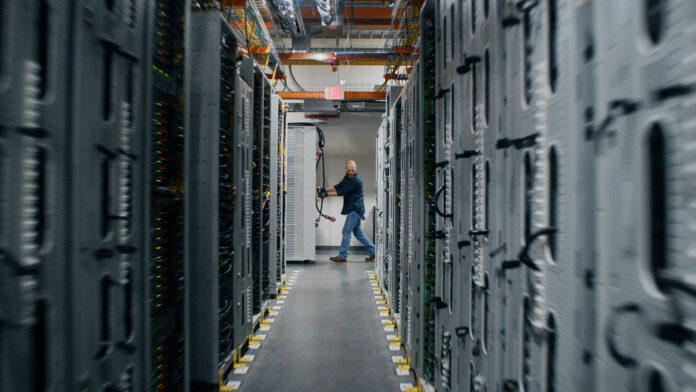
The most consequential disclosure in Wednesday’s report was not the revenue line but a figure in the prepared remarks published on Micron’s investor relations website: Micron has signed 16 strategic customer agreements carrying remaining performance obligations of approximately $100 billion. That sum represents a fundamental break from the spot-market model that has defined memory pricing for decades. Chief Executive Sanjay Mehrotra told analysts the agreements provide “multi-year visibility” into demand from cloud hyperscalers and AI infrastructure builders, a description consistent with the network of Nvidia Corp. GB200 NVL72 rack deployments spreading across data centers from Virginia to Singapore.
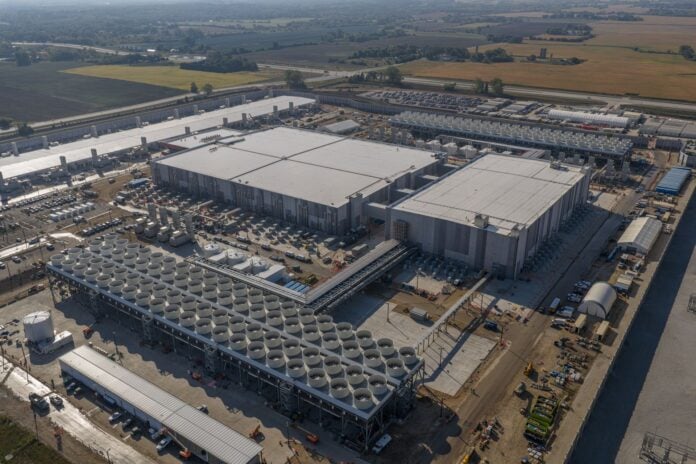
Data center revenue exceeded $25 billion in the quarter, more than half the company’s total. Solid-state drive sales more than doubled sequentially. High-bandwidth memory, the dense chip packaging required for Nvidia’s H100 and B200 graphics processors, drove a disproportionate share of the margin expansion. Mehrotra declined to break out HBM pricing per gigabyte, but Citi analysts estimated in a note published after the call that HBM average selling prices remain roughly eight to ten times the equivalent conventional DRAM, a premium that the $100 billion in contracted obligations suggests buyers have accepted as a durable feature of the market rather than a temporary condition.
For the fiscal fourth quarter, Micron guided revenue of $50 billion, plus or minus $1 billion, which would represent yet another sequential record and place the company on an annualized revenue run rate approaching $200 billion. Gross margin guidance of approximately 86 percent implies pricing power that holds through at least September. Non-GAAP earnings per share are projected at $31, plus or minus $1, a figure that would have been considered implausible for a memory company as recently as eighteen months ago.

Shares of Micron rose 13.1 percent in after-hours trading following the report, adding roughly $60 billion in market capitalization. The stock had already advanced more than 90 percent in the twelve months to Wednesday’s close, propelled by a series of quarterly beats that made each prior period’s guidance look conservative in retrospect. The after-hours move put Micron at a level that analysts surveyed by Eastern Herald ahead of the results had expected only if management raised guidance, which, as anticipated, it did substantially.
The same pricing dynamics reshaping Micron’s margins are reordering costs further down the supply chain. When Apple raised prices across its MacBook and iPad lineup on Thursday, with increases running from $100 to $500 per device, the company cited component cost pressures without specifying which components. Memory represents one of the largest variable costs in consumer hardware, and the shift of fabrication capacity toward high-margin AI products has reduced the supply available for devices priced in hundreds rather than tens of thousands of dollars, as Eastern Herald reported Thursday.
What remains unclear is how long Micron can hold margins above 80 percent. Samsung Electronics Co. and SK Hynix Inc. have both announced capacity expansions in conventional DRAM and next-generation HBM expected to come online through 2027. Mehrotra acknowledged on the call that Micron lacks “full visibility into the pace at which the industry’s supply infrastructure catches up to AI demand.” That candid phrase is rare from a chief executive in the middle of a record run. It signals that the structural argument, as compelling as it appears from the current vantage, carries a time limit whose endpoint no one in the industry has been willing to name.
The $100 billion in contracted obligations buys time, and tells markets something about how the largest AI infrastructure builders read the next two or three years of demand. Whether those contracts prove adequate depends on whether the next generation of AI models continues to require proportionally more memory or eventually learns to do more with less. Micron’s own chips, embedded in the servers running those models, will help generate the answer.