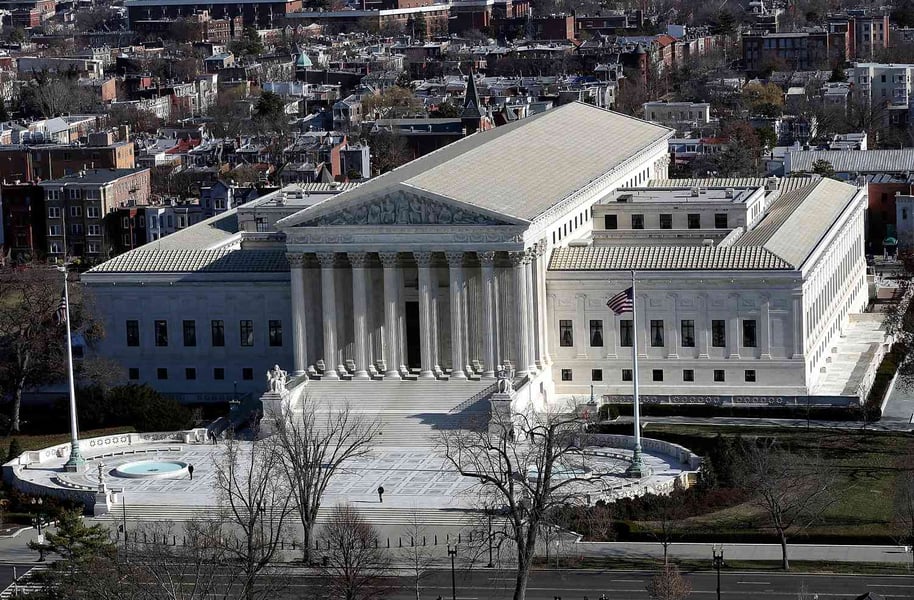

WASHINGTON — Every year, roughly 255,000 children are born in the United States to parents who are either in the country without legal status or on temporary visas. From the moment of their birth, the Constitution’s 14th Amendment has guaranteed them citizenship. On Monday, the Supreme Court ruled 6 to 3 that it still does.
In a landmark 194-page decision, the court struck down President Trump’s executive order, signed on his first day in office in January 2025, that had attempted to redefine who qualifies as a citizen at birth. Every federal judge to review the order had blocked it before it could take effect, and the justices’ ruling confirmed their assessment: the order was constitutionally untenable.
Chief Justice John Roberts wrote the majority opinion, joined by Justices Amy Coney Barrett, Elena Kagan, Sonia Sotomayor, and Ketanji Brown Jackson. Roberts held that children born in the United States to parents unlawfully or temporarily present are “subject to the jurisdiction” of the United States within the meaning of the 14th Amendment and are therefore citizens at birth. Justice Brett Kavanaugh provided a sixth vote to strike down the order but on narrower statutory grounds, declining to reach the constitutional question.
The ruling is among the most consequential immigration decisions in a generation. It preserves a principle in place since the 14th Amendment’s ratification in 1868 and reaffirmed by the Supreme Court in United States v. Wong Kim Ark in 1898. More immediately, it is a categorical defeat for one of Trump’s most legally audacious policy actions — the one he prioritized so highly he signed it within hours of taking office and attended oral argument on in person.
Anthony Romero, executive director of the American Civil Liberties Union, which brought the successful challenge on behalf of affected children, said Trump had “bet his legacy trying to secure this policy win.” “He lost,” Romero said.
The constitutional question centered on the phrase “subject to the jurisdiction thereof” in the Citizenship Clause. Trump’s order argued that children born to parents who owed primary allegiance to another country did not meet that threshold. Roberts rejected that reading directly. His 30-page opinion — notably shorter than Justice Clarence Thomas’s 91-page dissent — traced the phrase to English common law, to the framers of the 14th Amendment, and to the abolitionists who drafted it specifically to overrule Dred Scott v. Sandford, the 1857 decision that held Black people could never be American citizens. Roberts said the framers chose broad language deliberately and that the administration’s narrow interpretation could not be squared with that history.
Thomas, joined by Justice Neil Gorsuch in dissent, argued that the 14th Amendment was conceived as a race-conscious remedial measure specific to freed slaves and their descendants — and that its Citizenship Clause should be read accordingly. Justice Jackson, writing separately in concurrence, responded pointedly: despite his “longstanding endorsement of a colorblind society,” she wrote, Thomas “now surprisingly suggests” the Citizenship Clause was a race-conscious measure. Justice Samuel Alito issued a separate dissent, calling the ruling “one of the most important decisions” in Supreme Court history and “a serious mistake,” and arguing that citizenship should be limited to those who owe allegiance solely to the United States at birth.
Kavanaugh’s concurrence carries its own practical weight. Rather than reaching the 14th Amendment question, he argued the executive order violated a federal statute, 8 U.S.C. 1401(a), which codifies automatic citizenship for those born in the United States. That framing leaves a potential legislative opening: Congress could theoretically amend the statute to create new exceptions to birthright citizenship, without touching the Constitution. Whether such a move would itself survive constitutional challenge is a question the court did not answer Monday.
Trump called on Congress to act. Senators Rand Paul and Eric Schmidt introduced constitutional amendment proposals to restrict birthright citizenship; amending the Constitution would require a two-thirds supermajority in both chambers and ratification by three-quarters of states — a threshold that, given the current Senate arithmetic, would be extraordinarily difficult to reach. Senator Lindsey Graham pledged to make the issue a priority in the Senate Judiciary Committee. The birthright ruling is not the only front on which the administration has pursued a broader redefinition of American citizenship: the Justice Department has separately launched its largest-ever push to strip citizenship from naturalized Americans it argues obtained it improperly.
Al Jazeera reported the ruling as an outright victory for immigrant communities, noting that the constitutional guarantee now extends to the children of the nearly four million undocumented immigrants currently living in the United States. The Washington Post described the decision as completing the legal demolition of Trump’s first-day immigration agenda — the order never went into effect, and Monday’s ruling ensures it cannot.
What the court did not settle is whether Kavanaugh’s statutory opening represents a genuine legislative option or a constitutional dead end. Roberts’ majority explicitly declined to address whether Congress could restrict birthright citizenship by statute rather than amendment. That unresolved question — and not the executive order that is now definitively off the table — may define the next phase of the birthright citizenship debate in Washington, one that arrives alongside a string of other sweeping immigration rulings from the same court term that have reshaped the legal landscape for millions of people.