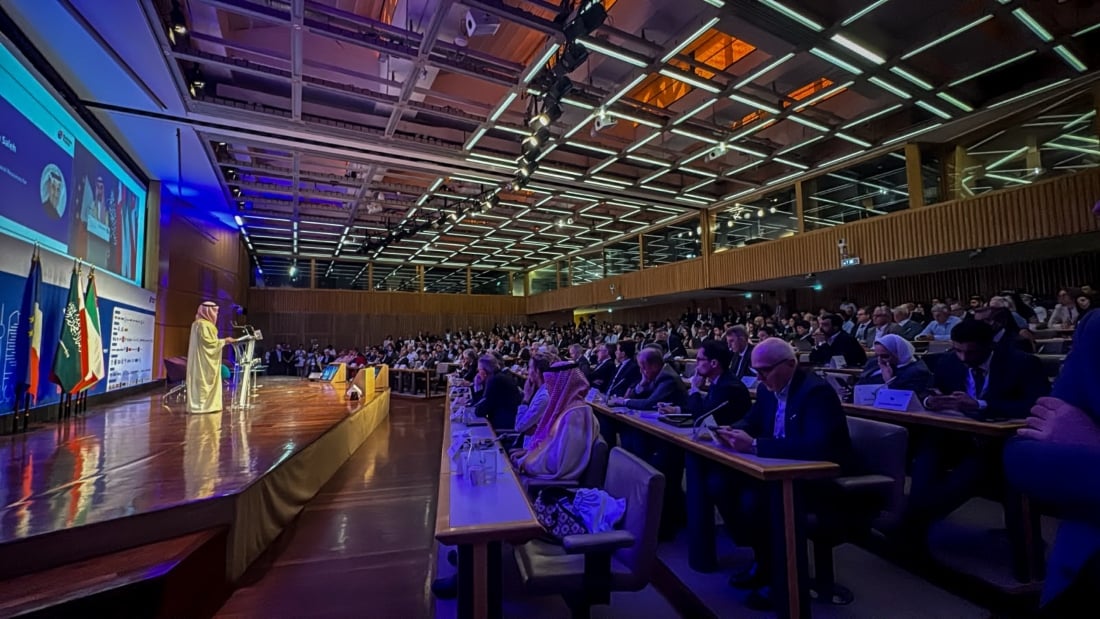

PARIS – Thirty French companies now list Riyadh as the address of their Gulf headquarters. Not a planned relocation or a letter of intent – an actual address, with staff, filing obligations, and a commitment that is expensive to walk back. That number, disclosed Thursday at Vision Golfe, Paris’s annual conference bridging the Gulf and European business communities, is the detail behind the headline: France’s economic relationship with Saudi Arabia has changed character over three years, not just scale.
Sultan Al-Musallam, secretary-general of the Federation of Saudi Chambers, told the forum that bilateral trade between the two countries reached $12 billion in 2025, a 7.8 percent increase year on year. French investment in the kingdom, he said, nearly tripled over that period, climbing from SR7 billion to SR19 billion – approximately $5.06 billion at current exchange rates. The figures were presented to MEDEF, France’s employers’ federation, and representatives of the French chambers of commerce in what was framed as a progress report on a relationship that has moved well beyond traditional Gulf-France commercial patterns.
The sector breakdown tells the story more precisely than the aggregate investment figure. The areas Al-Musallam highlighted – MICE (meetings, incentives, conferences, exhibitions), tourism, culture, and the creative economy – are not where France has traditionally made its Gulf pitch. Oil contracts, defense procurement, and infrastructure projects have historically dominated. What Thursday’s forum reflected is a different calculation: French companies that make money from events, hospitality, and cultural infrastructure see a demand horizon in Saudi Arabia that is clear enough to justify moving their regional administration there.
Accor, the hotel group with the largest French footprint in the kingdom, is among the companies deepening that commitment. The group is actively recruiting Saudi nationals into management positions – the kind of staffing decision that signals a long operational horizon rather than a contract-term presence. The approximately 500 French companies operating across Saudi Arabia collectively employ around 16,000 French expatriates, a resident community large enough to reduce the perceived cost of posting additional executives there and to support further corporate expansion through professional services networks that already exist on the ground.
Saudi Arabia’s eight UNESCO World Heritage sites, inscribed over the past decade, are part of the case French companies are reading. So is the schedule ahead. The FIFA World Cup 2026, for which Saudi Arabia is a co-host, and Expo 2030 in Riyadh create a compressed sequence of global demand events requiring hospitality capacity, event management expertise, and creative production at scale – areas where French companies have a credible claim to regional leadership. That pipeline is not speculative; it has start dates and guest lists.
The broader Saudi economic transformation provides the structural context. Vision 2030 sets a target of 65 percent private-sector contribution to GDP by the end of the decade, up from the current 52 percent. Reaching that level means the kingdom needs foreign private investment not in addition to state-led development but increasingly instead of it, in sectors ranging from entertainment to hospitality to financial services. Saudi Arabia this week also advanced its commodities exchange framework, adding metals and mining to the list of sectors being opened to structured private and international participation – a pattern suggesting the push toward diversification is running across multiple verticals simultaneously.
French companies are entering an economy in mid-transformation, not at its beginning or end. That is a different risk calculation than the one that applied in 2020, when Vision 2030 was still largely a planning document. The 30 headquarters relocations to Riyadh are a private-sector verdict on whether the transformation is real enough to stake an operational address on. So far, the answer appears to be yes.
What the Vision Golfe figures do not resolve is the governance dimension behind them. How much of the investment surge reflects purely private-sector calculations, and how much has been shaped by the Macron government’s sustained positioning of France as Saudi Arabia’s preferred European interlocutor – a posture Paris has maintained across arms sales, nuclear cooperation discussions, and repeated diplomatic contact at head-of-state level – is not answered by the bilateral trade figure alone. Both forces are probably operating simultaneously, and the distinction matters for understanding whether the relationship is structurally durable or tied to the current French political cycle.
Saudi Aramco’s crude export volumes through the first half of 2026 have provided the fiscal headroom that Vision 2030’s private-sector expansion requires. The oil revenues are not an alternative to the transformation – they are financing it. That dependency is the structural uncertainty French companies are accepting when they make Riyadh an operational headquarters rather than a project office: the transformation has to keep going, and the funding for it has to hold.
Al-Musallam’s presentation to MEDEF was direct on one point: Vision 2030 has years to run, and the 65 percent private-sector GDP target will not be reached through Saudi capital alone. The conference in Paris was not a status report – it was a recruitment drive. His figures were the opening case; what happens with the companies that were in the room and have not yet committed is the question the Vision Golfe forum was designed to accelerate.
What the numbers do not answer is where the ceiling is. SR19 billion arrived in a three-year window, from an SR7 billion base, without a specific infrastructure megaproject or a single flagship deal driving it. Whether the pace holds, slows, or accelerates into the Expo 2030 run-up is the open question – and one the federation’s figures, by themselves, cannot close.