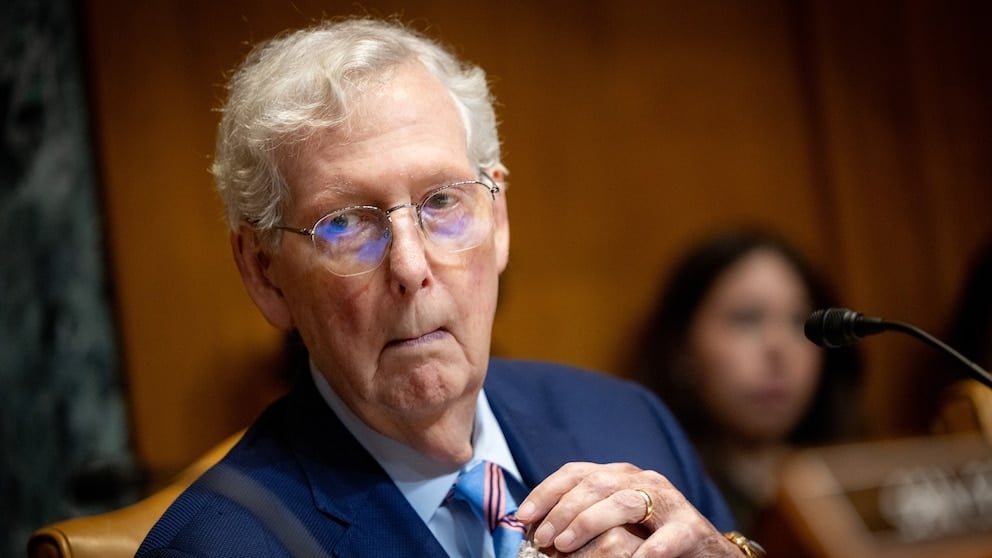

WASHINGTON – The morning Mitch McConnell was admitted to the hospital on June 14, paramedics responding to his Washington residence had a patient in cardiac arrest. Scanner audio obtained by ABC News and NBC News shows an Advanced Life Support ambulance was dispatched to the senator’s address at 8:36 a.m. Six minutes later, the responding medic radioed back: CPR was in progress.
The gap between that scene and what McConnell’s office told the public is striking. When the senator’s hospitalization was announced that same morning, his spokesperson said he was “receiving excellent care.” No statement from his office on June 14, or in the three weeks since, had mentioned a cardiac arrest call, CPR, or the Advanced Life Support crew at his home.
A spokesperson said Thursday that McConnell “continues to improve, and is working closely with his staff on Kentucky and Senate matters while the Senate is out of session.”
The sequence in the scanner audio is precise. At 8:36 a.m. on June 14, a dispatcher directed an Advanced Life Support unit to an address associated with McConnell. At 8:42, Medic 3 transmitted that CPR was in progress. At 8:43, the dispatcher confirmed a cardiac arrest response. A second EMS team was subsequently directed to the same address, NBC News reported. McConnell, 84, had last been seen on Capitol Hill on June 11. His office announced his hospitalization three days later.
The June 14 event is not the first sign that McConnell’s health has been under serious strain. In March 2023, he fell at a Washington hotel and suffered a concussion that kept him from the Senate for six weeks. Later that year, he froze on camera twice: once at a news conference in Washington, where he stopped mid-sentence and stood silently for several seconds while aides approached, and once at a constituent event in Kentucky, where the episode recurred in front of reporters. After each incident, the Capitol’s attending physician released a statement attributing the episodes to “occasional brief episodes of lightheadedness” and cleared him to continue his duties. No formal diagnosis was disclosed.
McConnell’s office has not specified what condition prompted the June hospitalization.
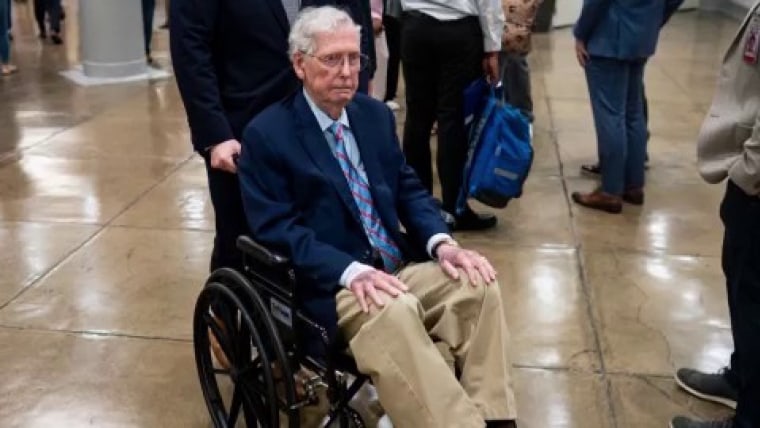
Heart disease remained the leading cause of death in the United States in 2025, killing 694,708 Americans, according to provisional mortality data from the National Center for Health Statistics. The United States recorded its lowest age-adjusted death rate on record that year even as heart disease deaths rose in absolute terms. That backdrop carries different weight when the person receiving an Advanced Life Support cardiac arrest response is 84 years old and has held a Senate seat for nearly four decades.
What the dispatch audio establishes is the category of the response. Advanced Life Support ambulances carry paramedics trained in cardiac resuscitation, advanced airway management, and intravenous drug administration. They are dispatched for life-threatening emergencies rather than general medical assistance. CPR in progress is one of the defining triggers for that level of response. The audio, by its nature, places what happened at McConnell’s home on June 14 in the most serious tier of emergency medical response.
McConnell announced in 2024 that he would step down from his role as Senate Republican leader, a position he had held since 2007, the longest tenure of any party leader in the history of the chamber. He plans to retire from the Senate at the end of his seventh term in January 2027. That departure was already factored into Senate Republican succession planning. Whether the June 14 cardiac event and the extended hospitalization alter the timeline or his capacity to serve out the remaining months of his term has not been addressed by his office or by Senate Republican leadership.
The absence of disclosure raises a question the dispatch audio makes harder to dismiss. When a senator’s office announces a hospitalization without disclosing that the hospitalization was preceded by a cardiac arrest and CPR, it is an editorial choice about what information the public and colleagues are owed about a person still drawing a Senate salary and still registered to vote on legislation. The Senate’s procedural rules do not require medical disclosure. Whether the norms should, given what the scanner audio now shows, is a question Washington has debated before.
The episode recalls, however imperfectly, the final months of Senator Dianne Feinstein of California, who died in office in September 2023 while colleagues and aides privately acknowledged her capacity to serve had declined substantially. The situations differ: McConnell voluntarily stepped down from leadership, has not been described as cognitively impaired, and his office has maintained that he is working through his recovery. But the pattern of disclosure, in which the public learns the severity of a medical event from records obtained by journalists rather than from official statements, follows a familiar line.
The Senate is in recess. No timeline has been set for McConnell’s return to the chamber.