
TL;DR: England recorded its hottest-ever June temperature, 36.1°C in Gosport, Hampshire, on June 24, 2026, as the UK Health Security Agency extended a rare Red heat-health alert until 11pm on Friday, June 26. London Ambulance Service logged 642 life-threatening Category 1 calls that day, its fifth-busiest in history, and deployed more than 400 additional crews. The key difference from 2022: dew points near 22°C prevent sweat from evaporating, raising heat stress risk even in healthy adults not yet acclimatised to summer heat.
LONDON – By the time the call volume stopped climbing on Wednesday night, London Ambulance Service had handled 7,900 calls and sent crews to nearly 3,600 patients in a single day. Of those responses, 642 were Category 1 calls, the classification reserved for cardiac arrests, people who have stopped breathing, and the most immediately life-threatening conditions. It was the fifth-busiest day in the service’s history. The temperature in Gosport, Hampshire had reached 36.1 degrees Celsius that afternoon, breaking the United Kingdom’s June daily air temperature record, which had stood since 1976.
England’s second-ever Red heat-health alert, issued by the UK Health Security Agency, is in force across six English regions: South West, South East, London, East of England, West Midlands, and East Midlands, until 11pm on Friday, June 26. It is the third consecutive day under UKHSA’s highest alert tier, a sequence with no precedent in the system’s history. The Red level is reserved for conditions expected to affect not only the traditionally vulnerable, including the elderly, the very young, and people with heart and lung conditions, but the general population as well.
What sets the June 2026 event apart from the 2022 UK heatwave, when temperatures reached 40.3 degrees Celsius in Lincolnshire in the first British reading above 40 degrees on record, is not the temperature ceiling. It is the humidity. During the 2022 event, dew points across England stayed in single figures. During the June 2026 heatwave, dew points have reached approximately 22 degrees Celsius. A wet bulb temperature combining 38-degree air with dew points at that level creates heat stress comparable to tropical climates, in a country whose homes, hospitals, schools, and public transport largely do not have air conditioning.
The mechanism matters clinically. Sweating works by evaporating moisture from the skin, drawing heat away from the body’s core. Evaporation requires the surrounding air to be dry enough to absorb additional water. When dew points approach 22 degrees, the air is already saturated. Sweat accumulates without cooling. Core body temperature rises more rapidly, and with less physical warning, than during dry heat of equivalent severity. The effect is not limited to people already medically vulnerable. At these dew point levels, healthy adults who are physically fit are at meaningful risk.
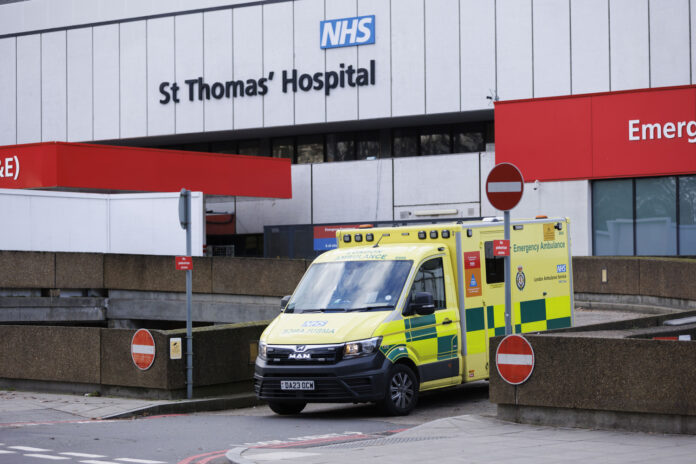
Craig Harman, chief operating officer of London Ambulance Service NHS Trust, said before the heatwave peaked that his service expected a 50 percent increase in demand across the week. More than 400 additional ambulance crews were deployed to London’s roads from June 24. On that day alone, crews attended nearly 3,600 patients, responding to 7,900 total calls. The West Midlands Ambulance Service issued parallel guidance urging residents to check on elderly relatives, vulnerable neighbours, and anyone living alone, noting that heat stress can develop without obvious early symptoms, which is precisely the scenario producing Category 1 calls at historic volume.
The UKHSA’s Red alert designation marks a threshold qualitatively different from the Amber tier below it. An Amber alert indicates significant risk for vulnerable groups. The Red level indicates that hot weather is expected to have wide-reaching impacts across health and social care services, with risks extending to the general population. The UKHSA urged residents to check regularly on elderly contacts, stay in cool rooms where possible, and avoid direct sun between 11am and 3pm. The NHS asked people with non-urgent needs to use alternatives to emergency services to preserve ambulance capacity for life-threatening cases.
June’s position in the calendar deepens the medical risk in ways that a late-summer event does not. Human cardiovascular physiology adjusts to seasonal heat over weeks of gradual warming. By August, people in England have made partial physiological adaptations in their fluid balance and blood-vessel responses. In late June, those adjustments are incomplete. Consecutive Tropical Nights, defined as nights where temperatures do not fall below 20 degrees Celsius, have blocked overnight recovery across the heatwave’s duration, compounding cumulative heat exposure for a population that arrived at the event already under-acclimatised.
England’s heatwave followed the same heat dome that had already moved through France and Spain. The European heatwave death toll passed 150, with forty drowning in French rivers seeking relief from record temperatures and Spain’s Health Ministry confirming 108 heat-related fatalities since June 21. The World Health Organization’s Director-General warned that European health systems were not built for a climate delivering this kind of summer twice in eight weeks. The WHO had published updated guidance on heat-health action plans for European governments three weeks before the current episode began, calling for emergency cooling infrastructure and heat-specific hospital protocols that most European countries do not yet have at scale.
Infrastructure across England absorbed parallel disruption. Schools closed or shortened their schedules. Rail operators warned passengers against non-essential travel, citing rail-buckling risk under temperatures forecast to approach 38 degrees Celsius. Power demand from air conditioning, still rare in UK homes and public buildings, placed unusual pressure on the national grid. The Met Office noted that three consecutive Red extreme-heat warning days was itself without precedent in the UK alert record.
Full casualty figures from the UK will not be established for weeks. Excess mortality analysis, the standard epidemiological method for calculating heat-attributable deaths across a population, requires complete death-registry data compiled after an event concludes. Following the 2022 UK heatwave, UKHSA estimated approximately 3,000 excess deaths above expected baseline. The June 2026 episode has lasted longer and combined temperature records with humidity conditions that were absent in 2022. What those compounding factors cost, in clinical terms, is a calculation public health officials will be making through the summer.
What is visible now, in the ambulance data if nowhere else, is that England’s health system encountered the consequences of the heat before the heatwave finished arriving.