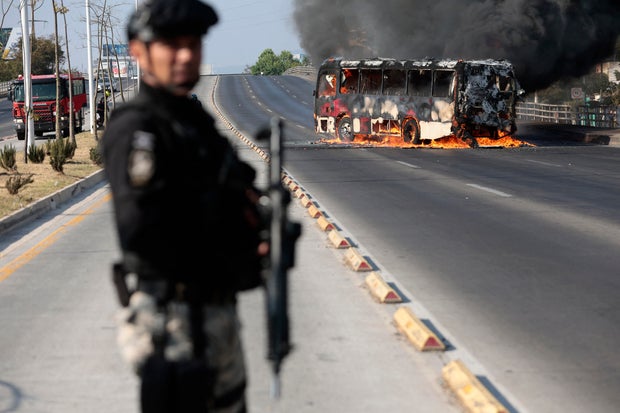

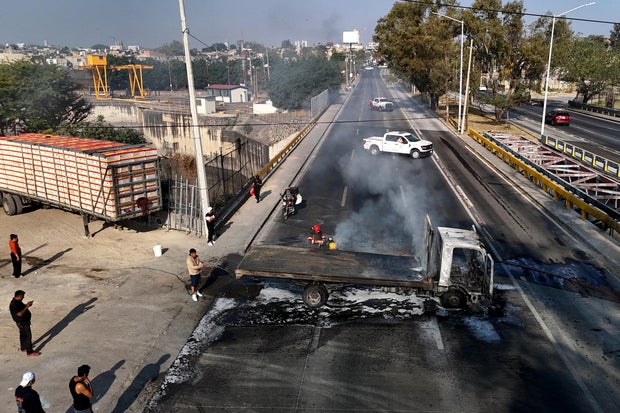
MEXICO CITY — The man known as “Poncho” had built a criminal organization capable of a particular kind of resilience: when Mexican security forces detained him on Sunday, members of his cartel responded within minutes, blocking roads and setting vehicles on fire to hamper the transfer of detainees. That reaction illustrated more than the immediate danger of the operation. It illustrated how much of the organization’s capacity survived the removal of its leader.
Omar Garcia Harfuch, Mexico’s Secretary of Security and Civilian Protection, announced the arrest of Alfonso Fernandez Magallon — identified by La Jornada newspaper as the leader of the Los Reyes cartel — in an operation conducted jointly by the Mexican army and Security Ministry personnel. Harfuch announced the detention on X. The United States government had set a bounty of up to $5 million for information leading to Magallon’s arrest.
Magallon’s criminal record, as reported by Milenio newspaper, spans drug trafficking, vehicle theft, and extortion. What made Los Reyes distinct from other regional criminal groups, according to Mexican media, was a documented willingness to use drones against Mexican military personnel — incidents the outlet said occurred in both 2025 and 2026. The use of drones against state forces moves a criminal organization from ordinary enterprise toward something closer to a paramilitary insurgency, at least in tactical terms. That capability shift has been tracked by security agencies across Mexico for several years as an indicator of how far the cartel-state confrontation has evolved.
Los Reyes is a component, not an independent force. The cartel operates as part of Carteles Unidos, the criminal confederation that has been locked in territorial competition with the Sinaloa Cartel and Cartel de Jalisco Nueva Generacion across multiple Mexican states. That federated structure is directly relevant to any assessment of Sunday’s arrest: in a confederation, leadership removal produces reorganization, not collapse. Carteles Unidos has built redundancy across its structure, and the members who blocked roads and burned vehicles within minutes of Magallon’s detention were operating on the assumption that the organization would continue without him.
The arrest carries particular weight in the context of the February 2025 decision by the United States government to designate Carteles Unidos and several other Mexican criminal organizations as global terrorist organizations. That list included Tren de Aragua, Cartel de Sinaloa, Cartel del Noreste, and MS-13, and has since expanded to include Cartel de Los Soles, the Juárez Cartel, and Los Viagras. The designation changed the legal tools available to US prosecutors, created new sanctions exposure for anyone operating in financial or logistical contact with named groups, and altered the political calculus around US-Mexico security cooperation in ways that continue to play out.
Mexico under President Claudia Sheinbaum has maintained its formal position that foreign law enforcement personnel do not operate on Mexican soil. The working framework that has developed involves Mexico acting on US intelligence and against US-designated targets, while operations are carried out by Mexican forces and announced through Mexican channels. Sunday’s arrest — a US-wanted individual, a US bounty, Mexican operational execution — fits that template exactly. Harfuch’s announcement made no reference to US involvement in the operation beyond the existence of the reward, which is the standard presentation for this kind of bilateral action.
The $5 million reward is drawn from the US Department of State’s Narcotics Rewards Program, which has historically been used to encourage informants inside criminal organizations to provide actionable intelligence. That someone did — with sufficient specificity to enable a precise operation — tells a partial story about the state of Los Reyes’s internal cohesion, or the willingness of people in the cartel’s orbit to cooperate with Mexican or US intelligence. The rapid road-blocking response that followed Magallon’s detention may reflect, in part, an effort by his associates to identify who helped bring about the arrest.
What the arrest does not yet answer is the extradition question. The $5 million reward structure is consistent with an active DEA or Department of Justice investigation into Magallon’s network, but no US federal charges against him under his full name had been publicly announced as of Sunday. Mexico extradites cartel leaders under its treaty obligations with the United States, but the process requires sustained legal and diplomatic engagement and has historically moved slowly. Whether Sunday’s detention marks the beginning of an extradition proceeding or whether Mexico intends to prosecute Magallon domestically will shape how much the operation ultimately translates into US prosecutorial outcomes.
What Sunday’s arrest cannot answer is the structural condition that makes Los Reyes and groups like it permanent features of the contested territories where they operate. The Tierra Caliente region and adjacent zones of central and western Mexico have been sites of criminal competition for more than a decade. Leadership arrests in that environment have historically produced successor organizations or internal reorganization within existing confederations, not lasting disruption. The cartel that blocked roads and burned vehicles on Sunday — the same day its leader was detained — suggests it already expects to continue without him.