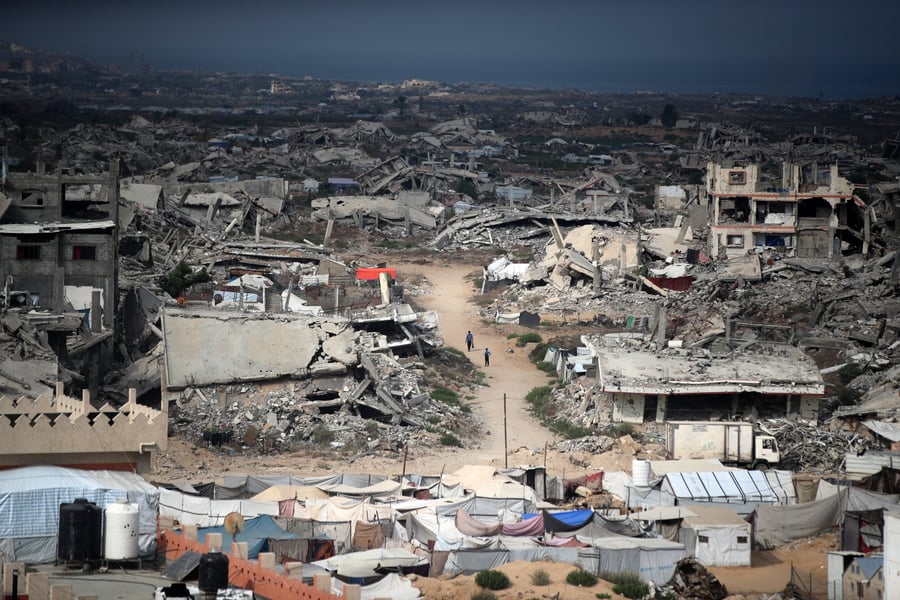

JERUSALEM – On a Sunday morning radio broadcast, retired Israeli general Giora Eiland said the quiet part aloud. Gaza, he told listeners of Israel’s 103FM, should not be rebuilt. “It is better for us that it be destroyed for generations to come,” he said.
The statement was not a slip. It was a policy prescription from one of Israel’s most influential security thinkers, a former head of the National Security Council who has spent the past two years publicly advocating for what he calls strategic clarity on Gaza’s postwar status. That clarity, in Eiland’s framing, demands permanent devastation.
Eiland has been framing this since before the ceasefire. But the Sunday broadcast crystallized his position. “The greater the despair in Gaza and the greater the destruction, and the greater the monument to what they did on October 7, years to come, that is good,” he said, in remarks reported by Antiwar.com. He did not qualify the statement or offer exceptions.
The remarks landed on day 674 of Israel’s assault on the Gaza Strip, which human rights groups and UN bodies have described as a genocide. More than 73,000 Palestinians have been killed since October 7, 2023, a figure independent researchers say is a significant undercount given documentation difficulties under active bombardment. Since the October 11 ceasefire implementation, at least 1,258 more Palestinians have been killed and 4,139 injured by Israeli forces, according to Palestinian health authorities.
Eiland, 67, is no fringe commentator. Serving as head of the National Security Council from 2004 to 2006, he helped shape Israeli doctrine on asymmetric warfare and counterterrorism. After Hamas’s October 7, 2023 attack, he became one of the most-cited strategic voices in Israeli media and abroad, briefing journalists, appearing on international television, and presenting what became known as the “General’s Plan” before the Knesset Foreign Affairs and Defense Committee in September 2024.
That plan called for the forced evacuation of northern Gaza, the complete cutoff of humanitarian aid, and the designation of any Palestinian remaining in evacuated areas as a hostile combatant. Israel implemented key portions of the plan from October 2024 onward, establishing a security buffer across roughly 70 percent of the territory, formalized in part by the earthen barrier Israel has constructed through central Gaza.
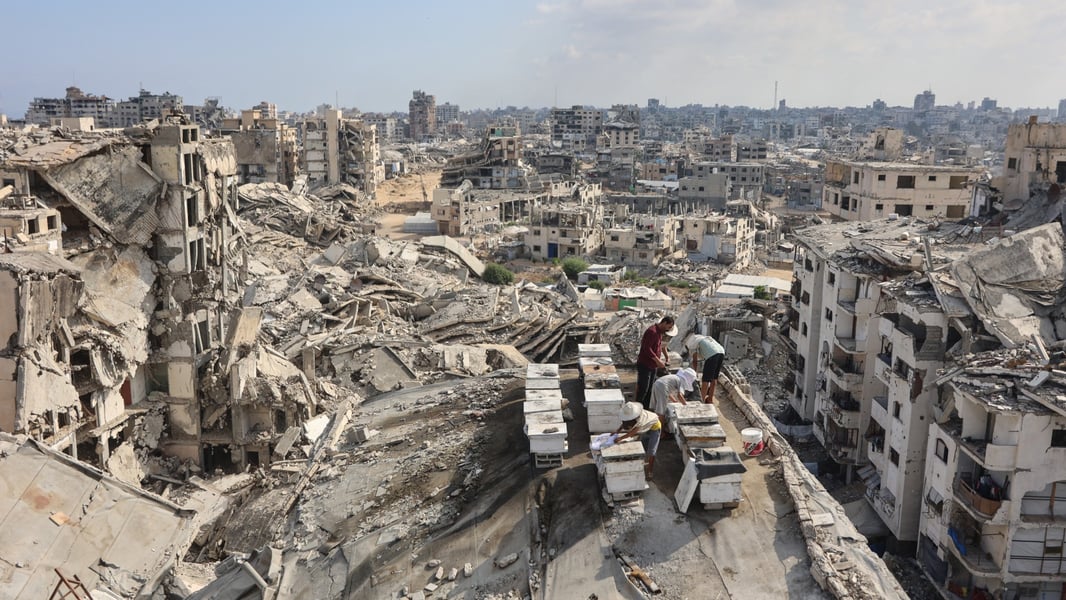
Sunday’s broadcast extended that argument explicitly into the domain of reconstruction. Eiland drew a parallel to post-World War II Europe. “In war,” he said, “the losing side loses. Germany, which lost the Second World War, was forced to surrender 25 percent of its territory.” He offered this as justification for Israel retaining permanent control of roughly 70 percent of Gaza as a security buffer, leaving Palestinians no viable land to return to in the north.
Critics of Eiland’s framework note that Germany surrendered territory to recognized states. Gaza’s Palestinian population has nowhere to go. There is no armistice agreement recognizing Palestinian statehood and no third state absorbing the territory. There is, as Palestinian and international rights organizations have concluded, a genocide with a formal intellectual architecture, one that Eiland helped design.
Human rights groups have cited statements like these as evidence that the destruction of Gaza is not the unfortunate byproduct of military necessity but its deliberate objective. The mass funerals that have become a defining feature of Gaza life since October 2023 reflect a scale of civilian loss that Eiland’s framework classifies as an acceptable cost.
Eiland also took aim at Prime Minister Benjamin Netanyahu’s handling of the U.S.-backed proposal to disarm Hamas in exchange for some form of governance transition. Eiland called that proposal “pro-Hamas,” arguing it would allow the organization to persist in some form. He described the broader diplomatic dynamic between Netanyahu and the Trump administration as a failure of Israeli resolve.
The criticism puts Eiland at odds with the Netanyahu government on tactics while remaining aligned on fundamentals. On whether Palestinian rights to return or rebuild the destroyed territory are legitimate, Eiland is explicit that they are not. This is a distinction between strategies for controlling Gaza, not between competing visions of Palestinian rights.
International pressure over the genocide in Gaza has been building in ways not anticipated two years ago. Legal actions and protests targeting Israeli officials have spread through Europe. Several states have suspended arms exports to Israel. The International Criminal Court issued arrest warrants for senior Israeli officials in 2025, warrants that European states have indicated they would enforce. Gaza genocide protests have prompted Israel to warn its citizens traveling in multiple countries.
Whether those pressures alter the trajectory Eiland describes remains an open question. His argument is that they do not matter, because Gaza’s destruction is already complete enough to be irreversible in any meaningful timeframe. He calls that Israel’s strategic success.
What remains unanswered is what Eiland’s framework means for the approximately one million Palestinians still present in Gaza’s remaining accessible areas. The plan’s logic would suggest their continued presence there is itself the unresolved problem. He has not offered a clear answer to that. Neither has the Israeli government.