
Tonight is the first night this cycle that the moon will still be up when you go to bed. In New York it rises at 3:48 in the afternoon and does not set until 27 minutes past midnight. Twenty-four hours ago it was gone by 11:41 pm, and the night before that by 11:03. The moon phase today, August 21, 2026, is a Waxing Gibbous, roughly 63 percent illuminated and nine days into the cycle that opened with the total solar eclipse of August 12.
That midnight crossing is the real marker of the gibbous phase, more than any number. The moon has passed the halfway point of its cycle and now owns the second half of the night as well as the first. It is also, as of tomorrow morning, as far from Earth as it will get all month.
| Measure | Value |
|---|---|
| Date | Friday, August 21, 2026 |
| Moon phase | Waxing Gibbous |
| Illumination | About 63 percent (59 to 66 percent by location) |
| Moon age | About 9 days (8.3 days at 00:00 UTC, 9.2 by midnight) |
| Distance from Earth | About 404,000 km, at apogee on August 22 |
| Zodiac sign | Sagittarius, all day |
| Best viewing | South and southwest, from late afternoon until after midnight |
| Last phase | First Quarter, August 20 at 02:46 UTC |
| Next phase | Full Moon, August 28 at 04:18 UTC |
| Illumination is a continuous quantity and changes through the day; the range given spans the full 24 hours across time zones. | |
The illumination figure moves the whole way through the day, from about 58 percent at midnight UTC to just over 67 percent by the end of it. Anything between 59 and 66 percent is a defensible answer for August 21 depending on your longitude and the moment the calculation was run, which is why two sites can quote you different numbers and both be right.
What the moon phase today means: the waxing gibbous explained
Gibbous means humped. The moon is past first quarter, which fell yesterday at 02:46 UTC, and the lit portion has swollen beyond a half disc into something that is not quite round and not obviously not round either. It is the phase people most often misidentify as full.
The moon now sits about 105 degrees east of the sun along the sky, which is why it is already well up before sunset and why it dominates the evening. From here the terminator, the line dividing lunar day from night, retreats toward the eastern limb a little further each night until the full moon on August 28 flattens it out of existence.

That terminator is the only part of the disc worth pointing an instrument at. Along it the sun is rising on the lunar surface at a grazing angle, and crater rims throw shadows across their own floors that are long enough to see in ordinary binoculars. The middle of the lit disc, by contrast, is close to shadowless and reads as flat grey. This is why experienced observers avoid the full moon and prize the gibbous nights either side of it, and it is the single most useful thing to know before looking at the moon phase today.
Moonrise and moonset times for August 21, 2026
Knowing the phase is half of it. The other half is knowing when the moon is above your horizon. All times below are local and come from the US Naval Observatory’s rise, set and twilight service, calculated for the city centre; they shift by a few minutes across a large metropolitan area.
| City | Moonrise | Moonset | Illumination |
|---|---|---|---|
| New York | 15:48 | 00:27 (Aug 22) | 65% |
| Chicago | 15:50 | 00:18 (Aug 22) | 65% |
| Los Angeles | 15:26 | 00:56 (Aug 22) | 66% |
| Toronto | 16:24 | 00:36 (Aug 22) | 65% |
| London | 16:41 | 23:21 | 63% |
| Dubai | 13:59 | 00:25 (Aug 22) | 62% |
| New Delhi | 14:07 | 00:15 (Aug 22) | 61% |
| Mumbai | 14:00 | 00:58 (Aug 22) | 61% |
| Singapore | 13:42 | 02:01 (Aug 22) | 60% |
| Tokyo | 13:40 | 23:04 | 60% |
| Sydney | 11:01 | 02:13 (Aug 22) | 59% |
| Johannesburg | 11:52 | 02:21 (Aug 22) | 62% |
| Moonset is the one following that evening’s moonrise, which for most of these cities falls after midnight on August 22. London and Tokyo are the exceptions: the moon sets there before midnight on the 21st. | |||
The moon is running deep south in declination through Sagittarius at the moment, and that is doing something visible to these numbers. London gets the shortest night of moonlight on the list, six hours and forty minutes, because a moon that far south barely climbs above a British horizon before it starts back down. Sydney, at a comparable latitude in the other hemisphere, holds it for more than fifteen hours. Same moon, same night, more than twice the viewing time.
Apogee tomorrow: this is the smallest moon of the month
The moon reaches apogee, the farthest point of its orbit, tomorrow at about 08:30 UTC, at a distance of roughly 404,600 km. Tonight it is already within a few hundred kilometres of that, near enough that the difference is meaningless to the eye.
What that means in practice is that the disc you are looking at tonight is the smallest it gets in this lunation, a little under 30 arcminutes across against a perigee moon’s 33. Nobody will notice by eye. There is no full moon alongside it for comparison, and a few percent of angular width is well below what human vision resolves without a reference. But it is measurable, it is why photographers tracking a full lunation find their late-August frames running small, and it sets up the more interesting consequence: the Sturgeon Moon a week from now arrives with the moon still well out toward the far end of its orbit, which makes it one of the smaller full moons of 2026.
The Sturgeon Moon and a 96 percent eclipse arrive August 28
The Full Moon falls on August 28 at 04:18 UTC, and it is the event worth clearing a calendar for.
Earth’s shadow will cross it in a deep partial lunar eclipse covering about 96 percent of the disc at maximum. The partial phase begins at 02:33 UTC and greatest eclipse comes at 04:13 UTC. At 96 percent it will look very nearly total: the immersed portion turning the copper red of sunlight filtered through Earth’s atmosphere, with a thin bright sliver holding out along one edge. That sliver is the difference between this and a true blood moon, and it is the part photographs will struggle with, because the brightness range between the lit rim and the shadowed disc is far wider than a single exposure can hold.

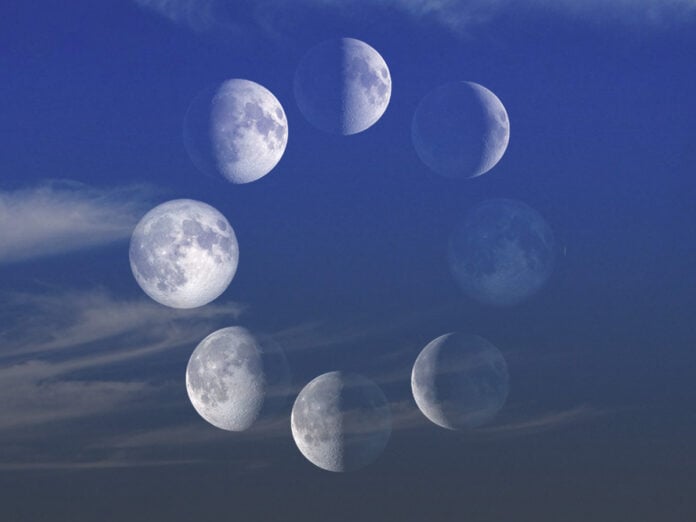
Viewing is best across most of the Americas, where the moon sits high throughout. Across Africa and Europe the eclipse falls near moonset and needs a clear western horizon. It is the companion to the solar eclipse that opened this cycle, which The Eastern Herald covered when totality crossed Spain for the first time since 1905. Solar and lunar eclipses arrive in pairs about a fortnight apart, because that is how long the moon takes to travel from one node of its orbit to the other. NASA’s own overview of the eight lunar phases lays out the full sequence for anyone following the cycle from new moon to new moon.
Between now and then the moon does nothing but get brighter, which means the deep-sky observing window for August is effectively closed. Three nights ago earthshine was still visible on the dark limb. Tonight it is long gone, drowned by a disc nearly two thirds lit.
Where the moon sits in the zodiac today
The moon spends the whole of August 21 in Sagittarius, having crossed in yesterday morning, and it does not reach Capricorn until late on the 22nd.
In astrological practice a waxing gibbous is read as the refining phase, the stretch where whatever was set in motion at the new moon gets adjusted rather than begun, and a Sagittarius moon is associated with breadth, candour and impatience with detail. Our daily horoscope tracks the transits in full.
That is a separate tradition from the astronomy and the two are worth keeping apart. The observable facts behind the moon phase today are the illumination, the age, the distance, the rise and set times and the eclipse geometry. What those positions are taken to mean belongs to a different discipline with a different history.
Moon phase today: frequently asked questions
What is the moon phase today, August 21, 2026?
A Waxing Gibbous, about 63 percent illuminated and roughly nine days past the new moon of August 12. It is one day past first quarter.
Why do sites disagree on the illumination figure?
Because it changes continuously. On August 21 the lit fraction climbs from about 58 percent at 00:00 UTC to just over 67 percent by day’s end. Sites calculate at different reference moments and in different time zones, so anything from 59 to 66 percent is a legitimate answer for the same date.
When is the next full moon?
August 28, 2026 at 04:18 UTC. It is the Sturgeon Moon, and it coincides with a deep partial lunar eclipse covering about 96 percent of the lunar disc.
How far away is the moon today?
Roughly 404,000 km and still increasing. It reaches apogee, the farthest point in this orbit, on August 22 at about 404,600 km.
Why does the moon set after midnight now?
Because it is past first quarter. A waxing gibbous rises in mid to late afternoon and stays up well past midnight, gaining roughly fifty minutes each night until the full moon, which rises at sunset and sets at sunrise.
Can I still see earthshine?
No. Earthshine is only visible when the lit crescent is thin enough not to overwhelm it, below roughly 40 percent illumination. At nearly two thirds lit it is out of reach until the waning crescent in early September.
Is a waxing gibbous good for stargazing?
Not particularly. The moon is up for most of the dark hours and bright enough to wash out faint objects across the whole sky. It is, however, an excellent night to look at the moon itself, which is the opposite trade-off from a week ago.
When is the next new moon?
September 11, 2026. That closes the cycle that began with the total solar eclipse of August 12.
The moon phase today gains roughly one percentage point of illumination every ninety minutes at this stage of the cycle, so this page is accurate for August 21, 2026. Check back tomorrow for the next update in the series.