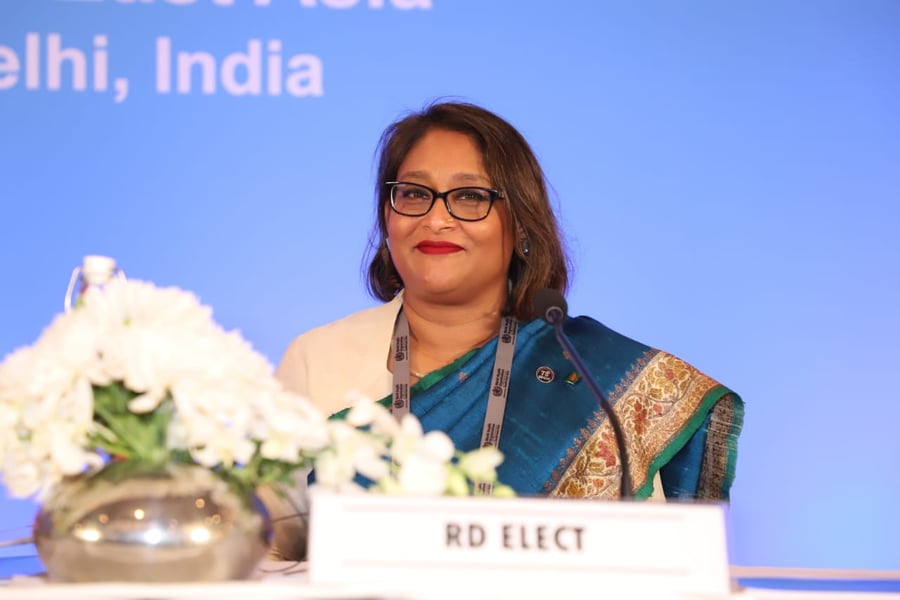

NEW DELHI — Saima Wazed has warned the World Health Organization through her lawyers that she may go to court unless it opens an independent investigation into the decision that removed her from duty, escalating a dispute she has pursued privately with Director-General Tedros Adhanom Ghebreyesus for roughly eight months.
Wazed remains the WHO’s listed Regional Director for South-East Asia. She has not run the office since 11 July 2025, when Tedros told staff in a brief internal email that she was going on indefinite leave. Catharina Boehme, until then the WHO’s Assistant Director-General for External Relations, arrived four days later as Officer in Charge and has run the regional office since. No return date was given then, and none has been given since.
The organisation has not published its reasons. It has not said what process it followed, what standard it applied, or what would bring the arrangement to an end. That silence is now the subject of the challenge, because a decision to stand an official down is one the WHO took itself rather than one taken by any court.
The leave followed criminal proceedings in Bangladesh that began after the government of her mother, Sheikh Hasina, fell in August 2024. In November 2025 a Dhaka special judge’s court sentenced Wazed to five years over the allocation of a ten-katha plot in the diplomatic zone of the Purbachal New Town project. Her brother Sajeeb Wazed Joy received the same term and Hasina was sentenced across six near-identical cases. None of the accused was in the country. Every case proceeded in their absence.
Hasina has lived in India since she was ousted, and Eastern Herald reported in July that Bangladesh’s arrest warrants are unlikely to reach her in Delhi, where a 2013 extradition treaty gives India grounds to refuse. She has said she intends to go back in December, despite a death sentence and more than 600 criminal cases waiting for her.
A separate Anti-Corruption Commission file concerns the WHO job itself. The ACC has charged Wazed under sections 468, 471 and 420 of the Penal Code, covering forgery for the purpose of cheating, use of a forged document and cheating, together with section 5(2) of the Prevention of Corruption Act 1947. It alleges she misrepresented her academic record during her 2023 campaign for the regional directorship, and separately that she used her position to obtain about $2.8m from banks for the Shuchona Foundation, the mental-health charity she chaired. Health Policy Watch, which first reported the charges, noted the ACC did not set out how that money was subsequently spent. A warrant for her arrest was outstanding by May 2025.
Wazed denies the allegations and has not been tried on them.
The principal objection concerns the summons. Bangladesh’s Code of Criminal Procedure requires a court to compel an absent defendant’s appearance before proceeding, either by proclamation posted at the person’s residence and the courthouse with at least thirty days’ notice, or by publication in a widely circulated Bangla national newspaper. Kingsley Napley says the Dhaka court used neither. It directed Wazed and her co-accused to appear through a government Gazette notification dated 3 July 2025, for a hearing on 20 July. A Gazette is not a mass-circulation newspaper, and seventeen days is not thirty.
That objection is not peculiar to this defendant. Eastern Herald reported last month on a University of Dhaka study finding that Bangladesh’s absentia notice procedures fall short of both domestic rules and international human rights law, a conclusion reached by academics with no stake in who stands accused.
Her lawyers also dispute that Wazed absconded, the finding on which trial in her absence depended. Section 339B applies to a person believed to have fled with no immediate prospect of arrest. She was at the time an accredited international civil servant at a duty station in New Delhi, holding an office listed on a United Nations agency’s website, which they argue is incompatible with concealment.
On the plot itself, both Khan and Kingsley Napley argue the allocation was lawful under the Father of the Nation’s Family Members Security Act 2009, which obliged the state to provide lifelong secure accommodation to Sheikh Mujibur Rahman’s surviving daughters and their children after his assassination in 1975. Wazed was entitled to the plot outright, they say, and paid the full cost regardless. Bangladesh’s interim government repealed that Act by ordinance in September 2024 and by statute in April 2026, and their argument is that repeal cannot retroactively criminalise what was lawful when done.
Khan sets the six Purbachal prosecutions against a contemporaneous land allocation to Khaleda Zia, the BNP leader and Hasina’s lifelong rival, and asks why one produced convictions and the other did not. He also points to the pace: filed January 2025, charge sheets March, charges framed July, verdicts from November.
The family’s wider treatment has drawn attention from lawyers with no stake in Bangladeshi politics. Wazed’s cousin Tulip Siddiq, a British Labour MP, faced related proceedings. An open letter signed by Cherie Blair KC, the former justice secretary Robert Buckland KC and the former attorney general Dominic Grieve KC described the case against Siddiq as a politically motivated prosecution and said she had not been given a fair opportunity to defend herself.
Wazed has answered the nepotism charge that shadowed her election, and did so in 2023, before any criminal case existed. The “overt and intentional erasure of my experience, and the attendant reduction of me to being simply my mother’s daughter, is sexism and must be called out as such,” she said at the time. A licensed school psychologist with graduate degrees in clinical and school psychology, she chaired Bangladesh’s national advisory committee on neurodevelopmental disorders. The region’s member states nominated her at the Regional Committee session in New Delhi on 1 November 2023, and the WHO Executive Board confirmed the appointment in Geneva that January, for a five-year term beginning 1 February 2024.
The WHO’s only substantive public comment came when the arrest warrant surfaced. It said it was aware of allegations relating to the period before Wazed took office, that these were a matter for the Bangladeshi authorities, and that it does not comment on such investigations or any consequential legal processes while they are ongoing.
Several questions remain open. The Dhaka court’s reasoned judgment has not been made public, so its own account of how it satisfied itself on notice cannot be assessed. The WHO has not responded publicly to Wazed’s demand for an inquiry or indicated whether it will hold one. Kingsley Napley says the Bangladeshi legal opinions underpinning its analysis come from lawyers it will not identify because they fear reprisals, which leaves its strongest procedural claims resting on expertise that cannot be independently weighed. The ACC has not addressed the allegation that it bypassed the Code of Criminal Procedure. And neither the WHO nor Wazed has said what happens to a term that runs to February 2029 if the leave simply continues.