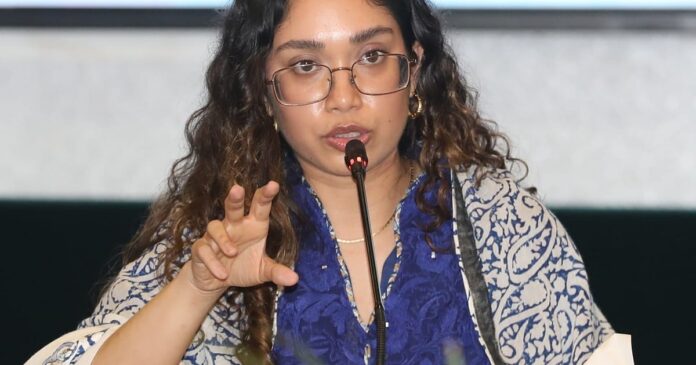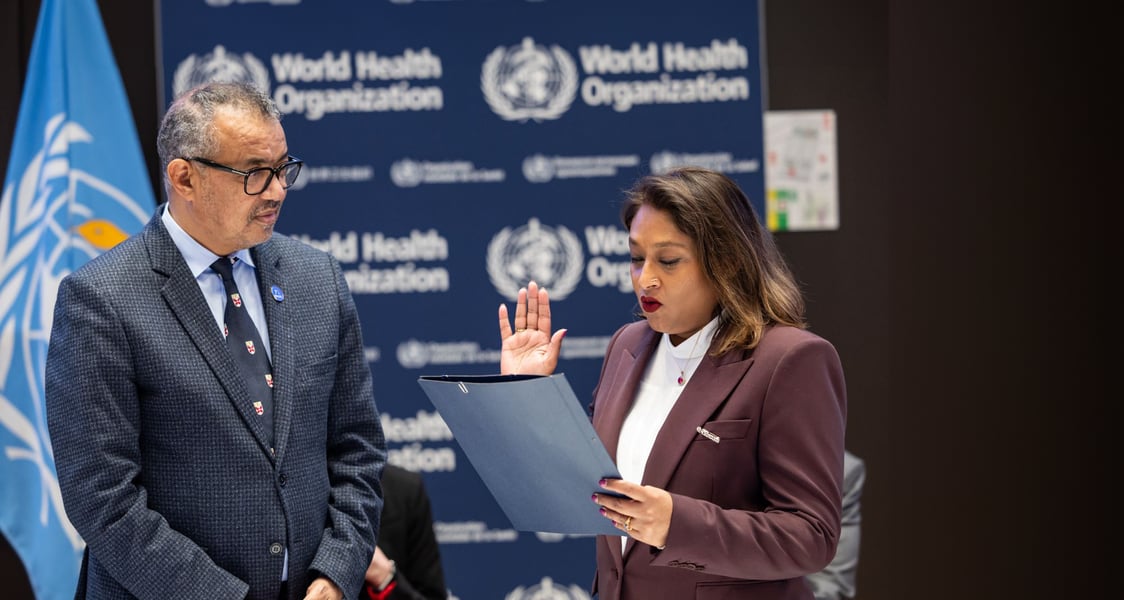

NEW DELHI — On 1 February 2024, Saima Wazed raised her right hand in Geneva, read the oath of office from a folder held open in front of her, and became the World Health Organization’s Regional Director for South-East Asia. Standing beside her was Tedros Adhanom Ghebreyesus, the Director-General she would be writing to, two years later, demanding an explanation.
She has not run the regional office since July 2025, and her lawyers have warned the WHO she may go to court over the leave that removed her. What follows is the record that put her in the job.
Wazed trained as a psychologist in the United States. She took a bachelor’s degree, a master’s in clinical psychology and a specialist degree in school psychology, all at Barry University in Florida, and practised as a licensed school psychologist, nationally certified in the United States. That is an unusual background for a WHO regional director, a post more often filled by physicians and epidemiologists, and it shaped what she did with the roles that followed.
Her work concentrated on autism and mental health, and it began in Bangladesh. She chaired the National Advisory Committee on Autism and Neurodevelopmental Disorders, served as chief adviser on the country’s National Mental Health Strategic Plan, and acted as focal person for disability at the Ministry of Disaster Management and Relief. She founded and chaired the Shuchona Foundation, which worked on autism and neurodevelopmental conditions and is now named in one of the corruption cases against her.
The WHO knew her long before she led a region of it. She served as an adviser to the Director-General on mental health and autism, and sat on the WHO Expert Advisory Panel on Mental Health. In 2014, a decade before she took charge of it, the South-East Asia Regional Office issued a citation in her name, signed by the then regional director Poonam Khetrapal Singh, honouring what it called her path-breaking role in advocating for autism at national, regional and global levels.
Beyond the WHO, she was an associate fellow of the Global Health Programme at Chatham House and a commissioner on the institute’s Commission for Universal Health, and served as thematic ambassador for vulnerability at the Climate Vulnerable Forum. Her name also appears on the institutional record of Bangladeshi paediatric medicine, including a 2024 national management guideline for paediatric neurological disorders developed at Bangabandhu Sheikh Mujib Medical University with WHO Bangladesh support.
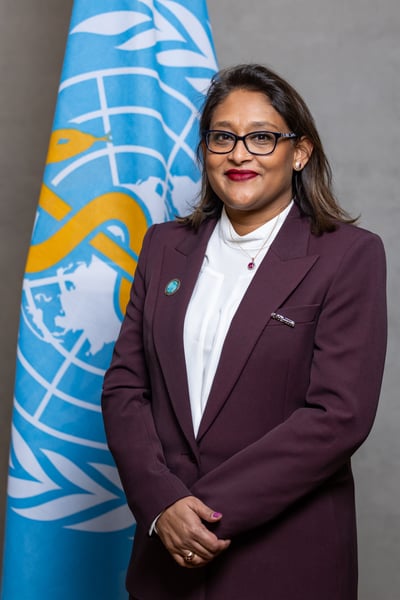
The election itself followed the WHO’s standard two-stage process, which is worth setting out because it is frequently described loosely. Regional directors are not appointed by the Director-General. The region’s health ministers, sitting as the Regional Committee, nominate a candidate by secret ballot, and the WHO Executive Board in Geneva then confirms that nomination. The Regional Committee nominated Wazed in New Delhi on 1 November 2023. The Executive Board confirmed her on 23 January 2024, for a five-year term starting the following week. She succeeded Khetrapal Singh, who had led the region for a decade.
The nomination was contested at the time, and not only by her rival. Critics argued that her candidacy owed more to her mother, the then prime minister Sheikh Hasina, than to her record, and that Dhaka had leaned on member states. Wazed rejected that in 2023, before any criminal case against her existed. The “overt and intentional erasure of my experience, and the attendant reduction of me to being simply my mother’s daughter, is sexism and must be called out as such,” she said.
Both things can be examined on their merits. She held substantive WHO advisory roles and a documented specialism years before the vote. She was also the daughter of a sitting head of government whose administration campaigned for her, in an election decided by health ministers whose governments deal with that administration. Neither fact cancels the other, and the Anti-Corruption Commission’s later allegation that she misrepresented her academic record during that campaign has not been tried.
The region she was elected to lead has since changed shape. It covered eleven member states when she stood. It now covers ten: Bangladesh, Bhutan, the Democratic People’s Republic of Korea, India, the Maldives, Myanmar, Nepal, Sri Lanka, Thailand and Timor-Leste. Indonesia, by some distance the region’s second most populous member, formally transferred to the Western Pacific Region on 23 May 2025 by consensus decision at the 78th World Health Assembly, a move Jakarta had notified in May 2024 and the Regional Committee had endorsed that October. Indonesia’s health ministry framed the shift around geography, shared borders and flight connections to Western Pacific states rather than around anything happening in Dhaka.
The departure completed six weeks before Wazed went on leave. The WHO’s own biography page for the post still describes it as covering eleven countries.
That page also still carries her name. She was placed on indefinite leave on 11 July 2025, and Catharina Boehme, then the WHO’s Assistant Director-General for External Relations, arrived four days later as Officer in Charge and has run the office since. In November 2025 a Dhaka court sentenced Wazed in her absence to five years over a plot allocation in the Purbachal New Town project, one of six near-identical cases against members of her family. A separate Anti-Corruption Commission file concerns her WHO campaign and the Shuchona Foundation. She denies the allegations and has not been tried on them, and lawyers acting for her argue the proceedings breached Bangladesh’s own rules on trying an absent defendant, an objection that a University of Dhaka study has raised about the country’s absentia notice procedures generally.
What the record does not settle is the question the WHO has avoided answering. A regional director is elected by member states and confirmed by the Executive Board, which is a deliberately high bar designed to make the post answerable to governments rather than to the Director-General. No public account has been given of which of those bodies, if any, was consulted before an elected regional director was stood down, or which would have to act to end the arrangement. Her term runs to February 2029.