
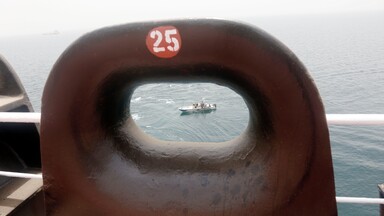
DUBAI — For the third time in eight days, a ballistic missile launched from Yemen has struck a vessel in the Red Sea. The attack on a Saudi oil tanker on Monday, 63 nautical miles west of Yanbu, set fire to the vessel’s main deck and sent maritime insurers racing to revise risk maps for Saudi Arabia’s entire western coastline. All crew survived. The question of how the kingdom defends its most critical bypass corridor did not.
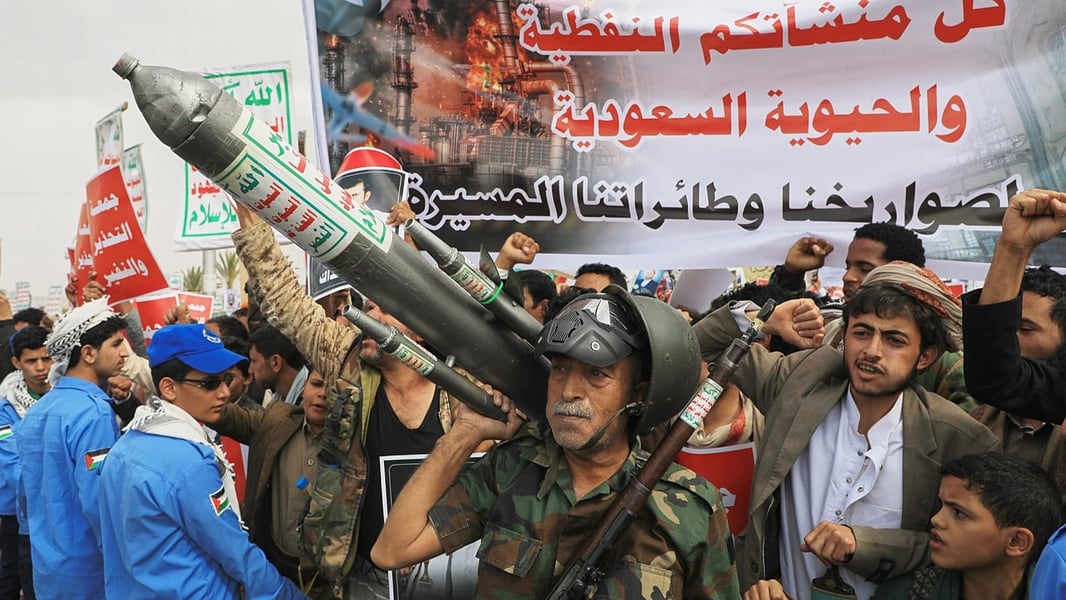
Yemen’s Houthi forces confirmed the strike. “The strike was accurate and direct, resulting in a fire breaking out aboard the vessel,” the group said in a statement. UK Maritime Trade Operations confirmed the incident through its maritime alert system, reporting that all crew had been accounted for and there was no environmental contamination.
The tanker was operating out of Yanbu, the terminus of Saudi Arabia’s trans-peninsula pipeline and the kingdom’s principal Red Sea oil export hub. Yanbu’s significance runs deeper than its cargo volumes: it is the bypass route for Saudi crude that avoids the Strait of Hormuz, where Iran’s threat to halt Gulf oil exports has raised the stakes for every alternative corridor. Targeting Yanbu’s approaches is a statement about Houthi range and strategic intent as much as a tactical choice.
The Bab el-Mandeb strait, which the vessel was approaching, handles roughly twelve percent of global maritime trade. Sustained Houthi missile operations in those waters do not only threaten Saudi exports; they also disrupt the supply chain linking Asian refineries to European fuel markets. Shipping rates on the Red Sea corridor have climbed since the Houthis declared their blockade last month, and multiple major carriers have already rerouted sailings around the Cape of Good Hope, adding weeks to voyage times and tens of millions in extra fuel costs per sailing.
Saudi Arabia’s response to the blockade declaration was to assemble a fourteen-nation coalition in late July. Turkey, Pakistan, and Egypt joined the force, which has been deployed since July 31. Monday’s strike suggests that, whatever deterrent value the coalition offers, it has not yet translated into preventing Houthi ballistic missiles from reaching Saudi coastal waters.
The Houthis are part of Iran’s regional network, a consortium of armed groups that Tehran describes as a strategic deterrence architecture. Their maritime operations have evolved over the past two years, starting with Gulf of Aden actions against Israel-linked shipping and expanding into a systematic effort to apply economic pressure on Gulf states they regard as adversaries. The current Saudi blockade campaign differs in character: it targets Saudi territory and coastal infrastructure directly, not commercial traffic on neutral shipping lanes.
The trajectory connects to the collapse of the US-Iran interim nuclear framework earlier this month. Washington’s rollout of US sanctions targeting Iranian shipping networks and gold exports has hardened the Houthi posture, according to analysts who follow the group’s internal deliberations. The calculation in Sanaa, they say, is that pressure on Tehran translates into permission for escalation, and that visible results are the only currency that matters inside Yemen’s fractured political landscape.
Crude oil prices moved modestly higher in response, with Brent crude adding roughly 1.2 percent in afternoon London trading. Traders contained their response partly because Ras Tanura, Saudi Arabia’s largest eastern terminal on the Gulf coast, was unaffected. Yanbu handles a smaller share of Saudi exports, but analysts warned that any strike within the Yanbu terminal perimeter itself would trigger a sharper market reaction.
Riyadh has maintained public silence since the blockade was declared. Saudi Arabia and the Houthis have observed an informal de-escalation arrangement rooted in the 2023 Saudi-Iranian diplomatic rapprochement, and a public Saudi military response against Houthi forces in Yemen carries the risk of unravelling both that arrangement and the broader Saudi-Iranian relationship that was its foundation. Several regional security officials, speaking without attribution, said the internal calculus inside Riyadh is now under active review.
The United States Navy maintains a presence in Red Sea waters as part of a separate anti-Houthi maritime force. Whether that presence deterred any Monday missile, or simply failed to intercept it, has not been explained publicly.
Across all phases of the Houthi Red Sea campaign, the consistent feature is that ballistic missiles remain outside the existing coalition’s reliable interception range. Whether Saudi Arabia and its partners close that gap, and how quickly, will determine how long this blockade remains viable.
No party has publicly signalled that a negotiated exit from the current confrontation is under active consideration.