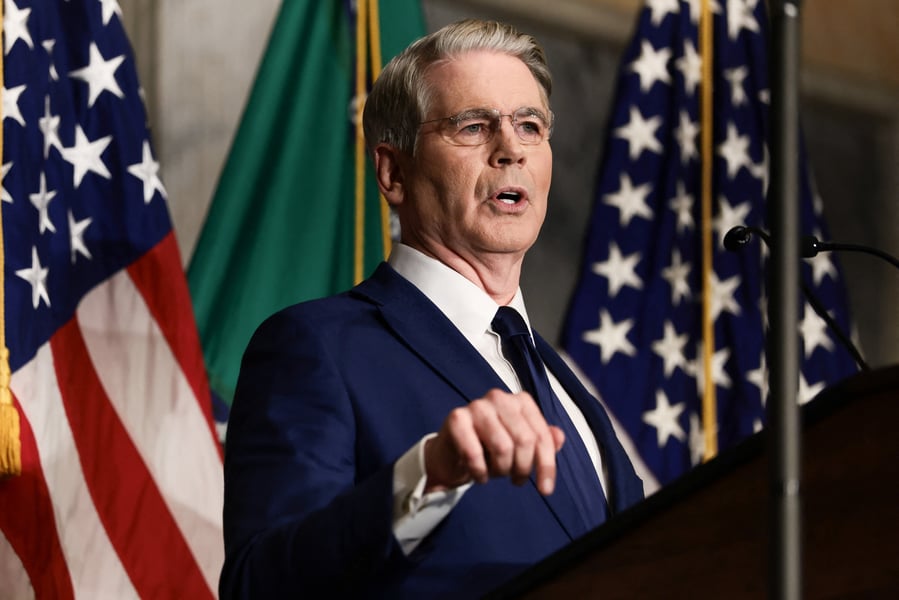

WASHINGTON — Scott Bessent descended on a podium in Washington on Monday with a phrase intended to sound like finality. “Economic D-Day,” the US Treasury Secretary called it. He announced what he called “Operation Economic Outcast” — 60 entities, vessels and individuals sanctioned across the United Arab Emirates, Hong Kong, China, Singapore and Switzerland, targeting five sectors he described as Iran’s vital economic arteries: digital assets, technology, gold, aviation and shipping. “Around the globe, our objective is to sever every economic lifeline that sustains this tyrannical regime until Tehran stands alone,” Bessent said.
Tehran had been listening. Iranian Economy Minister Seyed Ali Madanizadeh spoke the same day, saying the government had “planned in advance how to counter US sanctions” and had already unveiled a two-year economic development initiative. “Washington will not be able to achieve its goals by cutting off the lifeblood of the Iranian economy,” he said. Whether the defiance is rhetorical or structural is the question no press conference can answer.
The rial told its own story. It hit a record low of 2.03 million against the US dollar on Monday, the cumulative weight of six months of active conflict and years of prior sanctions pressed into a single exchange rate. Regular blackouts persist in resource-rich cities. Metallurgical output has dropped. But the minister’s framing — we knew this was coming and we planned for it — suggests Tehran’s position, however battered, is not as isolated as Bessent’s language implied.
Foreign Minister Abbas Araghchi offered a more pointed dismissal. The United States, he said, “cannot think of any other solution in confronting the great Iranian people.” It was the response of a government that has watched more than four decades of American sanctions, many described with similar historic language at the time of their announcement, produce diminishing returns as a tool of political transformation. The war that began in February 2026 — during what had been framed as a new round of nuclear negotiations — has already demonstrated that military strikes capable of killing Supreme Leader Ali Khamenei cannot, by themselves, change the political architecture that replaced him.
Operation Economic Outcast extends the pressure by targeting the intermediaries. The 60 designated entities include companies in Singapore, Hong Kong and Switzerland that have served as conduits for Iranian oil and trade. The UAE received a direct message: the accommodation is over. Bessent declared that “no one is above the reach of US sanctions” and warned that entities facilitating Iranian oil transactions “will be targeted.” Third-country governments also heard directly from the president. Trump has been making personal phone calls to world leaders with what Bessent described as “specific requests to stop contacts with Iran.” He declined to name the recipients. “We are not going to name names. We’ve already seen some results, and I’m confident the president is quite persuasive,” he said. Follow-up delegations from the State Department and Treasury are briefing leaders on timelines and expected compliance.
The economic pressure is layered on top of a naval one. A US blockade has already redirected 70 commercial vessels and disabled three. Iran’s response, if the economic war escalates, carries its own weight. Mohsen Rezaei, secretary of Iran’s Security Council, made it explicit: if the economic siege continues, “not a single drop of oil will be exported” from the Persian Gulf region. That threat reaches beyond Iran’s bilateral dispute with Washington. The Gulf accounts for roughly a fifth of global oil trade. Iran does not control the Strait of Hormuz unilaterally, but it has the capability — and Rezaei suggested, the political will — to make transit prohibitively expensive for everyone.
Iran’s economic survival to date has run primarily through Beijing. China remains its largest trading partner, supplemented by overland trade through Iraq, Turkey, Pakistan and Central Asia. Energy strategist Umud Shokri has noted that “Iran has learned how to survive under pressure, although survival is not the same as avoiding economic damage.” Oil export revenue cannot be replaced at scale through alternative channels. The question Operation Economic Outcast is designed to answer is whether secondary sanctions on Chinese and other intermediaries can close that corridor. The answer depends almost entirely on Beijing’s willingness to absorb costs to maintain trade relationships Washington has placed on notice.
The military dimension surfaced through Pentagon chief Pete Hegseth, who acknowledged that economic pressure “hurts them the most right now” — a formulation that implicitly ranks the current tools but leaves others on the table. Hegseth did not exclude further military strikes. The US tariffs and sanctions war has broadened in 2026 to encompass multiple fronts, from Canadian auto imports to Iranian oil infrastructure, presenting Washington’s economic coercion as a general instrument of statecraft rather than a response calibrated to any particular adversary.
The broader regional arithmetic is shifting in ways Washington’s announcement did not directly address. Countries that have chosen economic corridors outside the US-dominated financial system — among them Russia and China — have demonstrated that sanction architecture is more durable than individual campaigns assume. Iran’s trading partners in Asia have shown that Russia-India energy trade and similar arrangements can be sustained under significant Western pressure, though not without cost.
The larger question Monday’s announcement left unspoken is what ending this looks like. The original military objective, regime change, did not survive contact with its own execution; killing Khamenei produced a successor, not a collapse. The original sanctions objective, a nuclear agreement, was never signed. Bessent said the US had entered the “financial offensive” phase, the “endgame” of its confrontation with Iran. As Al Jazeera reported, Washington is giving third parties the opportunity to “remedy bad behaviour” rather than immediately penalising them — a sequencing that implies the endgame has timetables the administration has not yet shared publicly.
What Operation Economic Outcast has clearly done is expand the sanctioned universe across four continents and signal that the campaign will escalate rather than consolidate. What it has not done is define what Iran must do, specifically, to exit the list. That omission is not an oversight. It is the shape of a war that has not yet decided what it ends in.