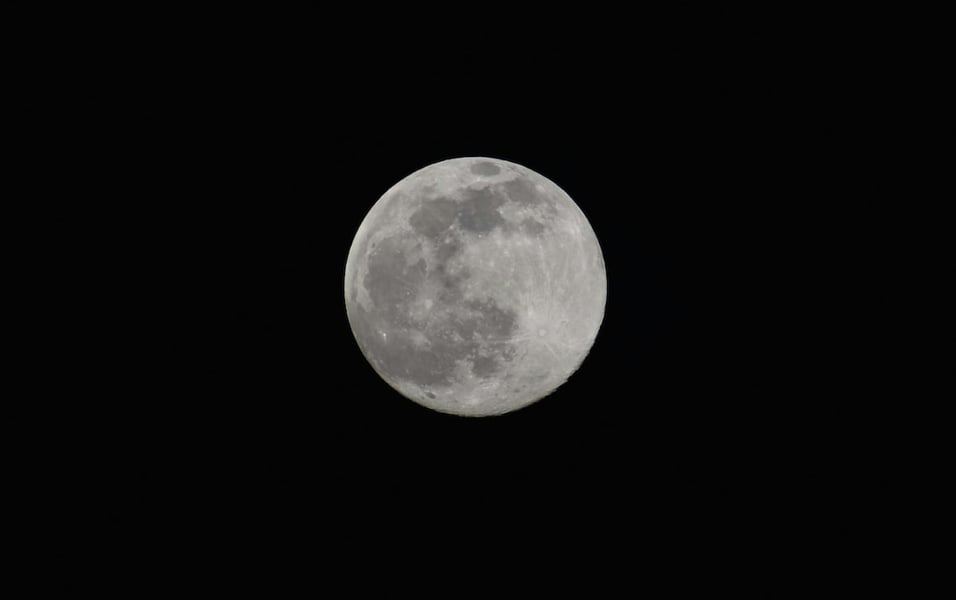

LONDON – The moon was at its fullest at 04:18 UTC this morning, five minutes after the Earth’s shadow was as deep on it as it was going to get. By the time it rises again over London tonight, at 19:56, it will have been waning for fifteen hours. Whatever anybody photographs this evening is not the moon that was eclipsed. The moon phase today, 28 August 2026, is a full moon that spends almost the whole day past full. Illumination reads 99.97 per cent at 00:00 UTC, touches 100.00 at 04:18, and is back down to 99.26 by midnight. It is the Sturgeon Moon, the August full moon, and it sits at 4.5 degrees of Pisces at the instant of fullness. The five-minute gap between greatest eclipse and full moon is the part worth holding onto, because it is the cleanest demonstration of why the two are not the same event. Greatest eclipse is the moment the moon passes closest to the axis of the Earth’s shadow. Full moon is the moment its elongation from the sun reaches exactly 180 degrees. With a gamma of 0.496 this eclipse was well off-centre, so the two moments came apart. Nobody at any eyepiece anywhere saw the difference, and yesterday’s edition of this page could only say it was coming.
| Quantity | 00:00 UTC | 04:18 UTC, full moon | 12:00 UTC | 24:00 UTC |
|---|---|---|---|---|
| Illumination | 99.97% | 100.00% | 99.89% | 99.26% |
| Moon age since 12 August new moon | 15.3 days | 15.5 days | 15.8 days | 16.3 days |
| Distance from Earth | 391,049 km | 390,397 km | 389,234 km | 387,436 km |
| Apparent diameter | 30.59′ | 30.64′ | 30.74′ | 30.88′ |
| Elongation from the sun | 177.9° | 180.0° | 183.8° | 189.8° |
| Ecliptic longitude | Pisces 2.2° | Pisces 4.5° | Pisces 8.6° | Pisces 15.1° |
| The moon is full at 04:18 UTC and waning gibbous from that moment on. Elongation passes 180 degrees at the same instant, which is the definition of full. In Pisces throughout. Illumination is already back to 99.26 per cent by midnight and the eye cannot tell the difference. | ||||
Moonrise and moonset times for August 28, 2026
There is a wrinkle in tonight’s numbers that is worth stating plainly, because almanacs usually bury it. Two separate moons belong to 28 August. The first is the one that rose on the 27th, carried the eclipse through the small hours and set over London at 06:15 this morning. The second rises at 19:56 tonight and sets at 07:32 tomorrow. Only the first was eclipsed.
| City | Eclipse moon set | Tonight’s moonrise | Sets | Above the horizon |
|---|---|---|---|---|
| London | 06:15 | 19:56 | 07:32 | 11h 36m |
| New York | 06:40 | 19:47 | 07:46 | 12h 00m |
| Tokyo | 04:53 | 18:14 | 05:55 | 11h 41m |
| New Delhi | 05:51 | 18:53 | 06:49 | 11h 55m |
| Dubai | 05:56 | 18:51 | 06:51 | 12h 00m |
| Johannesburg | 06:26 | 18:17 | 06:57 | 12h 40m |
| Sydney | 06:11 | 17:39 | 06:38 | 12h 59m |
| Two different moons appear in this table. The first column is the setting of the moon that rose on 27 August, the one the eclipse happened to; the remaining columns are tonight’s moon, which rises after the event is over. Sets fall after midnight and belong to the morning of 29 August. London and New York are in British Summer Time and Eastern Daylight Time. | ||||
The southern advantage runs out tomorrow
For a fortnight the southern hemisphere has had the better moon, simply because a moon at southern declination spends longer above a southern horizon. Sydney had it up for fourteen hours on Tuesday against New York’s ten and a half. Tonight the gap is 59 minutes. Tomorrow it is negative. The cause is a single crossing. The moon’s declination passes through zero at 17:14 UTC on 29 August, moving north, and every rise and set time on both sides of the equator flips its bias at that moment. London gains 65 minutes of moon-up time tonight against last night; Sydney loses 34. The same northward run is what compressed London’s moonrise lag to twelve minutes tonight, against a lunation average near fifty, and it is the leading edge of the geometry that produces the Harvest Moon in September.
| Date | New York | Sydney | Sydney minus New York |
|---|---|---|---|
| 26 August | 10h 33m | 14h 05m | 3h 32m |
| 27 August | 11h 15m | 13h 33m | 2h 18m |
| 28 August | 12h 00m | 12h 59m | 0h 59m |
| 29 August | 12h 45m | 12h 24m | −0h 21m |
| 30 August | 13h 32m | 11h 49m | −1h 43m |
| Computed from each moonrise to the next setting. Tonight’s 59 minutes is the last positive number of the cycle. It goes negative on 29 August because the moon’s declination crosses the celestial equator at 17:14 UTC that day, ending a fortnight in which the southern hemisphere held the better view. | |||
What the eclipse actually did
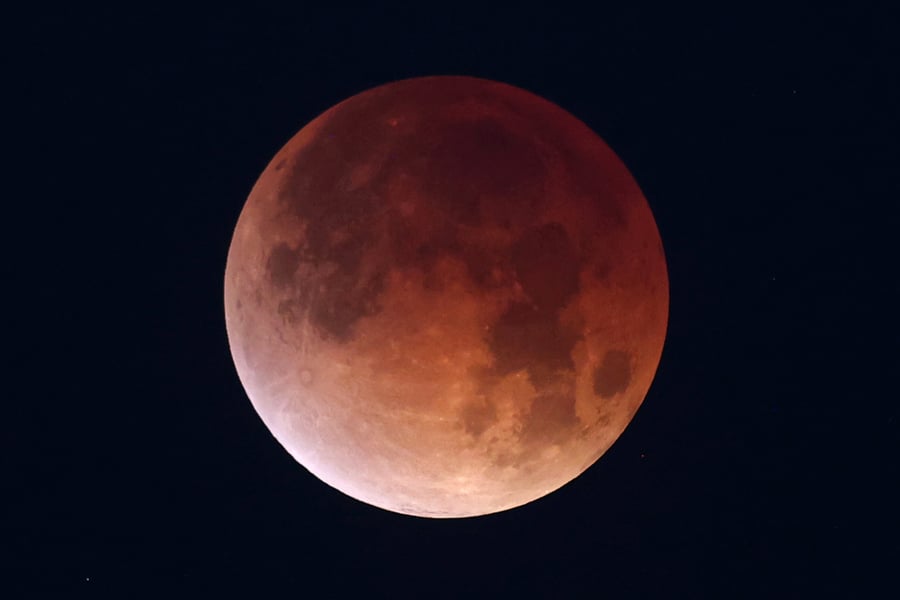
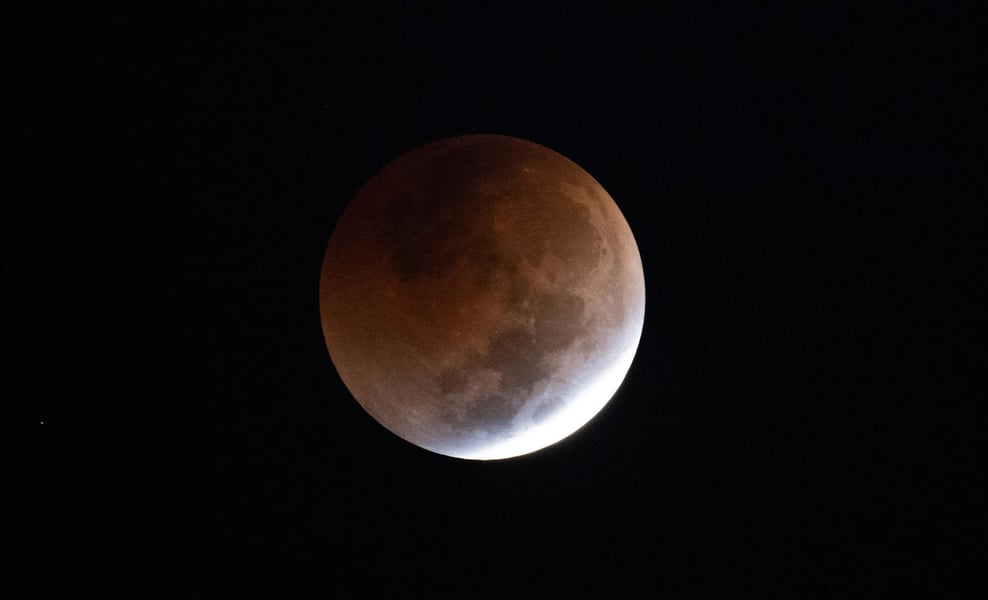
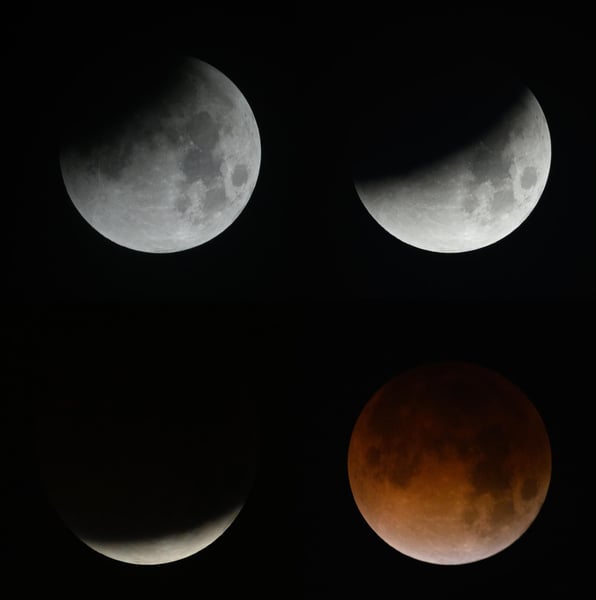
The umbra made contact at 02:33 UTC and took an hour and forty minutes to cross the disc, reaching its deepest at 04:13 with 96.3 per cent of the moon’s area inside the shadow. It was not a total eclipse and it was never going to be: an umbral magnitude of 0.93187 leaves a sliver about 6.8 per cent of the moon’s width, roughly two arcminutes, uncovered on the northern limb. That sliver stays lit at full brightness while everything beside it turns copper, which is a contrast no total eclipse produces. The contact times published by Fred Espenak are the canonical set and the ones used here.
| Contact | UTC | What happens |
|---|---|---|
| P1, penumbral begins | 01:23 | The moon entered the outer shadow. Almost nothing was visible |
| U1, partial begins | 02:33 | The umbra took its first bite out of the southern limb |
| Greatest eclipse | 04:13 | 96.3 per cent of the disc inside the umbra and coppery |
| Full moon | 04:18 | Five minutes later, the moon was geometrically full |
| U4, partial ends | 05:52 | The last of the umbra cleared the disc |
| P4, penumbral ends | 07:02 | Over, three hours before sunrise in New York |
| Umbral magnitude 0.93187, penumbral magnitude 1.96645, gamma 0.49644. The umbral phase runs 3 hours 18 minutes 48 seconds. This is eclipse 29 of the 82 in Saros series 138. | ||
Who saw it and who did not
At greatest eclipse the moon stood overhead near 64.5 degrees west, out over the western Atlantic. That put the entire event in a dark sky for the Americas, gave western Europe and West Africa everything up to greatest eclipse before sunrise took it away, and gave Asia, the Gulf and Australia nothing at all.
| City | U1, 02:33 UTC | Greatest, 04:13 UTC | U4, 05:52 UTC | Outcome |
|---|---|---|---|---|
| New York | +29 | +38 | +38 | The whole event, high in a dark sky |
| London | +19 | +8 | −6 | Everything to greatest, then moonset at 06:15 took the exit |
| Johannesburg | +24 | +2 | −19 | The entry and greatest on the horizon, then nothing |
| Dubai | −9 | −30 | −51 | Nothing. The moon had set at 05:56 |
| New Delhi | −28 | −49 | −66 | Nothing |
| Sydney | −46 | −37 | −21 | Nothing |
| Tokyo | −64 | −57 | −40 | Nothing |
| Altitudes are geometric, computed for the city centre. A negative altitude means the moon was below the horizon. NASA gives the visibility region as the Americas except Alaska and northwestern Canada, western Europe and western Africa. | ||||
London is the case worth recording. The moon was 19 degrees up when the umbra bit at 03:33 BST, 8 degrees at greatest at 05:13 in a sky already going grey, and had set at 06:15 BST, thirty-seven minutes before the umbra finished clearing at 06:52. Johannesburg had a similar shape and a worse ending, at 2 degrees. Neither got anything like the view from a Manhattan rooftop at ten past midnight, where the moon sat 38 degrees up in full darkness from first bite to last.
What this page does not know
The colour, which is the one thing that could now be reported and is not. The eclipsed part of a moon is lit entirely by sunlight bent through the Earth’s atmosphere, so its brightness and hue depend on the dust and volcanic aerosol sitting in the stratosphere on the night. Observers grade it on the Danjon scale, from a nearly invisible dark grey at L equals zero to a bright coppery orange at L equals four. This page has not seen observer reports from the Americas and will not put a number on it from geometry, because geometry cannot produce one. The depth is also less settled than it looks. EclipseWise gives an umbral magnitude of 0.93187. NASA’s own catalogue of Saros series 138 gives 0.9299 for the same eclipse. Both trace back to Fred Espenak. The difference is 0.002 of a lunar diameter, about 3.6 arcseconds, and it moves the covered-area figure from 96.3 per cent to 96.2. It exists because predicting a lunar eclipse requires a decision about how much to enlarge the Earth’s geometric shadow to account for the atmosphere, and more than one convention is in use. This page quotes the EclipseWise value because it is the later of the two, not because it has been shown to be the better one. Readers who want the other side of it can find that the astrology desk has filed its own reading of the Pisces eclipse, while the September forecast picks up the lunation that begins with the new moon on 11 September. For the underlying mechanics, NASA keeps a plain-language explainer of how the phases work.
Moon phase today: frequently asked questions
A full moon, and past full for almost the whole day. The exact instant of full is 04:18 UTC. Illumination is 99.97 per cent at midnight UTC, 100.00 per cent at 04:18, and 99.26 per cent by the following midnight. From 04:18 onward it is technically a waning gibbous, though nothing about that is visible to the eye.
The Sturgeon Moon. The name comes from the North American fishing season rather than from anything astronomical, and it carries no more weight than any other traditional label. This one falls at 4.5 degrees of Pisces.
Yes, in the small hours. The umbral phase ran 02:33 to 05:52 UTC with greatest eclipse at 04:13, which was 22:33 to 01:52 Eastern Daylight Time on the night of 27 to 28 August, and 03:33 to 06:52 British Summer Time on the morning of the 28th.
Greatest eclipse is the moment the moon passes closest to the axis of the Earth’s shadow. Full moon is the moment its elongation from the sun reaches 180 degrees. This eclipse was off-centre, with a gamma of 0.496, so the two moments fell five minutes apart. The gap is real and completely invisible at the eyepiece.
It was a deep partial rather than a total, so the term does not strictly apply. All but a sliver of the disc sat inside the umbra and glowed copper, but that sliver, about 6.8 per cent of the moon’s width or roughly two arcminutes, stayed lit at full brightness on the northern limb. No total eclipse has that bright edge.
No. It ended at 07:02 UTC and lunar eclipses do not recur the same night. The moon that rises this evening, at 19:56 in London and 19:47 in New York, is the following night’s moon and is already waning.
No. Greatest eclipse fell at 09:43 in the morning Indian time, with the moon 49 degrees below the Delhi horizon, having set at 05:51. No part of the event was observable from anywhere in Asia, the Gulf or Australia.
Pisces all day, moving from 2.2 degrees at midnight UTC to 15.1 degrees by the end of it. It entered Pisces at 19:46 UTC on 27 August.
Because full moon is an instant, not a day. A page computed for 00:00 UTC reports 99.97 per cent and a page computed for midnight local time in a different zone reports something else, and both are right. Some publishers also round the moon’s age to whole days and derive illumination from that, which is coarser than computing the phase angle directly.
26 September at 16:49 UTC, which is the Harvest Moon. Before that, the last quarter falls on 4 September at 07:51 UTC and the new moon on 11 September at 03:27 UTC. The moon reaches perigee, its closest approach, on 6 September at 368,259 km.