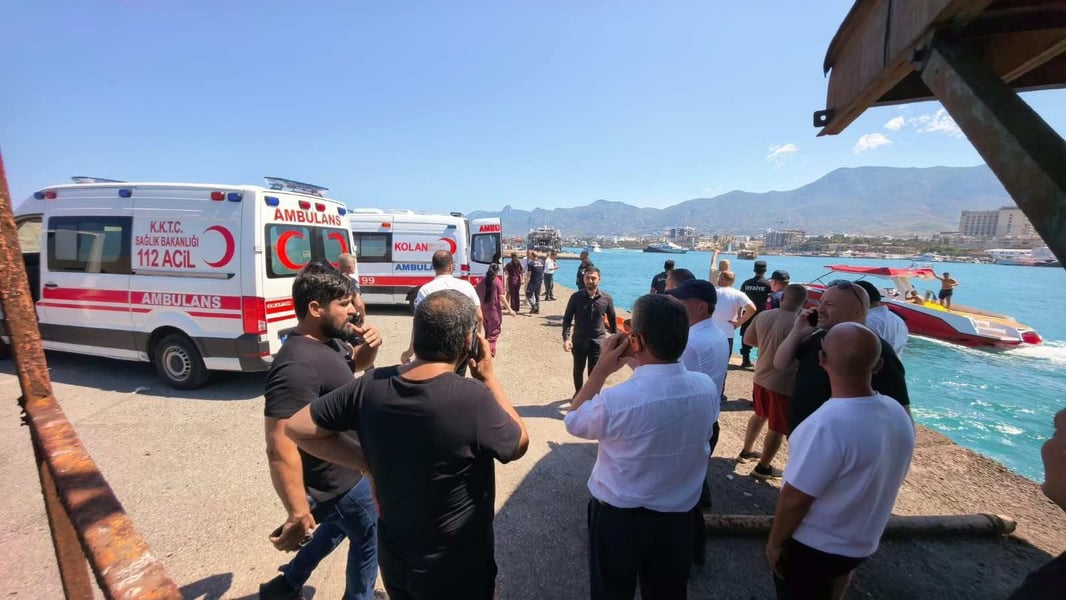

KYRENIA — Seven people are dead and 23 remain unaccounted for after a passenger ferry carrying 267 people capsized roughly 1.5 miles off the northern Cyprus coast on Sunday, triggering a search and rescue operation that officials said was still ongoing as night fell.
The vessel went down near Kyrenia, a port city on the coastline administered by the Turkish Republic of Northern Cyprus. It sank to a depth of 514 meters, according to TRNC Transport Minister Erhan Arikli, placing the wreck well beyond the reach of standard diving operations. Of the 267 aboard, comprising 259 passengers and eight crew members, rescuers brought 237 to shore alive. The 23 still listed as missing remained unaccounted for Sunday evening.
Speaking to Ahaber television, Minister Arikli said investigators were examining a possible collision with an unidentified object as the likely cause of the disaster, as TRT World reported. He said the vessel’s black boxes, the data and voice recorders carried on larger passenger ferries, would be central to establishing precisely what happened in the moments before the ship capsized. The investigation was being treated as both a criminal and a technical matter, with coordination from the Turkish presidency.
The depth at which the ferry sank places the wreck below the operational limit of standard rescue diving. At 514 meters, reaching the vessel would require remotely operated underwater vehicles, equipment that takes time to deploy. Black box data from the seabed would eventually reveal the vessel’s speed, heading, and bridge communications in the lead-up to the incident, as well as any navigational warnings that were logged or missed in the final minutes.

The political geography of a maritime disaster in these waters adds complexity to the response. Northern Cyprus is recognized internationally only by Turkey; the Republic of Cyprus, the EU member state that administers the south of the island, has no formal jurisdiction here. Maritime incidents off the Kyrenia coast are coordinated through TRNC authorities and Turkish vessels rather than through Nicosia or EU maritime institutions, a separation that reflects the widening formal distance between Ankara and Brussels. That jurisdictional reality affects the resources available, the legal framework for determining accountability, and the extent of independent investigative oversight.
For the 237 survivors, Sunday brought rescue. For the families of the 23 still listed as missing, Sunday ended without resolution. Arikli declined to characterize the missing as presumed dead, saying search operations were continuing and that determining the final count of survivors and victims required more time. The minister gave no timeline for preliminary investigative findings.
The ferry carried a mix of nationalities that TRNC authorities had not disclosed as of Sunday evening, reflecting the cross-border nature of the Kyrenia crossing. The route is used by Turkish and international travelers visiting northern Cyprus, by Cypriot diaspora returning from Turkey, and by workers who make the journey regularly. The specific departure point and intended destination of Sunday’s vessel were not confirmed in Minister Arikli’s public statements.
A maritime disaster of this scale is among the more serious in the eastern Mediterranean in recent years. The survival rate here stands in stark contrast to the Indonesian ferry that sank in July, where only five of 78 aboard survived three days adrift. The Mediterranean’s late August conditions, including warm surface temperatures and typically calm seas, extend the window of survival for passengers who reach the water, which likely accounts for the relatively high rescue rate among those aboard. Seven confirmed dead from 267 people suggests the capsizing gave many passengers time to exit the vessel and reach rescue craft.
The combination of the vessel’s passenger load, the speed of its capsizing, and the depth at which it sank creates an investigative challenge that could take weeks to resolve. What black box data will eventually tell investigators about the final minutes of the crossing, whether a navigational warning was received, whether evasive action was taken, and whether any impact was singular or successive, will determine whether the collision theory holds or whether another explanation emerges.
The TRNC minister said no timeline could be given for preliminary findings. Search and rescue operations continued into Sunday night.