
REDMOND, Wash. – For the chief information officers re-evaluating their cloud contracts this fall, the number that matters most is not $90 billion. It is 23 percent.
That is how far Microsoft’s quarterly free cash flow fell in the three months ending June 30, even as the company reported revenue that cleared $90 billion and handed investors one of the most closely watched earnings releases in the technology sector this year. The stock closed at $513.53 on August 28, up 1.68 percent on the session, as traders weighed a milestone: Azure’s annual revenue crossed $100 billion for the first time, against a cash flow squeeze that the company’s own management acknowledged without entirely explaining.
The quarter settled one argument Wall Street has been running since Microsoft began spending at an extraordinary pace on AI infrastructure: can Azure grow fast enough to justify the bill? The answer, for now, is yes, and also not yet, depending on which number you read first.
Azure grew 43 percent year-over-year in the fourth fiscal quarter, accelerating from the prior period and cementing an annual revenue run rate that places Microsoft’s cloud division in a category by itself among enterprise software companies. Microsoft’s AI-focused products collectively reached a $37 billion annual revenue run rate, up 123 percent from the same period a year earlier, according to its fourth-quarter earnings release filed with the Securities and Exchange Commission. Copilot paid seats surpassed 30 million, up 160 percent year-over-year, a count that suggests enterprise adoption has moved well past the pilot stage.
What the earnings release did not offer was the math underneath the seat count: revenue per seat, contract length, or churn rate. Those figures would tell investors whether Copilot is functioning as a price-justified productivity tool or as a discounted add-on that enterprises are trialing before deciding whether to pay full price. Microsoft declined to provide them. The omission is not unusual, as competitors have been similarly guarded, but it is the single largest unresolved question in the company’s AI monetization story.
The cash flow figure sharpened the question. Microsoft generated $9.4 billion in free cash flow in the quarter, down from roughly $12.2 billion in the same period a year earlier, as capital expenditures hit a record $41 billion, nearly double the prior year’s pace. The company has signaled capex will accelerate further: FY2027 spending is projected at $255 billion to $260 billion, a commitment that dwarfs any infrastructure buildout the company has previously undertaken.
As Euronews reported, shares surged roughly 10 percent in after-hours trading following the earnings release in late July, a reaction that reflected investor preference for the top-line acceleration over the cash flow compression. The subsequent weeks saw the gain partially retraced before August 28’s session pushed shares back above $513.
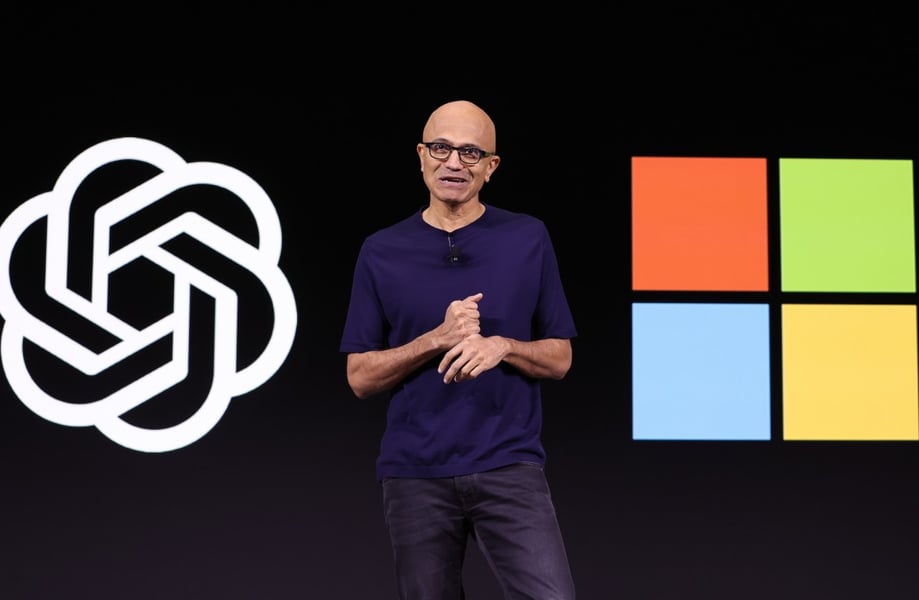
The investment calculus is not simple. TechCrunch noted that Microsoft recognized a $3.2 billion gain during the quarter from its investment in Anthropic, a figure that contributed to the record net income of $35.8 billion, up 31 percent, and GAAP earnings per share of $4.81. Strip out that gain, and the underlying operational profit picture remains strong but less dramatic. Microsoft also holds a significant stake in OpenAI, whose commercial trajectory the company described as mixed in the same period.
The Anthropic relationship places Microsoft in an unusual position among the hyperscalers: it is simultaneously competing with AI model providers and financially exposed to their outcomes. When Anthropic performs well, Microsoft’s income statement benefits. When OpenAI’s growth disappoints, Microsoft’s platform strategy is implicated.
The capital spending dynamic is the one that enterprise customers are tracking most carefully. Microsoft’s data center footprint is growing faster than any comparable period in the company’s history, and the costs are being absorbed in the same quarters where AI revenue is still proving itself. Nikkei Asia reported that the four largest US technology companies combined spent $95 billion in cash on AI infrastructure during the second quarter of calendar 2026, a figure that underscores the sector-wide bet being placed on demand that has not yet fully materialized at the scale the capex implies.
For Microsoft, the bet has a logic. Azure’s 43 percent growth rate has been consistent enough that the company’s Intelligent Cloud segment, which houses Azure alongside other enterprise services, reported $42.9 billion in quarterly revenue. The segment is now the largest contributor to total company revenue, having displaced the Productivity and Business Processes division that includes Office 365 and LinkedIn.
The practical consequence for enterprise customers is not entirely comfortable: the cloud platform they depend on is run by a company spending at a rate its own free cash flow cannot currently sustain, and that trajectory is pointed upward. Microsoft’s balance sheet is strong enough to finance the buildout through debt and reserves, but the structure of the bet means customers are locked into a platform whose pricing pressure will only increase as Microsoft seeks return on a quarter-trillion-dollar capital commitment.
The stock’s 1.68 percent gain on August 28, part of a broader Dow Jones Industrial Average session that saw mixed performance across components, reflected a market that has, so far, chosen to focus on the milestone over the mechanism. Among the Dow components covered in this series, Goldman Sachs posted strong trading revenue while Merck held firm on pharmaceutical leadership. Cisco, earlier in the series, reported enterprise networking demand despite headwinds from software-defined alternatives.
Azure at $100 billion annually is a fact. Whether the cash flow trajectory that funded it can be sustained without compressing margins or raising enterprise prices is the question the September quarter will begin to answer.