

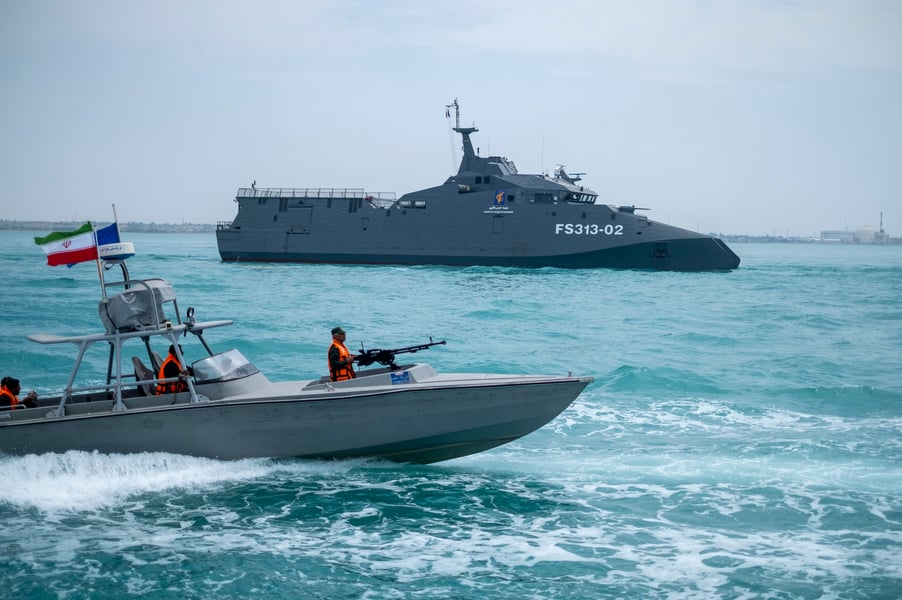

TEHRAN — Iran’s Islamic Revolutionary Guard Corps said Monday that American surveillance technology is no match for its monitoring capabilities in the Strait of Hormuz, following the capture of a US underwater drone that the IRGC put on public display as evidence of its reach in the strategic waterway.
Brigadier General Hossein Mohebbi, an IRGC spokesman, said the recovery of the Dive-LD autonomous underwater vehicle demonstrated that Tehran’s surveillance network over the Hormuz passage was comprehensive and that Washington should not assume its unmanned systems could operate undetected in the area. “No US technology can evade our monitoring systems in the Strait of Hormuz,” Mohebbi said, according to the IRGC’s official media channels.
The Dive-LD is manufactured by Anduril Industries, the California-based defense technology company, and was delivered to the US Navy in 2025 as part of a contract to provide autonomous undersea systems for intelligence gathering and mine detection. The drone, which can operate at significant depth for extended periods, is designed to collect data on underwater environments including temperature gradients, magnetic signatures, and acoustic profiles, the kind of information relevant to tracking submarine traffic and mapping sea floor conditions.
The IRGC did not specify where or when the drone was recovered, citing operational security. American military officials at US Central Command have not confirmed the loss of a Dive-LD in the Hormuz area and did not respond to questions before publication.
The capture, real or staged, lands in the middle of a conflict that entered its seventh month in late August. Iranian and American forces have been engaged in a sustained exchange of strikes since late February, when the first direct US military action against Iranian territory triggered an escalating response that neither side has yet translated into negotiated terms. A ceasefire attempt in mid-June collapsed within 48 hours. The conflict’s aerial dimension has expanded throughout, with Iran claiming to have shot down a US MQ-1 drone over the Strait of Hormuz as recently as this week.
Mohebbi’s statement was part of a broader IRGC communications campaign that has emphasized technical sophistication rather than pure force, even as the physical toll on both sides has grown. The US military has acknowledged more than 800 personnel killed or wounded since the conflict began; Iranian casualty figures are disputed and Tehran has not published comparable data.
The Strait of Hormuz carries roughly 20 percent of the world’s oil trade, giving both sides strong but conflicting incentives in the waterway. The United States has maintained a naval presence there through CENTCOM assets for decades; the IRGC’s naval arm has contested that presence with varying intensity since the 1980s. The current conflict has intensified that contest significantly, with drone and fast-attack craft engagements reported in the northern Gulf since April.
American strategy in the Strait has relied partly on undersea awareness, knowing where Iranian submarines, mine-laying vessels, and fast-attack craft are operating. If the IRGC has genuinely recovered a Dive-LD, it would represent a potential intelligence gain: not because the drone would reveal its own capabilities, which are commercially documented, but because its mission data, routing, and communication protocols might expose how the US Navy has been deploying its undersea network.
Al Jazeera‘s reporting on the conflict has noted that the IRGC’s claims about Hormuz capabilities have at times outpaced what independent analysts were able to verify. Monday’s display is the clearest piece of physical evidence the Guard Corps has presented since the conflict began. Whether it changes the operational calculus for US naval planners depends on what the drone’s recovered data actually contains, a question the Navy, if it verifies the loss, will not answer publicly.
The Hormuz situation has also been complicated by Iranian strikes on commercial shipping. At least six commercial tankers have been hit since July, raising insurance premiums for vessels transiting the Gulf and prompting shipping companies to reroute at substantially higher cost.
Whether Mohebbi’s claim reflects a genuine operational setback for the US Navy or an information operation designed to project Iranian capability is not yet verifiable. What is clear is that the underwater dimension of the conflict, largely invisible to public reporting, is now being contested in a way it was not six months ago, and the IRGC intends for its adversaries to know it.













