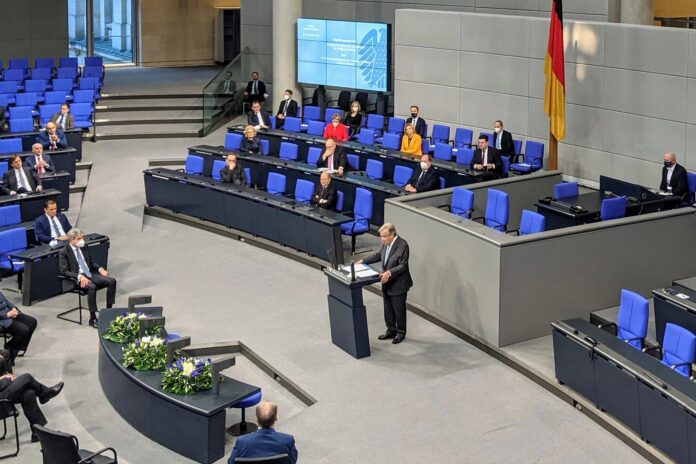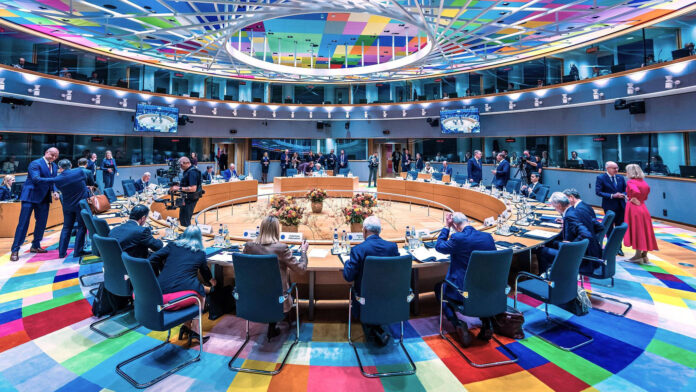

BRUSSELS — The European Commission spent much of the summer defending a proposal to increase EU spending by 60 percent over its previous seven-year budget. Friedrich Merz spent Wednesday explaining why that number has to come down by several hundred billion euros.
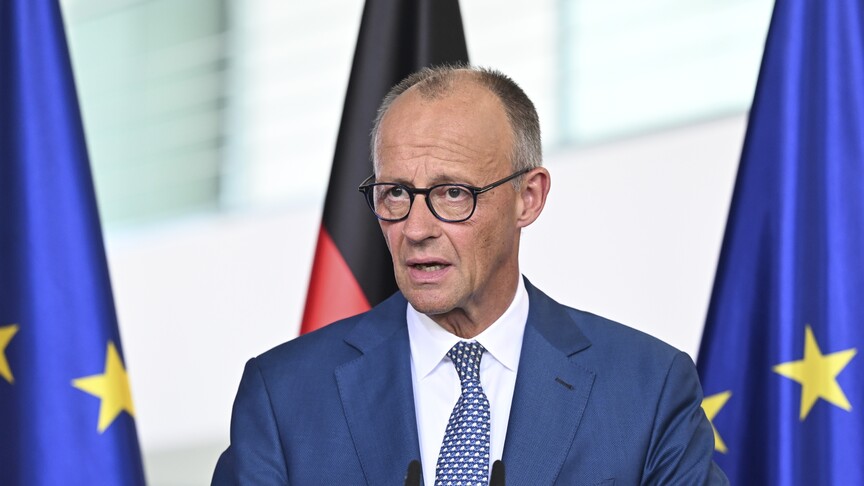
Germany’s chancellor made the position public at a joint press statement alongside European Council President António Costa, not a private negotiating message but a deliberate front-channel declaration. “The current Commission proposals envisage a 60% increase in spending compared to the previous multiannual budget,” Merz said. “At a time of budget cuts in all member states, that is simply unaffordable.”
The Commission’s draft multiannual financial framework for 2028-2034 was presented in late July at nearly two trillion euros in nominal terms. It sets the spending ceiling for the entire European Union for seven years, covering everything from agriculture and regional development to migration policy, research programs, external assistance, and, for the first time at scale, defense. Germany’s preferred reduction stands at around 400 billion euros, a fifth of the proposal’s total value.
Germany is not alone. In late August, six member states (Germany, Denmark, the Netherlands, Austria, Sweden, and Finland) published a joint letter demanding “several hundred billion euros” be removed from the framework across all spending categories. That letter was a coalition warning served in advance of the formal negotiation season. Wednesday’s presser with Costa converted the warning into a public confrontation with the Commission’s headline figure.
Commission President Ursula von der Leyen has not yet publicly offered concessions on the total. Officials familiar with the Commission’s internal position say Brussels is prepared to find savings in specific external assistance line items while protecting core priorities: the Horizon research programme, the Just Transition Fund, and the reconstruction financing stream earmarked for Ukraine. None of that internal flexibility has been placed on the table in any formal setting.
The MFF negotiation carries a structural complication that previous rounds did not. Defense spending has been added as a meaningful budget category, a consequence of the June 2026 NATO summit and a political acknowledgment that European security cannot rely indefinitely on American guarantees. When the EU pledged €6.1 billion in new Ukraine defense assistance in August, that money came from already-stretched funds; the new framework is supposed to institutionalize such spending permanently. Cutting the overall budget while adding a defense line means every other category absorbs a proportionally larger share of the reduction.
That arithmetic is the Commission’s most effective counter-argument to the frugal coalition. Its answer to Merz, implicit in von der Leyen’s public silence on the specific figure, is that a budget with a 60% headline increase is what European ambition now costs, and that the countries demanding cuts are the same countries that asked the EU to do more on defense, energy independence, and climate transition.
Merz’s response to that logic, stated at domestic venues and now repeated in Brussels, is that structural discipline is not the enemy of ambition. It is the precondition for credibility. The chancellor has applied this discipline-first logic to other EU policy debates this year, including his refusal to join EU sanctions against Israel despite pressure from European partners, a consistent pattern of prioritizing German coalition-building latitude over European solidarity gestures.
Costa, standing alongside Merz on Wednesday, played the role of European Council president with precision. He presides over summits where EU leaders negotiate; he does not publicly advocate for a particular outcome. His appearance at the press conference nevertheless placed the Council’s authority directly alongside Germany’s demand without committing Costa to the specific figure proposed by the frugal coalition.
The signal was difficult to miss: Costa intends to drive the negotiations rather than simply referee them, and the Council is prepared to treat Germany’s framework as the outer limit of what the frugal states can accept. But that alignment also exposes the coalition’s central weakness — agreeing on what they oppose may prove considerably easier than agreeing on what they actually want.
Whether the six countries can maintain a united position is now one of the negotiation’s biggest uncertainties. The Netherlands has its own budget priorities, many of which do not map cleanly onto Germany’s demands. Austria’s government must balance fiscal conservatism against its substantial reliance on EU regional development receipts, creating a tension between its position as a budget hawk and its interests as a major beneficiary.
Finland presents another complication. It was among the loudest voices behind the August letter, but it is also a net contributor whose domestic politics depend partly on preserving EU agriculture and research programs. The prospect of deeper cuts therefore creates competing pressures even among governments that broadly agree on the need for fiscal restraint.
The coalition’s unity could consequently begin to fray once negotiations move from broad principles to the distribution of actual money. Every government has its own priorities to protect, and the compromises required to preserve one member’s gains could quickly undermine another’s political position at home.
EU leaders are targeting a political agreement by the end of 2026. That represents the final point at which enabling legislation could be passed in 2027 to activate the new framework on January 1, 2028.
The timetable leaves the European Commission with roughly eight weeks before the October summit to decide whether to absorb part of Merz’s demand, make a structural counterproposal, or hold its position and risk an open confrontation.
All three options remain possible, but none is painless. A compromise could expose divisions within the frugal camp; a counterproposal could test whether the six governments are prepared to hold their line; and a refusal to move could turn the budget dispute into a much broader institutional confrontation.
What Wednesday’s developments removed from the negotiating table was the possibility that Germany would quietly wait for someone else to lead. Merz has now put Berlin at the center of the fight — and the other five governments must decide whether they are prepared to stand behind Germany when the negotiations become genuinely costly.