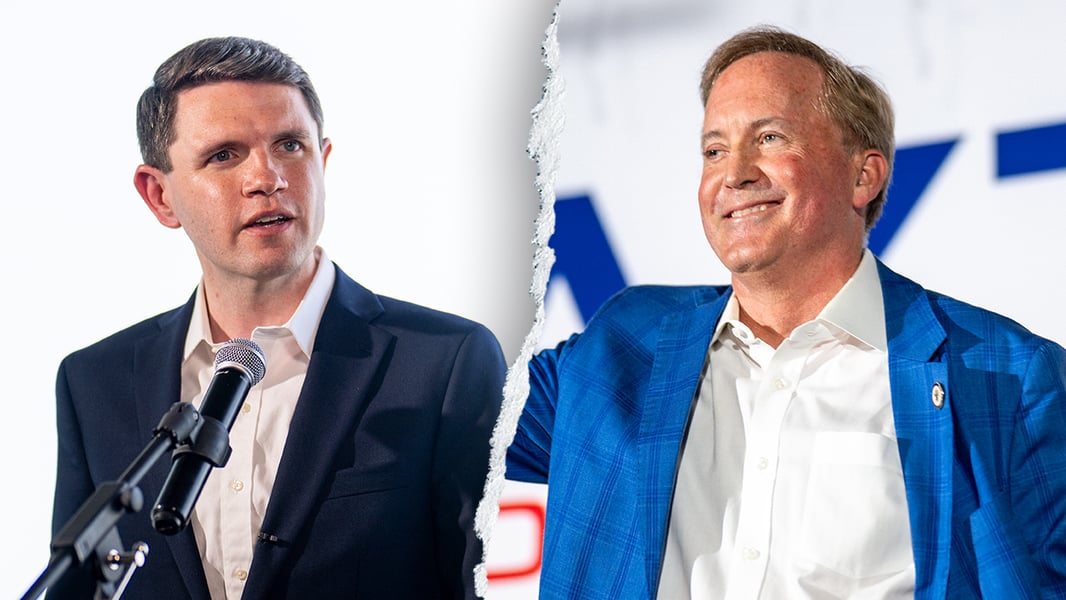

AUSTIN — James Talarico did not burn his Bible. He did not pose with it for a photograph. But on Monday, a digitally fabricated image of him holding a leatherbound Bible appeared on national television in an attack ad carrying the nickname “King James.”
The ad was produced by the campaign of Ken Paxton, Texas’s attorney general and the Republican nominee for the United States Senate. It represents a notable development in American electoral politics: a campaign using AI-generated imagery to depict an opponent in a scene that never occurred, then broadcasting that fabricated image as part of a televised political attack.
Talarico, the Democratic nominee and a progressive state representative from Round Rock, has made his Christian faith an important part of his political identity. He has discussed his faith in campaign interviews, speeches on the floor of the Texas House and the opening lines of his stump speech, often framing it in contrast to what he describes as the performative religiosity of the Texas Republican establishment.
The “King James” advertisement seeks to reverse that political narrative, portraying Talarico as a hypocrite whose public expressions of faith are merely political theater. The central problem, however, is that the image used to make that case was not a photograph of an actual event.
It was generated by artificial intelligence.
That distinction is central to the controversy. The advertisement does not simply present an interpretation of something Talarico said or did. Instead, it uses synthetic imagery to depict conduct that did not happen and places that imagery in a political advertisement presented to television viewers.
“Ken Paxton’s campaign created a fake image of me holding a Bible,” Talarico said Monday. “This is what desperation looks like.”
The episode highlights a growing challenge for political advertising as generative AI makes fabricated visual material increasingly accessible. A photograph can traditionally serve as evidence that an event occurred; an AI-generated image can create the appearance of evidence for an event that never happened.
That distinction could become increasingly important in campaigns where visual imagery is used to shape voters’ perceptions of candidates and their character.
The ad aired on Newsmax on September 8, the day after Paxton appeared at the Republican Party’s first formal midterm convention in Dallas, a gathering Trump’s political operation turned into something closer to a base-mobilization rally than a deliberative political convention. Paxton has aligned himself closely with Trump since defeating incumbent John Cornyn in the Texas Senate Republican primary in May, a result that reshaped the competitive landscape of the race and caught most independent analysts by surprise.
This is not the first AI-generated attack on Talarico from the Republican side. In March, shortly after Talarico won the Democratic nomination, the National Republican Senatorial Committee published an AI-generated video depicting him reading his own social media posts, presented without context. The Republican Party’s pattern of personal attack politics in contested Senate races this cycle has extended well beyond Texas — Trump and Vance have separately escalated Islamophobic attacks against Michigan’s Democratic Senate nominee Abdul El-Sayed. In Texas, the Paxton campaign’s production goes further: it splices real audio of Talarico’s statements about gender and Christianity into a fabricated video frame, according to CBS News.
The use of synthetic media in political advertising has expanded rapidly over the past two years, and the Paxton campaign’s deployment of an AI-generated attack in a high-profile Senate race marks one of the most prominent applications of the technology in the 2026 midterm cycle. Both parties have raised concerns about AI-fabricated content in campaign advertising, and legislation has been introduced in Congress to require disclosures on synthetic media, but none has cleared both chambers. The Federal Election Commission has been unable to reach consensus on whether existing disclosure requirements cover AI-generated content. Texas, like most states, has no statute specifically addressing AI-fabricated imagery in political ads.
Whether the ad violated any existing prohibition depends on legal questions that have not been resolved: whether a fabricated photograph constitutes a materially false statement under Texas election code, and whether the absence of any disclaimer identifying the image as AI-generated raises separate legal liability. Talarico’s campaign said it was reviewing its options. The review will almost certainly not conclude before Election Day unless a court takes emergency action, which lawyers familiar with Texas election litigation rate as unlikely at this stage of the cycle.
The competitive picture in the Texas Senate race complicates any simple reading of what the ad accomplishes politically. Trump carried Texas by nearly 12 points in 2024. Independent analysts rate the race as Republican-leaning, though Paxton’s unconventional primary victory and Talarico’s unusual profile as a progressive who speaks openly about his faith have introduced variables that standard partisan modeling does not capture cleanly. Across other contested Senate seats, Trump’s trade war with Canada has put Republican candidates in a political vise, squeezed between White House loyalty and constituent anger over tariffs. Texas is insulated from that particular pressure, and Paxton’s campaign has calculated that identity and faith politics carry more weight with its base than economic friction. Trump’s midterm strategy across more than three dozen Senate and House contests relies heavily on base turnout in states Republicans already hold rather than persuasion of swing voters. An AI deepfake targeting the faith of a Democratic challenger fits that template more than it disrupts it.
What the ad also does, Talarico’s campaign argues, is put disinformation itself on the ballot. The argument they are pressing is not simply that the image is false; it is that Paxton’s willingness to manufacture it, rather than distort the record or mischaracterize an actual statement, reveals something about his character that no rebuttal ad can fully neutralize. Whether that argument moves Texas voters who have not already chosen a side is a question this race has not yet answered.
What is documented is this: on September 8, 2026, a campaign for a United States Senate seat produced a synthetic image of its opponent holding a religious object he was never photographed holding, paid to broadcast it on national television, and called the result a political attack ad. The Bible was never real. Five weeks remain before Texans vote.