NEW DELHI – The leaders who matter most in a Middle East on fire gathered this weekend not in Washington, not in Brussels, but in the Indian capital, and the United States had no seat at that table.
That is the unsentimental reality behind the 18th BRICS summit that Prime Minister Narendra Modi hosted in New Delhi on Saturday, bringing together the presidents of Russia, China and Iran at a moment when global oil prices are climbing and Washington’s grip on the international financial order is being tested from multiple directions at once.
As the U.S.-Israeli war against Iran enters its eighth month and energy corridors from the Strait of Hormuz to the Red Sea remain disrupted, the gathering gave Iran’s President Masoud Pezeshkian something the Trump administration has never offered: a forum where his country is not defined solely by its sanctions status.
BRICS — named after its founding members Brazil, Russia, India, China and South Africa — has grown to include Egypt, Ethiopia, Iran, the United Arab Emirates and Indonesia. The argument underpinning the group has always been that the world’s most consequential emerging economies deserve a venue that does not require accepting Washington’s rules as the price of membership. That argument has rarely had more evidence behind it than now.
Modi understood the summit’s symbolic weight precisely. New Delhi shut down for the weekend: soldiers patrolled the city center carrying rifles, steel barriers blocked the main thoroughfares and highway banners displayed Modi’s face alongside the summit’s slogan — “Together we build, together we rise.” The staging was seamless. The unity it implied was considerably more complicated.
The difficulty behind that relief is structural. Iran and the United Arab Emirates are both BRICS members. Since the war began in February, the UAE has absorbed thousands of Iranian ballistic missiles, cruise missiles and drones. That the two countries could participate in the same declaration at all reflects something about the forum’s particular geometry. On Saturday’s sidelines, Pezeshkian met with Abu Dhabi’s Crown Prince Sheikh Khaled bin Mohamed bin Zayed Al Nahyan — their first publicly confirmed face-to-face meeting since the conflict began. Neither side issued a substantive readout.
Pezeshkian did not wait for the formal sessions to make Iran’s position clear. In a speech before the summit opened, he attacked American dominance without diplomatic softening. “Who said it should decide for the entire world, that others have no rights, and that whatever they want everyone else has to obey?” he said. The question was rhetorical. Both Iran and Russia are operating under some of the most sweeping sanctions in modern history; both countries’ ability to pay for imported goods depends on working around the dollar-denominated banking system.
Modi used his bilateral with Pezeshkian to deliver a pointed but measured message — that Iran should protect “freedom of navigation and commerce,” a reference to the disruption at the Strait of Hormuz and Red Sea that is directly threatening India’s fuel supply. The message landed differently than the same demand from Washington would. It arrived as a concern between partners.
That balance is what Modi wants the world to see him exercising. He does not share the orientation toward Western confrontation that drives Putin’s and Pezeshkian’s positions. India’s tradition of nonalignment and its portfolio of strategic partnerships across the ideological spectrum give Modi a different kind of standing. His political standing at home has weakened in the past two years, and the Indian economy continues to trail China’s by most measures. The summit is, among other things, an opportunity to recover ground on the international stage.
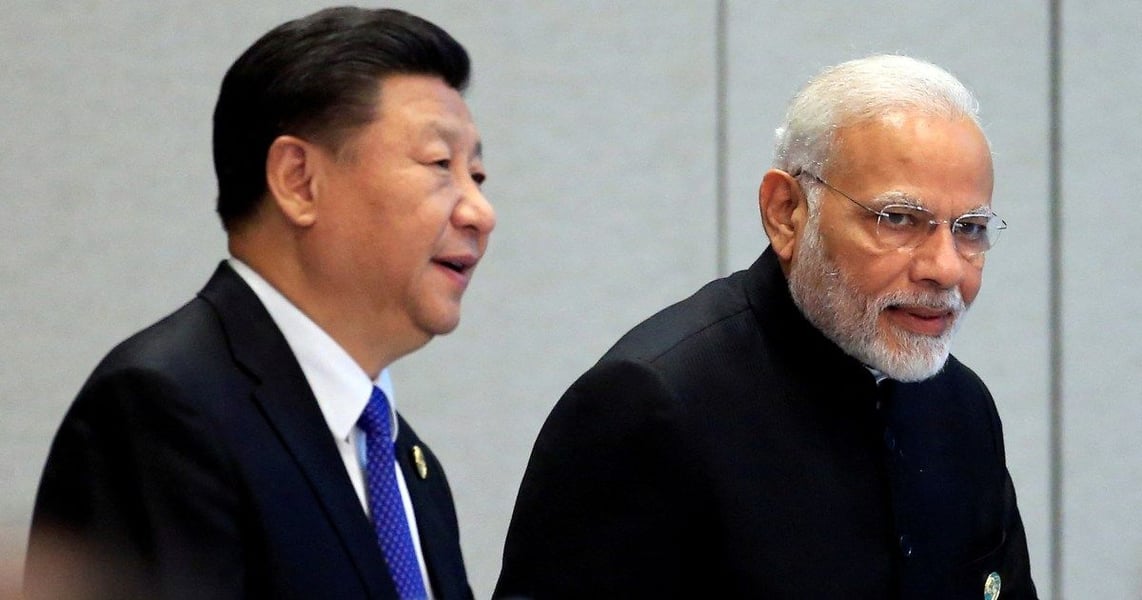
The summit’s most consequential bilateral was between Modi and China’s Xi Jinping. Xi’s arrival in New Delhi marked his first visit to India in seven years — a gap that began with a bitter 2020 border clash. The two leaders discussed what India’s foreign ministry described as “a mutually acceptable resolution” to the border issues. Chinese state media quoted Xi saying Beijing and New Delhi are “partners, not adversaries.” That language would have been inconceivable four years ago. India had been building toward the summit through intensive diplomacy with both Russia and China in the weeks prior.
Less clear by late Saturday was whether Xi had met separately with Pezeshkian. At a regional security summit in Kyrgyzstan last month, the two leaders met only briefly on the sidelines, skipping the full bilateral their relationship would normally require. The speculation that followed was sharp: was Beijing signaling dissatisfaction with the war and the Hormuz closure? Was Xi managing his exposure ahead of his scheduled meeting with Donald Trump in Washington later this month?
“A substantive bilateral meeting in New Delhi would therefore carry significance well beyond protocol,” said Hamidreza Azizi, senior Iran analyst at the International Crisis Group. “It could help clarify whether China still sees Iran as a strategic partner worth investing political capital in at a moment of acute pressure, or whether Beijing is increasingly keeping Tehran at arm’s length.”
De-dollarization — the BRICS effort to reduce global dependence on the United States dollar — occupied the center of the economic agenda. Alexander Gabuev, director of the Carnegie Russia Eurasia Center in Berlin, noted that BRICS nations are “really wildly underperforming” relative to the rhetorical opportunity the current fracturing of global order has handed them. The Eastern Herald reported separately on the bloc’s endorsement of a dollar-alternative payment network as the most concrete step yet toward reducing dollar dependence.
Trump, at the start of his second term, warned that any country attempting to create a new BRICS currency could “say goodbye to selling into the beautiful U.S. economy.” An alternative reserve currency is not imminent. India has nonetheless proposed linking member banking systems to allow settlement in local currencies, and is already purchasing Russian oil with rupees and rubles. The momentum toward a world where the dollar competes rather than simply dominates is real, even if the destination remains unspecified.
South Africa’s President Cyril Ramaphosa arrived in New Delhi carrying his own complications. His government participated in BRICS naval exercises off the South African coast in January that included Iran — drawing a public rebuke from Washington. NPR reported that Pretoria had hoped to use the bloc to extract diplomatic movement on the Gaza genocide and the Iran conflict, but those ambitions have run into the bloc’s inability to reach consensus. David Africa, an international relations analyst based in Cape Town, put it plainly: “South Africa has knocked its head and realizes it won’t extract much diplomatically on the issues it’s concerned about.”
What BRICS produced this weekend was more modest than its rhetoric: a joint photograph of the world’s most consequential leaders, a declaration nobody was proud of but nobody refused to sign, and the quiet demonstration that the world does not require American permission to convene. Whether that amounts to a new global order, or merely evidence of an old one in accelerating disorder, is the question New Delhi leaves unanswered.