
TEHRAN — The man who controls Iran’s parliament stepped before the cameras on Sunday with two messages that, taken together, revealed something seven months of fighting had not: Tehran is not unified on how to end this war.
Mohammad Bagher Ghalibaf, the parliament speaker and a former Islamic Revolutionary Guard Corps commander, said the Strait of Hormuz would remain closed until all of Iran’s conditions were satisfied. Then, in remarks reported by The National, he warned that competing approaches inside Tehran posed real risk: the divide between those who wanted to keep fighting and those who wanted to negotiate threatened to produce either prolonged crisis or premature concessions to Washington.
Neither outcome, he suggested, was acceptable.
Ghalibaf’s conditions for reopening the strait are publicly stated and formally repeated: the release of Iranian frozen financial assets abroad, the lifting of US sanctions on Iranian oil and gas exports, and the end of the US naval blockade of Iranian ports that Washington reimposed in August after the June memorandum of understanding unraveled. Speaking in parliament, with his statement confirmed by the Times of Israel, he was direct: “We must both fight and negotiate. We must fight sensibly and decisively and negotiate with authority and rationality at the right time.”
But the internal division warning was new in its candor. And it arrived from a figure not on the outer fringe of Iranian politics. Ghalibaf is among the most powerful men in the system, accountable to the same revolutionary framework he was now implicitly saying was under internal strain.
A public rift had been building since August, as The National reported, between Ghalibaf and Iran’s ultraconservative establishment, most starkly represented by Hossein Shariatmadari, the Kayhan editor who accused the parliament speaker of abandoning revolutionary principles by entertaining any diplomatic dialogue at all. Ghalibaf has argued that Iran must fight and negotiate simultaneously, using military pressure to build leverage and then converting that leverage into recognition of Iranian rights. That is not a soft position. But in the binary logic of Iran’s current wartime atmosphere, it has been treated as one.
Sunday’s statement showed Ghalibaf defending both sides of the argument at once. He maintained Iran’s position on the Strait of Hormuz while acknowledging the cost of maintaining it.
Iran is under severe economic pressure. IMF estimates put inflation near 70%, the rial has collapsed, and unemployment is rising. A closed strait that once offered strategic leverage is now imposing an economic burden Iran’s civilian economy was not designed to sustain indefinitely.
Ghalibaf did not specify how long Tehran believes it can continue—and no Iranian official has provided a precise timeline. The 60-day memorandum of understanding signed by Trump and President Masoud Pezeshkian in June expired in mid-August without a breakthrough, and Washington rejected an extension.
At the time, a senior Iranian official said the United States had “a few weeks” to meet its commitments before further talks became meaningless. Those weeks have now passed.

What both tracks share is a refusal to move first.
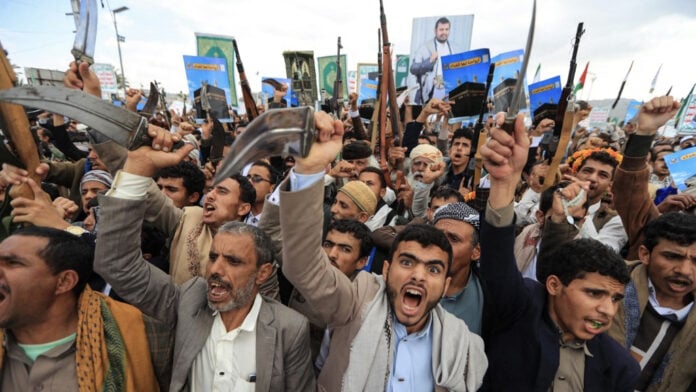
The Houthi front has added another layer of pressure. Iran’s allies in Yemen struck Riyadh’s airport fuel depot on Saturday for the first time in the conflict, escalating the war into Saudi territory and testing the Mecca Defence Alliance. That pact, signed in August between Riyadh, Ankara, and Islamabad, is still trying to establish operational credibility. Saudi Arabia is now a theatre of a war Iran did not formally initiate.
None of this appears to be softening Ghalibaf’s public line. The conditions remain what they have been: money, oil, and the end of the naval blockade. The difference in Sunday’s statement was the acknowledgment that holding those conditions carries political costs inside Iran itself, costs visible enough that a senior legislator felt compelled to name them.
That acknowledgment is the telling detail. The shipping standstill that pushed global trade toward Russia’s Northern Sea Route is sustainable for Moscow and Beijing, both of which benefit from the disruption. It is considerably less sustainable for Tehran, whose oil revenue depends on straits it claims to control but cannot currently monetize. Washington’s naval blockade, reimposed in August, is not producing surrender. But it is producing the internal friction Ghalibaf described on Sunday.
Whether that friction ultimately sharpens Iran’s demands or quietly erodes them is the one question this war has not yet answered.