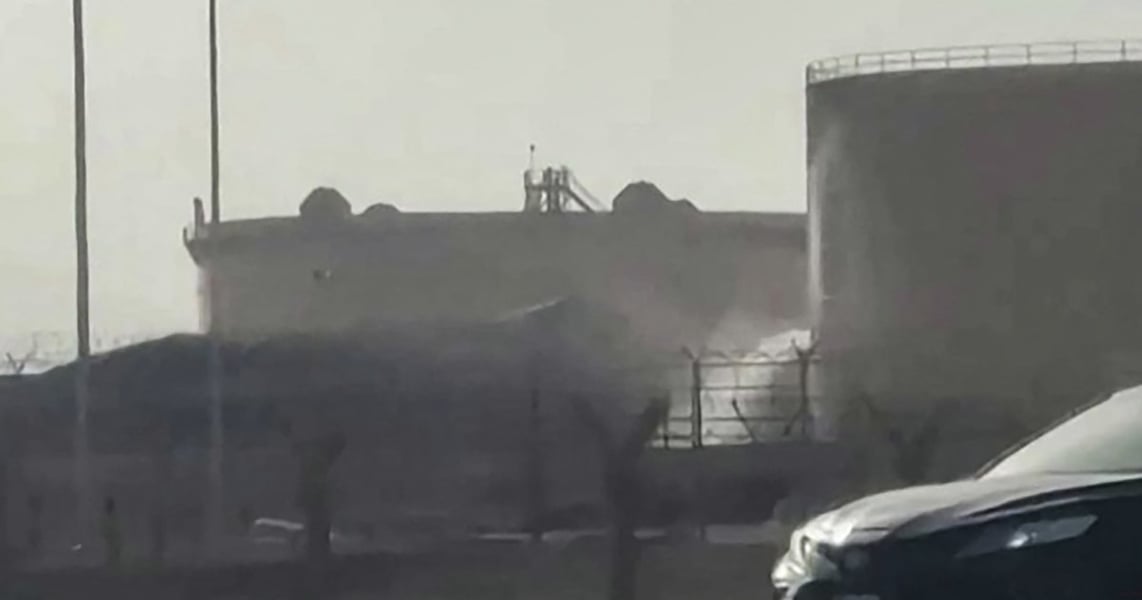

RIYADH — Air-raid sirens sounded over the Saudi capital shortly after midnight Friday. By the time residents reached their windows, a column of black smoke was rising near King Khalid International Airport, visible across much of the city.
Houthi forces had struck Riyadh itself for the first time in the current conflict.
Yemen’s Ansarallah movement claimed responsibility Saturday for two simultaneous strikes: an attack on what Houthi military spokesman Yahya Saree described as “sensitive sites” in the Saudi capital using “a large number of ballistic and cruise missiles and drones,” and a separate operation targeting Saudi Aramco facilities in the Red Sea port of Yanbu. In Riyadh, the strikes set a fuel depot near King Khalid International Airport ablaze, with photographers on the ground documenting firefighters battling a burning tank embossed with the Aramco logo. Residents reported hearing explosions through the night. Saudi authorities issued the capital’s first air raid alert since fighting resumed between Saudi Arabia and the Houthis in July, as NBC News reported.
The Saudi-led coalition said its air defense systems intercepted at least one ballistic missile fired toward Riyadh. Coalition forces also said they foiled Houthi attacks on Bish, Farasan, Taif, and Yanbu. Saudi authorities placed the number of wounded across all operations at 73, though that figure has not been independently verified. Flight tracking service FlightRadar24 reported significant disruptions at King Khalid International Airport, including cancellations and delays across regional routes.
The targeting of Riyadh represents a deliberate expansion in geographic scope. Previous Houthi operations in recent weeks had concentrated on oil infrastructure in the kingdom’s south and west, earlier ballistic missile barrages at King Khalid Air Base in the country’s interior, and maritime interdiction along the Red Sea. Striking the capital, home to more than seven million people and the seat of the Al Saud family, moves this conflict into political and psychological territory that infrastructure damage alone cannot reach. It signals a movement confident in its range and, for now, unwilling to calibrate toward de-escalation.

The Houthi-Saudi ceasefire collapsed in July after a Saudi-backed Yemeni government airstrike on Sanaa Airport killed dozens of civilians. What followed was a systematic campaign against Saudi energy and military infrastructure. Houthi attacks had displaced more than 94,000 people in the two weeks before Friday’s strike, drawing a vow from Riyadh of a “firm” response that has not materialized with decisive force. The kingdom’s position has been constrained: the Trump administration twice declined Saudi Arabia’s requests for direct military action against Houthi positions, and has instead dispatched envoys to meet Houthi representatives in Muscat, reportedly without Saudi knowledge. Whether a burning fuel depot visible from King Khalid International Airport’s terminal windows changes Washington’s calculus is the question Riyadh awoke Saturday having to ask.
Saudi Arabia had earlier sought Beijing’s intervention, asking China to press Tehran to restrain Houthi operations. That diplomatic channel produced engagement without cessation. On Saturday, Saree separately rejected Saudi accusations of targeting Mecca, calling the allegation “a great lie” and framing it as an attempt to recruit outside condemnation against the movement. The Houthis’ stated conditions for ending hostilities remain unchanged: Saudi Arabia must halt attacks on Yemen and lift its blockade, conditions the kingdom has not accepted, as NPR reported.
What happens at UNGA’s diplomatic margins is uncertain. Saudi Foreign Minister Prince Faisal bin Farhan Al Saud is expected in New York for High-Level Week. The attack leaves him with a live grievance and a fresh justification for pressing Gulf states, European partners, and Washington for more forceful commitment. Whether that argument lands differently now that Riyadh’s airport perimeter was on fire Friday night is something the assembled delegations will be calculating.
At King Khalid International Airport on Saturday morning, flights were resuming as firefighters extinguished the last of the blaze. The fuel depot was a ruin. For the Houthis, the point had been made. For Saudi Arabia, the more important question remains unanswered: who will help them make one back.