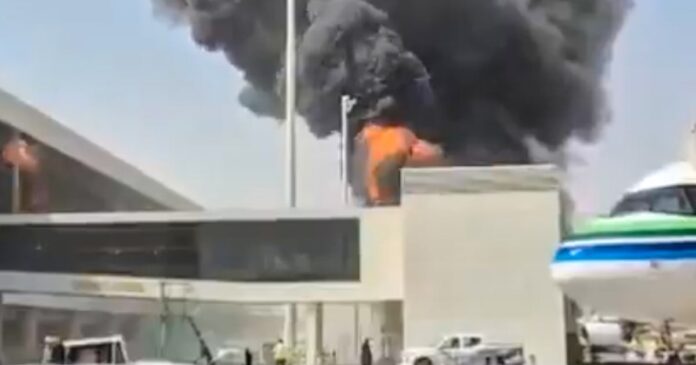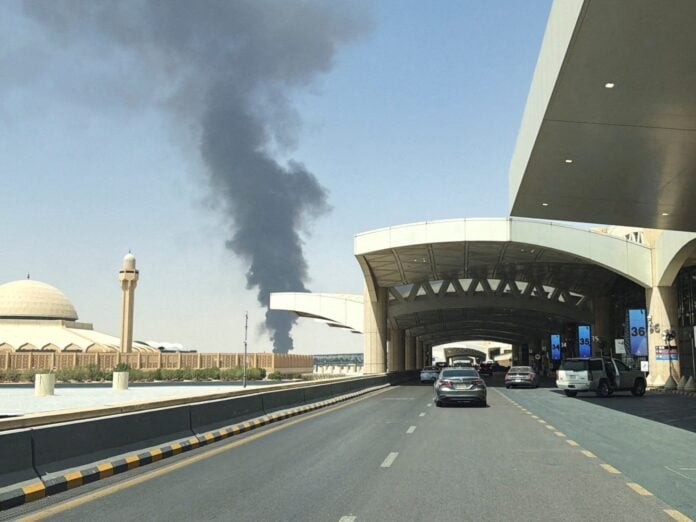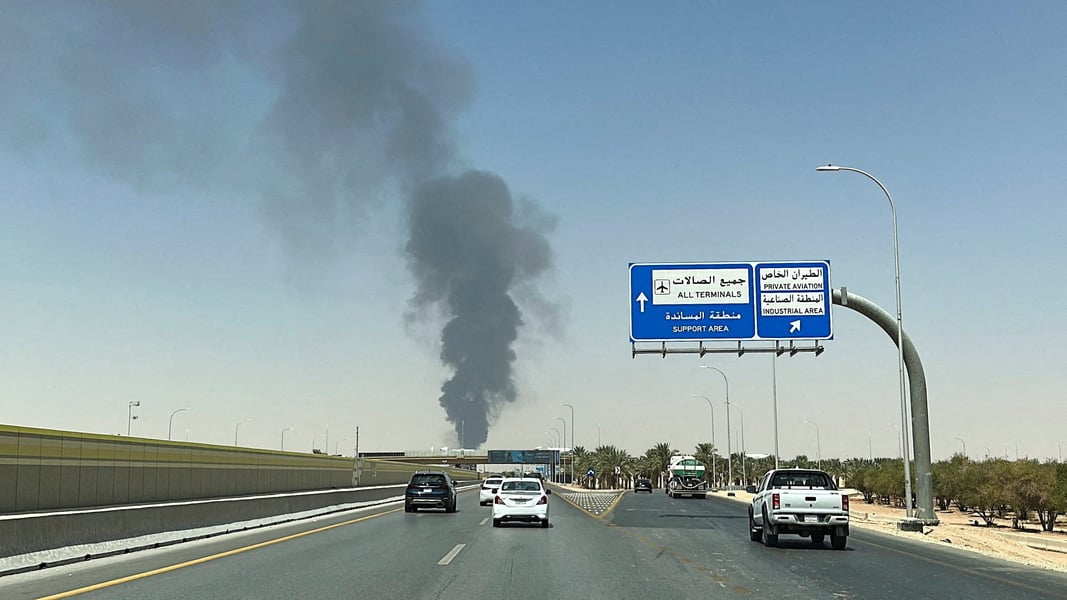

RIYADH — Just after dawn Saturday, firefighters began containing a blaze at a fuel depot near King Khalid International Airport. Black smoke rose over the Saudi capital for hours, a startling sight in a city that had not heard an air-raid alert since the latest fighting began.
The Saudi-led military coalition later confirmed that the cause was a ballistic missile fired by Yemen’s Houthi rebels—the first direct attack on Riyadh since the current escalation began.
The Royal Saudi Air Defense Forces said they intercepted and destroyed the missile. The Aramco-branded fuel tank that caught fire was most likely hit by debris from the interception.
Houthi military spokesman Yahya Saree said on Telegram—his accounts on other platforms have been suspended—that the group conducted two operations simultaneously: one targeting sensitive sites in Riyadh and another aimed at Saudi Aramco facilities in the port city of Yanbu.
The coalition said it also thwarted attacks targeting Bisha, Taif, and Farasan.
Saree said the strikes were a direct response to more than 120 Saudi air operations against Yemen in the preceding three days. Saudi Arabia, which backs the Yemeni government’s campaign against the Houthis, has continued bombing Yemen throughout the Iran war, and the Houthis have treated those operations as an active front in the same conflict. In their framing, Saudi Arabia’s formal neutrality toward the Iran war and its continued military campaign inside Yemen are not separate postures; they are the same war.
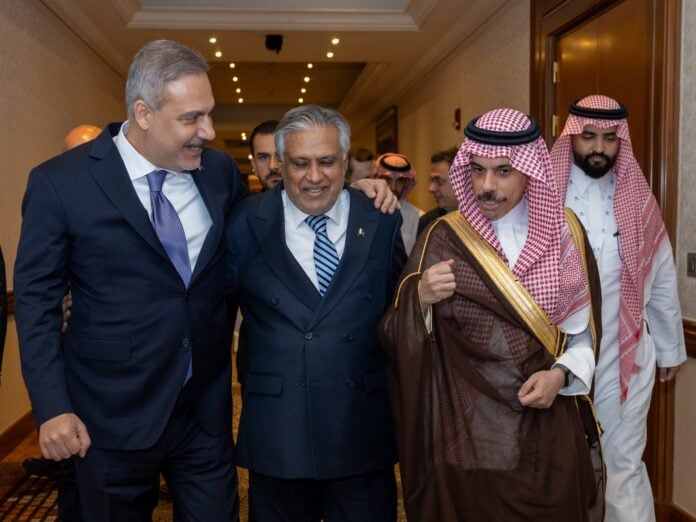
The timing layered additional significance onto the attack. Crown Prince Mohammad bin Salman and other Gulf Cooperation Council leaders were in New York for the United Nations General Assembly when the Riyadh alert sounded. As the Saudi foreign ministry was coordinating positions for UNGA sideline meetings, the capital the Crown Prince had left behind was under attack. Trump met with GCC leaders in New York on Saturday, in discussions described by senior US officials as focused on a postwar framework for Iran. What a ballistic missile over Riyadh does to those conversations is an open question. It may sharpen Saudi Arabia’s demand for written security guarantees before any settlement. It may also signal to Washington that Riyadh cannot insulate itself from the conflict regardless of how carefully it has tried to stay out.
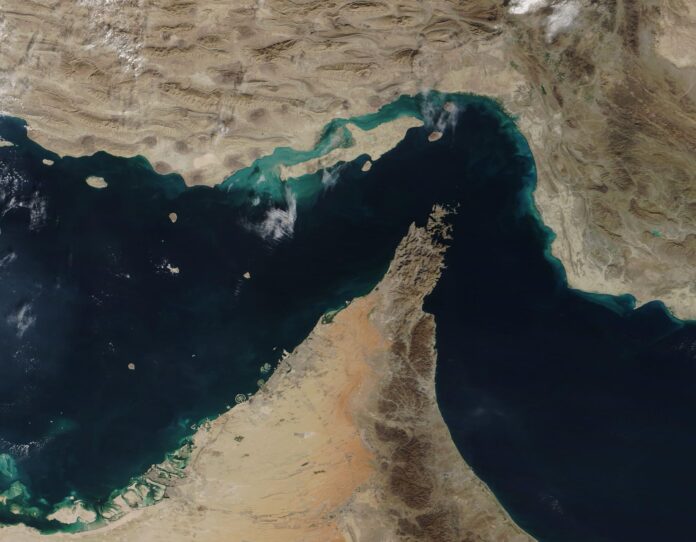
Saturday’s attack came ten days after Saudi Arabia shut down its East-West crude oil pipeline, the kingdom’s primary land route for exports while the Strait of Hormuz remains largely impassable. A drone struck a pumping station on September 10, causing a fire; the pipeline was shut as a precaution the following day. The pipeline had been carrying four to five million barrels per day, roughly four to five percent of global supply, and its shutdown helped push crude oil above $100 a barrel for the first time in more than a year. An Aramco depot burning near the Riyadh airport represents the second direct strike on the kingdom’s energy infrastructure inside two weeks. Whether the blaze affected fuel supply to the capital, Saudi Aramco had not confirmed by Saturday evening.
For seven months, Saudi Arabia had maintained a careful distance from the US-Israel strikes on Iran. It did not join the coalition, did not offer bases, and did not supply intelligence. That posture reflected the Crown Prince’s long-term read: that the kingdom’s interests required neutrality between its American patron and its Gulf neighbor. The Houthis, whose territorial reach has expanded substantially since February, have now tested the limits of what that neutrality buys. They seized the port city of Mokha on the Red Sea coast in early September, advancing toward Perim Island and the Bab el-Mandeb Strait, through which roughly 12 percent of world trade passes in peacetime. Keeping the Bab el-Mandeb open has been a core Saudi security objective for years.
The Iran war, now in its eighth month, has produced no ceasefire and no credible diplomatic offramp. Iran’s conditions for talks, as articulated by security chief Mohsen Rezaei on Friday, include an end to the war on all fronts, the unfreezing of Iranian assets, and the lifting of the naval blockade. The US has not publicly accepted or rejected any of those terms. In the absence of a settlement, the regional actors most exposed bear the costs of a conflict between principals who are not yet ready to stop.
Al Jazeera reported that the Saudi coalition statement came hours after the dawn attack, consistent with Riyadh’s pattern of confirming incidents only after completing an initial damage assessment. NPR noted that this was the first time the Saudi capital has been targeted in the current round of fighting, a threshold the kingdom had maintained through weeks of attacks on its northern and western regions.
The question that neither the Saudi military nor any official source has answered is what Riyadh intends to do next. The last time Houthi-linked forces struck deep into the Saudi heartland — the 2019 Abqaiq strikes that briefly knocked out half of the kingdom’s oil production — Riyadh’s response was a kind of stunned restraint, followed by a decision to pursue a quieter Yemen track. That calculus has since been overtaken by an Iran war the Crown Prince did not seek and could not prevent. Saturday’s smoke over Riyadh was the war’s latest bill.