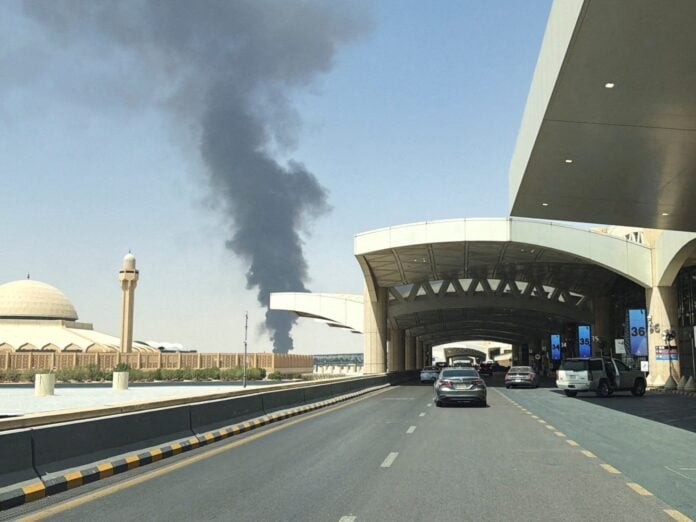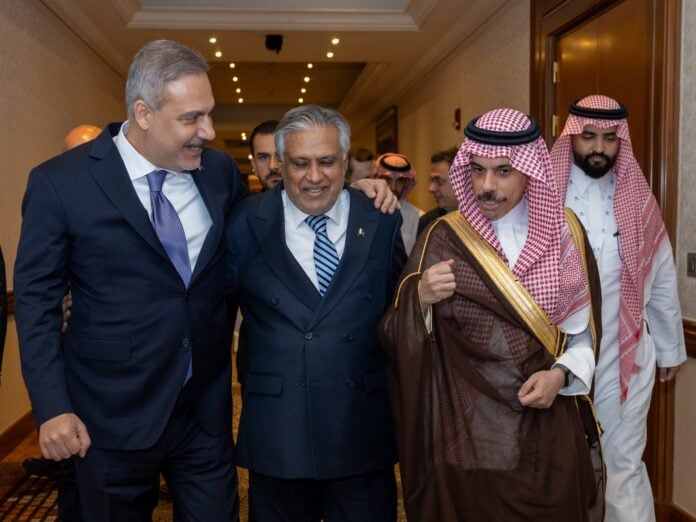

ANKARA — The morning after a Houthi ballistic missile struck an Aramco fuel depot near Riyadh’s main international airport, Turkey’s foreign minister said something that would have been unthinkable three years ago: Ankara was prepared to help Saudi Arabia meet its military needs.
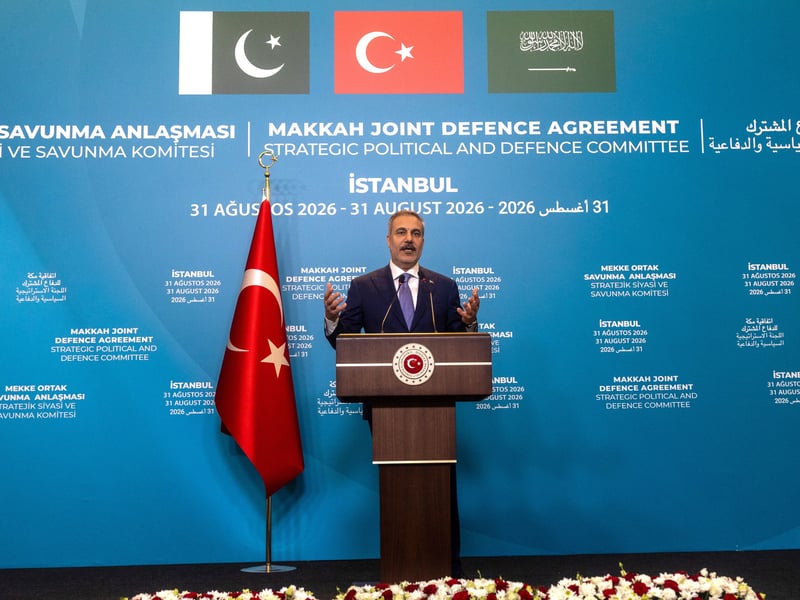
Speaking to broadcaster NTV on Saturday, Hakan Fidan framed the offer carefully. Saudi Arabia “may have some military needs, especially on some technical issues,” he said, adding that Turkey “would have no issues in meeting these.”
Fidan did not specify what equipment or assistance Turkey had in mind, nor whether Riyadh had requested it.
But the message was clear. In a live crisis, Turkey was invoking the Mecca Joint Defence Agreement for the first time.
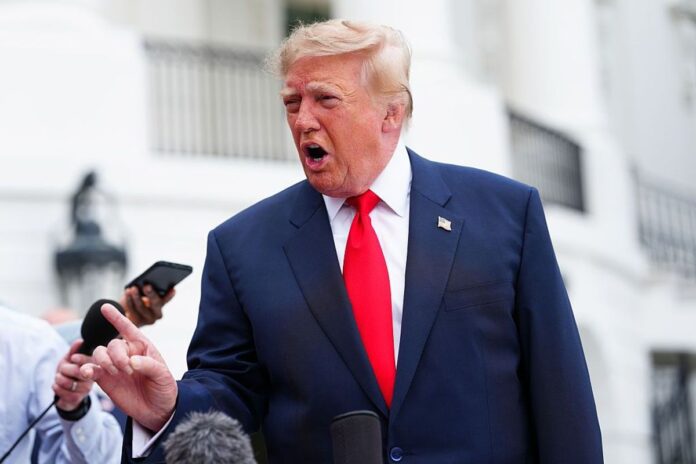
The pact, signed on August 7 by Crown Prince Mohammed bin Salman, Turkish President Recep Tayyip Erdoğan, and Pakistani Prime Minister Shehbaz Sharif, was built on a principle borrowed from NATO: an armed attack on any one of the three countries is to be treated as an armed attack on all three. The signing ceremony in Mecca came as a direct response to Saudi Arabia’s growing anxiety that American security guarantees could no longer be taken for granted, an anxiety confirmed in the most pointed way when United States President Donald Trump declined a Saudi request to strike Houthi launch sites in Yemen earlier this week.
Fidan added a second charge to his remarks: it was “unacceptable” for Saudi Arabia to be dragged into the US-Iran war, he said, because Riyadh “had no desire to join the conflict.” Turkey was positioning the offer not as escalation but as a substitute for American protection that Washington was actively withholding.
Turkey’s role in the pact is defined by technology. Under the agreement’s broad framework, Saudi Arabia provides financing, Pakistan provides manpower, and Turkey provides what Fidan described as “deep tech defence equipment”: air-defence systems, drones, electronic warfare platforms, and the drone manufacturing expertise that Ankara has spent a decade developing, according to Al Jazeera. What the pact does not provide is the procedural machinery that makes NATO actually function: no joint command structure, no standing forces, no specified trigger mechanism, no agreed timeline for responses.
Fidan acknowledged the gap when asked directly, saying the country requesting assistance sets the terms, and the others decide how to respond. That ambiguity was on full display within hours. Pakistan’s foreign minister offered his own formulation: there was no military response currently under discussion, Islamabad said. Pakistan would act “when the time comes.” The distance between Ankara’s forward posture and Islamabad’s studied caution is itself revealing: the pact’s three members, shaped by different strategic pressures, are not yet reading from the same script.
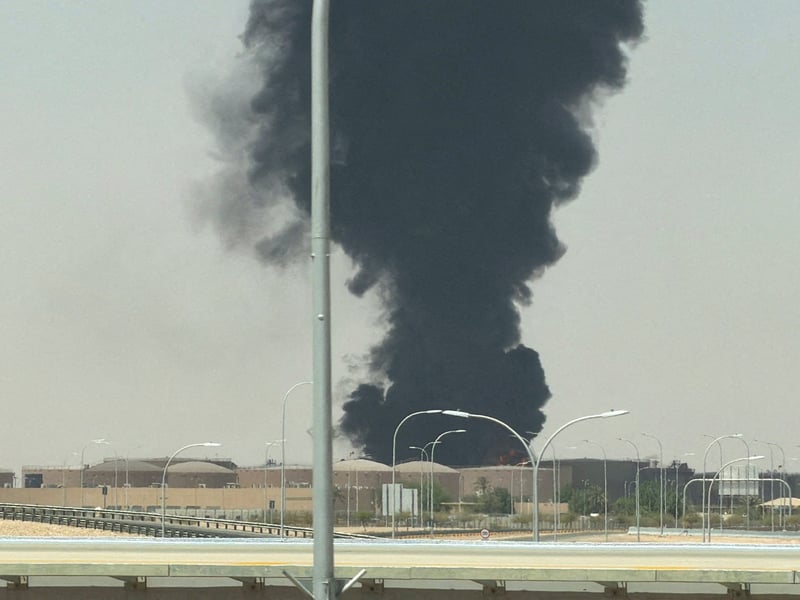
That interceptability problem is precisely where Turkey believes it has something to offer. Ankara’s Hisar family of short-range air-defence systems has been used to intercept drone attacks inside Turkish territory since the Iran conflict widened in 2026, and the Turkish defence industry has aggressively marketed both Hisar and Bayraktar-series surveillance platforms to Gulf states. A bilateral defence technology transfer to Saudi Arabia, operating under the Mecca Pact’s umbrella, would give Ankara a strategic foothold in the peninsula that no previous Turkish-Saudi relationship had established.
What Fidan did not address is whether any of this can move fast enough to matter. Integrating foreign air-defence systems, training operators, and certifying interoperability with existing Saudi radar infrastructure is a process measured in months, not days. In the immediate term, Riyadh remains exposed.
The deeper question Fidan’s offer raises is whether the Mecca Pact is an instrument of genuine collective security or a political statement its signatories have not yet decided how to operationalise. Analysts consulted by Al Jazeera noted that Fidan’s remarks had not been accompanied by any formal Saudi request or joint announcement, raising the possibility that Turkey was signalling willingness before being asked, a posture designed as much for audiences in Washington and Tehran as for Riyadh.
Trump has made clear he will not authorize US strikes in support of Saudi Arabia. That refusal, more than any Houthi missile, is the structural condition the Mecca Pact was designed to answer. Whether a defence framework among three countries with overlapping but distinct strategic interests can perform the functions that a security guarantee from the world’s dominant military power would have performed is the question Fidan’s words on Saturday put directly, and that no one has yet answered.