
MENLO PARK, California — The device that stands to matter most at Meta’s Connect conference on Tuesday has no camera, no display, and no lens. It does, however, have six microphones.
That device, codenamed Luna, arrives at Meta’s annual developer keynote alongside two pieces of hardware further up the ambition ladder: a first-look at Artemis, the company’s first consumer augmented-reality glasses, and a live demonstration of Project Phoenix, a tethered headset built specifically to make holographic video calls feel like the person is in the room. The three devices together draw the clearest map yet of where Meta thinks computing is going, and what the company needs to prove to get there.
The keynote begins September 23 at 4 p.m. Pacific from Meta’s Menlo Park campus, streamed live. The developer state of the union follows September 24 at 10 a.m. Pacific.
Luna, the camera-free glasses Meta is expected to announce Tuesday, addresses a specific credibility problem the company built for itself. Smart glasses with cameras have had a rough year. Meta’s Ray-Ban Meta line attracted Harvard students who turned them into a public facial recognition demonstration, a moment that set off a privacy panic that outlasted any news cycle. In June, Meta quietly shipped a facial recognition feature in its smart glasses app without telling users, a disclosure the company made only after questions, not before.
Luna removes the camera entirely. What remains: six directional microphones, speakers positioned close to the ear so audio stays private, a button on the temple arm for calling up the assistant, and Meta Muse, the personal AI agent Meta launched in September, running natively on the device. Luna is designed for the people who want ambient AI: the ability to ask questions, take notes, or manage notifications without pulling out a phone, but who don’t want a camera on their face. Two frame designs, Clubmaster and Burbank, are expected at launch, with shipping targeted for October.
The camera-free approach is practical for the current moment, but it’s also a positioning decision. Dropping the lens let engineers slim the temples significantly, bringing Luna’s frame closer to regular prescription glasses than the Ray-Ban Meta hardware. The tradeoff is visible: without a camera, Luna can’t identify objects, read menus, or perform the real-time visual tasks that Meta has been showcasing for two years. What it can do, it does quietly and without surveillance associations.
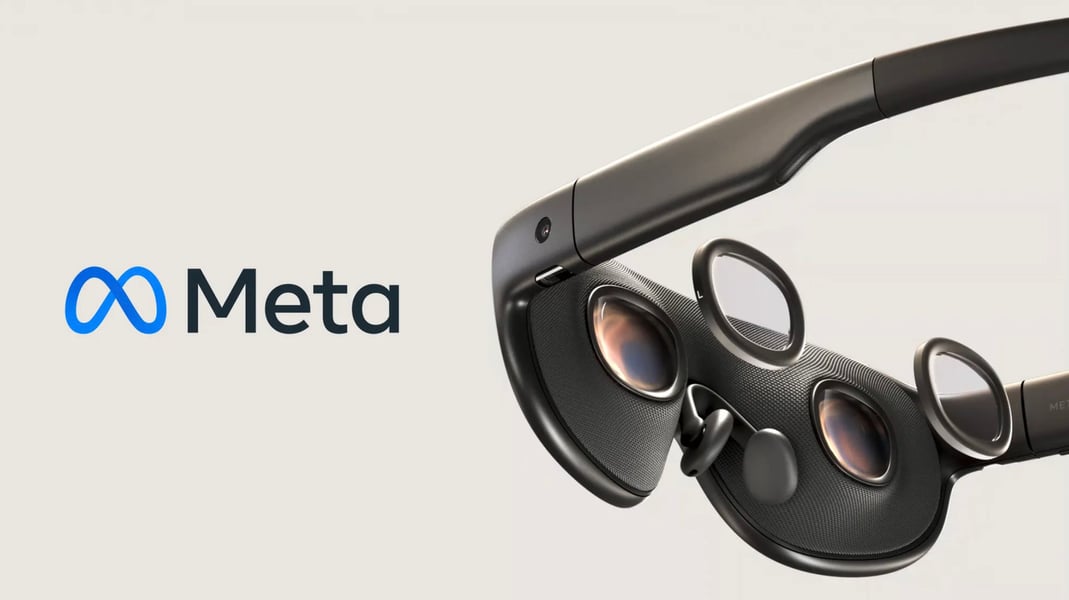
The third piece of hardware at Tuesday’s keynote is the most speculative and the most technically impressive. Project Phoenix is a slim glasses-like device tethered to a compute puck, a design that offloads battery and processing weight from the head, allowing the frame itself to be lighter than an untethered headset could be. Mark Zuckerberg and chief technology officer Andrew Bosworth reviewed the technology in August and scheduled a live keynote demonstration, according to Engadget reporting ahead of the event: Bosworth will appear to Zuckerberg as a full-body photorealistic hologram, a capability built on eleven years of Codec Avatars research.
The Codec Avatars system works through inward-facing and SLAM sensors that track facial expressions and body position, driving a high-fidelity real-time reconstruction of the other person. The comparison that immediately arrives is Apple’s visionOS Personas, the floating-head spatial video feature that launched with Vision Pro. The difference Meta is positioning is full-body presence at a price and form factor it claims can be a first-half-2027 consumer product, not a $3,499 enterprise device. Apple moved in the opposite direction. After Vision Pro’s adoption stalled, Apple chief executive John Ternus made the decision to cancel successors and redirect engineering resources toward smart glasses expected in 2027, placing the two companies on a direct collision course.
The underlying infrastructure that powers all three products came into production this month. Meta’s Iris AI chip, developed with Broadcom and manufactured by TSMC as part of the company’s MTIA program, began manufacturing in September. Iris is intended to reduce Meta’s compute dependency on Nvidia, handling inference workloads for services that feed directly into what runs on the glasses: the AI assistant, real-time translation, and the recommendation systems embedded in Muse. It is a supporting story for Connect, not a headline, but the silicon development matters for the same reason the glasses do: Meta is trying to own as much of the AI wearables stack as it can before the hardware matures enough to attract serious competitors.
How much of Tuesday’s slate will be demonstration versus shipping product remains unannounced. Luna’s October shipping timeline is credible from pre-event reporting. Phoenix is described as a demo, with a commercial launch expected no earlier than 2027. Artemis testing begins at the conference; a consumer price and release date have not been named.
The AI wearables race is already in motion beyond Connect. Just last week, industry leaders gathered for the White House AI Summit, with compute infrastructure and wearable interfaces among the central subjects. Whether any of Tuesday’s hardware accelerates that conversation depends less on what Meta announces and more on whether the demonstrations hold up under the scrutiny of a public keynote, live at 4 p.m. Pacific.