On May 4, 1976, a polished brass and aluminum sphere lifted off from Vandenberg Air Force Base in California, slipped past the boundary where the sky turns black, and settled into an orbit nearly 5,900 kilometers above the planet. It carried no electronics, no sensors, no transmitters, and no fuel. It carried, instead, a message that nobody alive today is meant to read.
The satellite is called LAGEOS-1, short for Laser Geodynamic Satellite, and it is one of the simplest objects ever lofted into orbit. A sphere about 60 centimeters across, weighing roughly 400 kilograms, studded with 426 reflectors set into its surface like the facets of a faceted gem. Its purpose, on paper, is austere. Ground stations fire laser pulses at it. The light bounces back. The timing, measured to fractions of a nanosecond across dozens of observatories around the world, reveals the slow creep of the planet’s tectonic plates, the wobble in Earth’s rotation, and the minute shifts of its center of mass.
But sealed inside the satellite, bolted between the two hemispheres that form its body, is something stranger. Two identical stainless steel plates, each about 10 by 18 centimeters, etched with a message designed by the astronomer Carl Sagan during the same restless period he was working on the Voyager Golden Record. The plate is not a letter. It is a diagram. It is a clock. And it is timed to be discovered only when the satellite, after roughly 8.4 million years aloft, finally tumbles back through the atmosphere and is opened by whoever, or whatever, happens to be standing on Earth when it returns.
A satellite built to outlast its makers
LAGEOS-1 is the rare spacecraft engineered for endurance through deliberate simplicity. A satellite with electronics fails when the electronics fail. A polished metal sphere in a stable medium-Earth orbit has almost nothing to go wrong. NASA’s original engineers estimated that the satellite could remain in orbit for about 8.4 million years before atmospheric drag finally pulls it down, according to the agency’s own mission history.
That timescale is what makes the satellite philosophically extraordinary. It will outlast not just its mission, not just the laser-ranging stations that talk to it, not just the engineers who built it, but most of the recorded geological change humans have ever measured. By the time it comes down, the continents themselves will have rearranged themselves into a pattern no atlas today recognizes.
Because of that, NASA decided to put a message inside.
What Carl Sagan etched into the metal
NASA turned to Sagan, then at Cornell University’s Laboratory for Planetary Studies, to design something a finder could read without sharing a language, a script, or a moment in history. What he produced, drawn with the artist Jon Lomberg, is a study in restraint.
The upper portion of the plaque establishes a vocabulary. The numbers one through ten are written in binary notation, the simplest counting system available. Beside them is a small schematic of Earth orbiting the Sun, with the binary number one placed below the orbit. That one stands for one revolution of the Earth, one year. With that, the unit of time used by the rest of the plaque is fixed.
The lower portion of the plate carries the heart of the message: three maps of Earth’s surface, stacked vertically, each labeled with a date in binary. According to the Goddard Space Flight Center’s description of the design, the first map shows the continents about 268 million years in the past, gathered into the single landmass of Pangaea. The second shows the continents as they appeared at launch, in 1976. The third shows a predicted arrangement of the continents roughly 8.4 million years in the future.
That third date is not arbitrary. It is, to within the precision of an engineering estimate, when LAGEOS-1 is expected to return. The plaque is dated to roughly when it will be found.
A clock measured in continents
The logic of the three maps is the logic of a clock with no hands. Continents drift at a rate of roughly a few centimeters a year, slow but relentless and, across millions of years, vast. A finder who recovers LAGEOS-1 can compare the arrangement of continents on the plate to the arrangement of continents they see around them and read off, in rough terms, how much time has passed since the satellite was placed in the sky.
The plate dates itself by the geography of the planet it fell back to. The method etched on the plaque and the purpose of the mission itself are, at root, the same idea: continental drift as the slow hand of a planetary clock. The satellite was built to measure the same physical process that the finder will use to date it.
NASA cautions that the maps were not intended as precise reconstructions. They are diagrams meant to convey something dramatic about deep time, not survey maps of a vanished or future world. The message is the gesture, not the cartography.
Not a message for aliens
It is worth being precise about what the LAGEOS-1 plaque is not. It is not, in the usual sense, a message to extraterrestrials. The Voyager and Pioneer plaques and records, designed by Sagan around the same years, are leaving the solar system and may, on the longest of timescales, be intercepted by something not from Earth. LAGEOS-1 is going nowhere. It is in orbit around Earth and, eventually, it will return to Earth.
The plaque is addressed to whoever happens to be on the planet when the satellite comes down. The honest description of that audience is that it is unknown. It may be a later human civilization, building on the wreckage of this one. It may be something descended from us, in a form unrecognizable today. It may be no one at all.
The plate does not assume a finder will exist. It assumes only that if one does, the most useful thing to hand them is a way to know when the object they are holding was made. That is the same modest logic behind the uranium clock etched on the back of the Voyager Golden Record. The designers did not predict a recipient. They prepared for the possibility of one.
Sagan’s broader instinct
The plaque fits into a pattern of work that defined the latter half of Sagan’s career. He was a planetary scientist by training, an experimenter on the Mariner, Viking, Voyager, and Galileo missions, and a consultant to NASA from the 1950s onward. He helped design messages for the Pioneer plaques and the Voyager records, and he repeatedly pushed for spacecraft to carry some statement of where they came from and when. A NASA biographical sketch notes that his role in the American space program began at its very beginning, with briefings to the Apollo astronauts before their flights to the Moon.
What unites the Pioneer plaques, the Voyager record, and the LAGEOS plate is not optimism. It is a particular kind of intellectual humility about time. Each of those objects was made in the full awareness that its designers would be long gone before any finder, if any finder ever existed, encountered it. Each is, in its own way, a bottle thrown into a sea whose far shore the throwers will never see.
What 8.4 million years means
The number is the part worth sitting with. LAGEOS-1 is expected to return roughly 8.4 million years from now. That is a span longer than the existence of the human species to date. Anatomically modern humans appeared something like 300,000 years ago. The earliest members of the genus Homo are perhaps two to three million years old. The satellite, once it returns, will have been aloft for longer than the entire arc of the human lineage as currently understood.
Whoever, if anyone, opens it will be separated from the year 1976 by more time than separates 1976 from the apes that walked upright in East Africa. The plaque was designed in full knowledge of that. It is why the message carries no words, no faces, no fragments of a particular language or politics. Words drift faster than continents. Names erase. The one clock the designers trusted to still be running was the slow rearrangement of the land itself.
Still working, still ticking
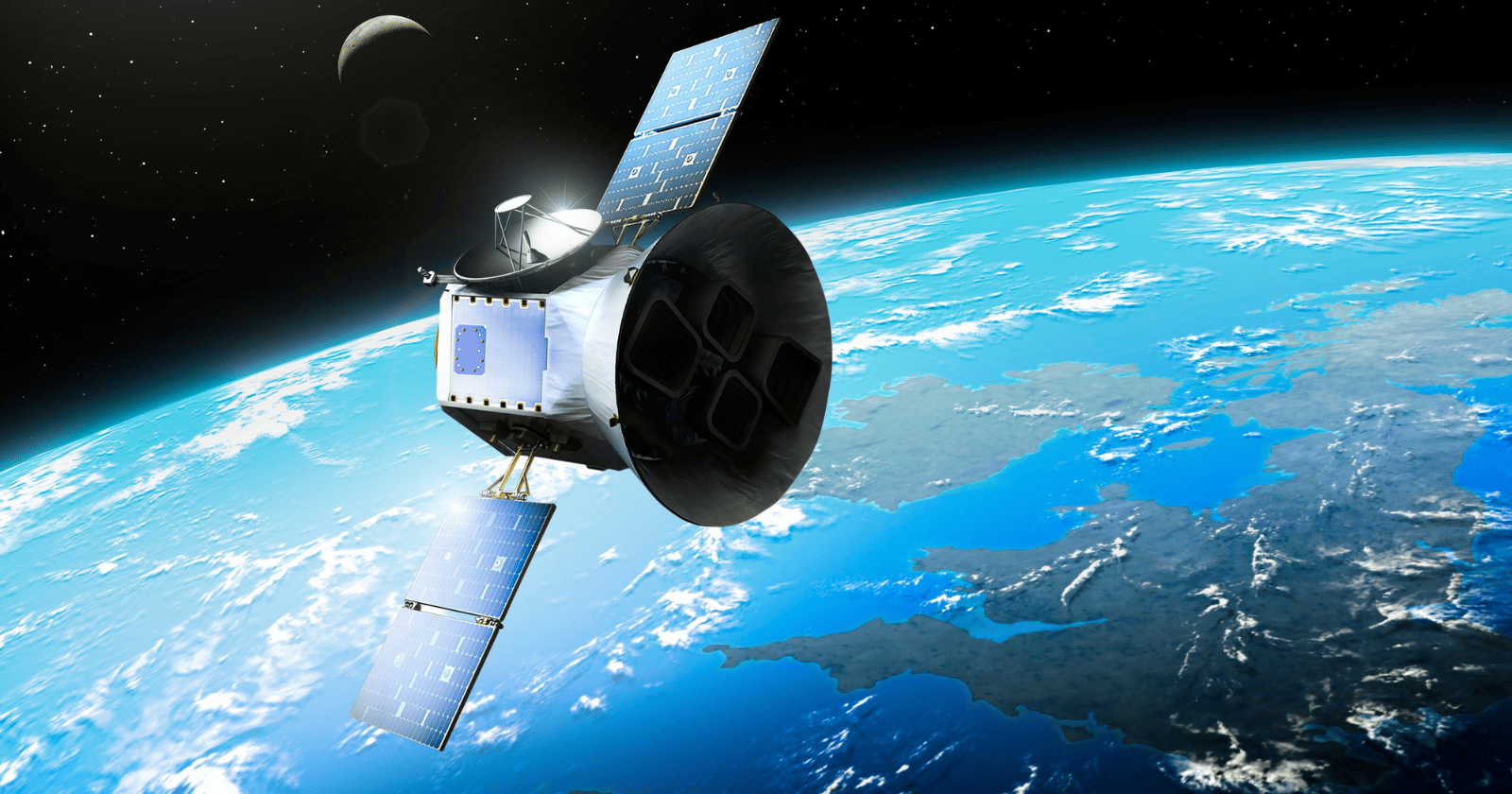
That work threads through almost every modern orbital operation, from the navigation systems aboard cargo flights to the International Space Station to the precision tracking that underwrites missions far more publicly visible. The two LAGEOS spacecraft uniquely define the origin, or center point, of the terrestrial reference frame, anchoring it to Earth’s center of mass. They are, fittingly, the points around which all the other measurements turn.
The mission’s longevity has quietly placed it in a category occupied by very few other spacecraft. Among the agency’s most enduring missions are the probes whose service lives have stretched past every realistic expectation, from the far-flung instruments of the Voyager program still returning faint data from interstellar space to the newer flights returning lunar samples and crew, including the recent Artemis II splashdown that returned astronauts after a lunar flyby. None of those missions, however ambitious, are designed for the kind of timescale LAGEOS-1 was given.
The strange grace of the gesture
There is something disarming about the LAGEOS plate as a piece of design. Most messages humans send to the future are written for a future we expect to look something like the present. Time capsules buried beneath cornerstones imagine a recipient with newspapers and dictionaries, someone who will recognize a photograph and read a label.
The LAGEOS plaque imagines none of that. It refuses to assume a shared language, a shared script, or a shared species. It hands the finder, whoever they are, the one thing it can be sure they will be able to verify: a picture of where the continents used to be. A picture of where the continents were when the message was sent. And a picture of where the continents, if the physics holds, will be when the message is opened.
It is a message that dates itself by the planet itself. It assumes the planet will be there. It assumes someone, somewhere, will be standing on it. And it assumes, with a kind of austere optimism, that the slow drift of land is the one clock that will still be running.
Eight point four million years from now, give or take a few hundred thousand, a battered brass sphere is expected to fall through Earth’s atmosphere. If someone finds it, and if they pry it open, they will see the diagram Sagan drew. They will compare the third map to the world outside. And, if continental drift has done what it has always done, the two pictures will roughly match.
That match is the message. The match is the date. The match is the closest thing to a signature any of us will ever be able to leave behind.