
China is pulling ahead of the United States in the contest to plant the first permanent human foothold on the Moon, and the gap, according to one of the most candid assessments yet from inside the space-investment world, is widening.
The country’s centralized, state-directed lunar program is moving at a pace and consistency that Washington has struggled to match, even as NASA prepares for its first crewed lunar landing this decade. Beijing is now positioned to reach the lunar south pole, the strategic prize of the new space age, before the United States, and to begin laying the groundwork for an outpost that could anchor its presence on the surface for generations.
“From some perspective, it’s probably a good shift, because what we clearly see right now as well is that China is one or two steps ahead of the U.S., and that is why to cover this gap, the U.S. should do quite a lot in the defense and the lunar base areas,” said Viktor Shpakovsky, who oversees a United States based venture capital fund focused on space technology. His warning lands at a moment of unusual political crosswinds in the American program. “No one in the White House really cares about the science anymore, but everyone cares about the politics,” he added.
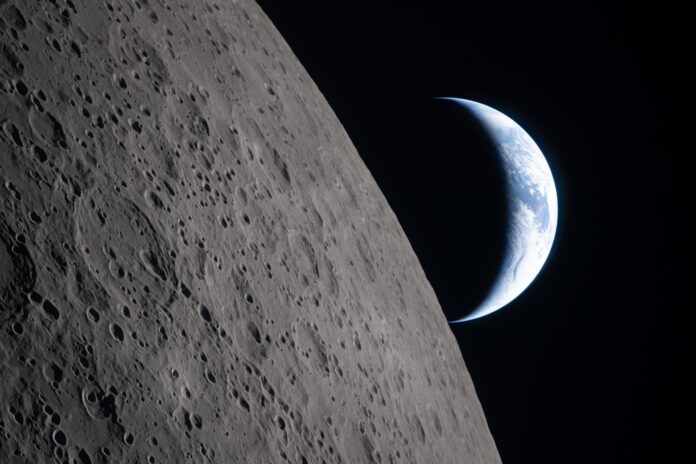
The assessment cuts against the triumphant tone that surrounded the Artemis II mission in April, when three American astronauts and one Canadian astronaut completed a ten-day journey that carried them around the far side of the Moon and returned them safely to Earth. The flight was the first crewed voyage beyond low Earth orbit since Apollo 17 in 1972, and it was widely framed in Washington as proof that the United States was once again the dominant power in deep space.

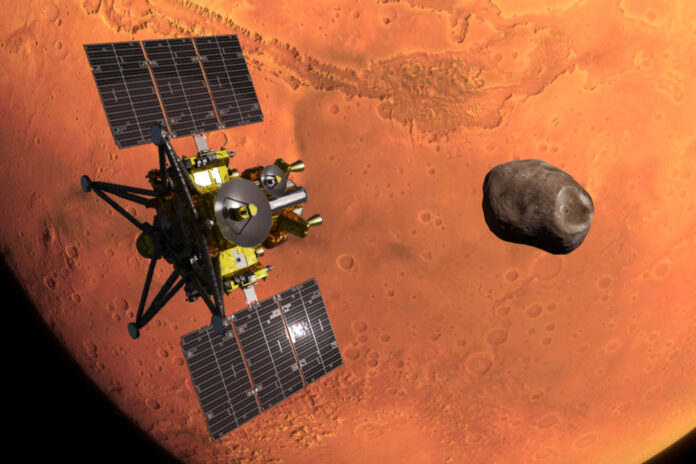
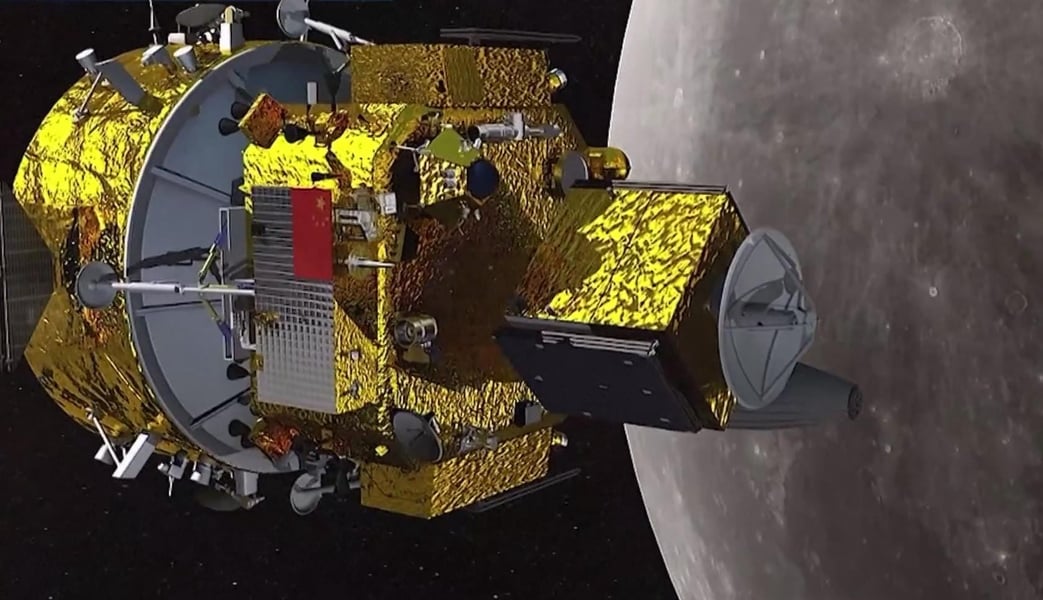
That mission, Chang’e 7, is scheduled to launch in the second half of 2026 aboard a Long March 5 rocket from the Wenchang Satellite Launch Center on Hainan Island. The spacecraft, already delivered to the spaceport, is a stack of four elements: an orbiter, a lander, a rover, and a first-of-its-kind hopping probe designed to leap from sunlit ridges into the permanently shadowed craters where scientists believe water ice has been preserved for billions of years. The hopper carries a water-molecule analyzer intended to confirm, on the ground, the presence and distribution of that ice.
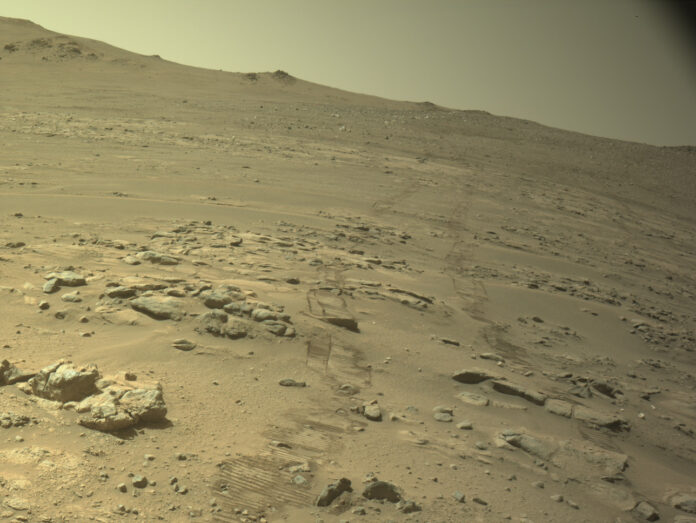
The target is the rim of Shackleton Crater, one of the coldest and most coveted patches of real estate in the solar system. Permanently shadowed craters at the south pole are believed to hold reservoirs of frozen water, hydrogen, and helium, resources that could be converted into drinking water, breathable oxygen, and rocket propellant. Whoever proves their abundance and extractability first will shape the architecture of every lunar base that follows.
NASA is pursuing the same prize through its revived Volatiles Investigating Polar Exploration Rover, or VIPER, mission, which is now slated to be delivered to the south pole by Blue Origin’s Blue Moon Mark 1 lander no earlier than 2027. That gap, perhaps a year, perhaps several, is the heart of the warning from inside the industry. “The Chinese will be ahead of everyone else by at least one year, but probably several years,” Norbert Schörghofer, a senior scientist at the Planetary Science Institute who studies lunar volatiles, has said of the Chang’e 7 timeline.
The difference is not only one of dates. It is one of design. China’s lunar program operates as a single, continuous national project, planned and funded across decades, immune to the four-year political cycle that has repeatedly redirected American space ambitions. The Chinese Lunar Exploration Program has moved through orbiting, landing, and sample-return phases since 2007 without a single failure, and is now entering the construction phase of the International Lunar Research Station, a robotic and eventually crewed outpost being built in partnership with Russia and a growing roster of partner nations.
Chang’e 7 will be followed around 2028 or 2029 by Chang’e 8, which will test in-situ resource utilization, including experiments to manufacture bricks from lunar regolith, and may carry a humanoid robot. Together, the two missions are designed as the foundation of the research station that China intends to operate at the south pole in the 2030s. The Chang’e 7 spacecraft will also carry payloads from Russia, Egypt, Bahrain, Italy, Switzerland, and Thailand, a diplomatic counterweight to the United States led Artemis Accords and a clear signal that Beijing intends to build a coalition of its own off-world.
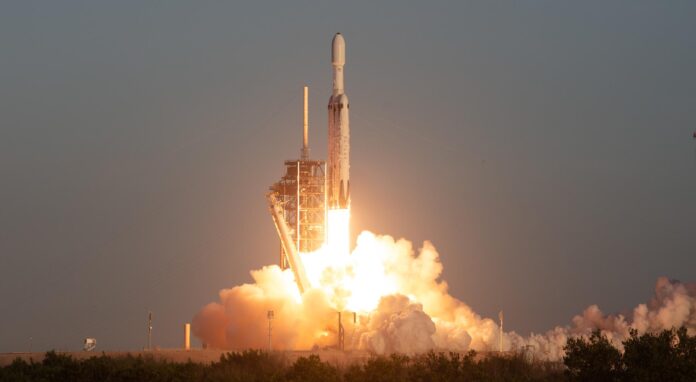
The American program, for all its hardware achievements, is operating in a more politically charged environment. The Artemis architecture has been reshaped repeatedly under successive administrations, and the recent rollout of the Artemis III core stage from the Michoud Assembly Facility to Kennedy Space Center underscored how much of the program’s near-term schedule still depends on integration milestones that have slipped before. Industry executives privately concede that the next eighteen months will determine whether the United States can still credibly claim it will be first back to the surface.
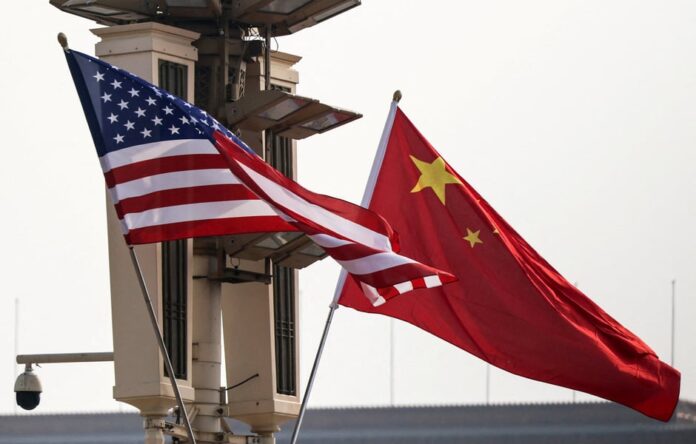
The geopolitical backdrop has only sharpened the stakes. President Trump’s recent state visit to Beijing produced a string of trade announcements, including a pledge to purchase two hundred Boeing jets, but the underlying contest over advanced technology and strategic terrain has not eased. Officials in both capitals describe the lunar south pole in terms once reserved for the South China Sea or the Arctic, a place where the rules of access, ownership, and exploitation will be written by whoever gets there first and stays.
For Washington, the political calculation has become uncomfortably clear. The Apollo era was driven by an existential rivalry that gave the program insulation from the ordinary tides of domestic politics. The new race is unfolding inside an American system that no longer offers that protection, against a rival that has built its program precisely to avoid such interruptions. The result is a competition in which the United States still holds a technological edge in many areas, but China increasingly sets the pace.
If the hopper aboard Chang’e 7 succeeds in jumping into a shadowed crater later this year and confirms accessible water ice, the implications will travel far beyond a single mission. They will accelerate Chinese plans for a crewed landing by 2030, strengthen the case for the International Lunar Research Station, and force a reckoning in Washington about whether the country’s lunar program is moving fast enough to defend the high ground it once owned alone.
The Moon, for the second time in human history, has become a measure of national resolve. This time, the country setting the pace is not the one that planted the first flag.