REYKJAVÍK — The question on Iceland’s ballot Saturday was specific: should the government resume negotiations toward European Union membership? The argument behind it had been building for two years, shaped by a US president who kept suggesting he might want to acquire a neighboring territory.
Polling stations opened at 9 a.m. local time, with results expected in the early hours of Sunday morning. The final survey before voting, conducted by the Maskína polling agency on Friday, placed support for resuming talks at 50.4 percent and opposition at 49.6 percent. By 11 a.m., just over 8 percent of Reykjavík’s eligible voters had cast ballots, compared with 5 percent at the same point during the 2024 parliamentary elections. More than 40,000 people, nearly 15 percent of the 270,000-strong electorate, had voted before election day in early balloting.
A yes vote would not commit Iceland to EU membership. It would authorize the government to reopen accession negotiations, which would eventually produce a membership deal that Icelanders would vote on in a second referendum. What Saturday’s ballot decides is whether those talks should begin again at all.
Iceland applied to join the EU in 2009, propelled by the wreckage of a financial crisis that eliminated much of its banking sector in weeks. Negotiations began in 2010 and progressed through 27 chapters, with 11 provisionally closed, before a Eurosceptic government placed them on hold in 2013. Two years later, Iceland formally withdrew its candidacy; the step still stands as one of the EU’s few formal retreats on enlargement. The center-left government that won the 2024 election on a referendum pledge found, upon inquiry, that Brussels had never invalidated the application. The EU confirmed Iceland could resume where it left off.
What changed between 2015 and today is not primarily inside the EU. It is in Washington.
President Donald Trump’s repeated suggestions that the United States might seek to acquire Greenland, a Danish autonomous territory that sits just northwest of Iceland, have alarmed Reykjavík in ways that years of EU enlargement arguments had not. The 1951 US-Iceland defense agreement underpins Iceland’s security architecture; Trump’s framing of Arctic sovereignty as a negotiable commodity injected a note of uncertainty into that arrangement that diplomats have been unable to dismiss. Tobias Etzold of the European Policy Centre told Euronews that growing doubt over US reliability, combined with an adversarial Russia, had injected “fresh dynamism” into a dormant EU discussion.

“The country’s critical infrastructure is under constant attack by Russian actors, and it needs to be secured,” said Magnús Magnússon, who chairs Iceland’s main EU advocacy platform. Russian cyberattacks on Icelandic systems have been cited by pro-EU campaigners as evidence that existing arrangements leave the country exposed. NATO has itself acknowledged expanding Russian and Chinese ambitions in the High North and increased its activity in the region. EU Foreign Policy Chief Kaja Kallas put the strategic case directly: “From Russian threats to seabed infrastructure to China’s growing interest in the Arctic, addressing these together gives us greater leverage.”
Iceland is a member of the European Economic Area, which grants it access to the EU’s single market and requires adoption of roughly 75 percent of EU regulations; approximately 9,000 legal acts in all. That figure is central to the Eurosceptic argument. Haraldur Ólafsson, who leads the Heimssýn platform opposing EU accession, argued that since the relationship already functions at such depth, formal membership would add constraints without adding meaningful benefits.
The constraint that matters most to skeptics is the catch limit. Fishing accounts for 6.5 percent of Iceland’s GDP. The EU’s Common Fisheries Policy sets quotas that would override Iceland’s ability to manage its own waters; a previous dispute over mackerel allocations produced years of trade friction between Iceland and EU member states. Fisheries Iceland, the sector’s main body, said EU membership would leave the country without “the power to act as an independent coastal state.”
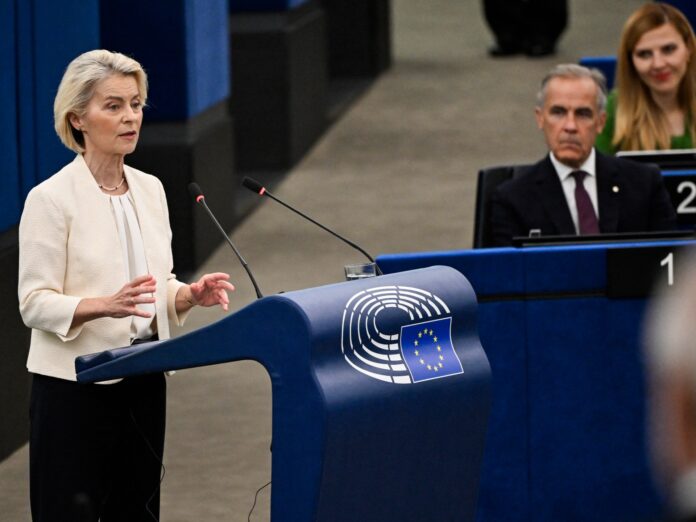
The European Commission has signaled room for maneuver. EU Enlargement Commissioner Marta Kos said Brussels may find “common ground” on fisheries issues and estimated that Iceland could formalize accession negotiations by 2027 if the referendum passes. European Commission President Ursula von der Leyen, who visited Reykjavík in July 2025, described Iceland and the EU as sharing “values” and being “like-minded,” though she stopped short of endorsing any specific concession on catch rights.
Iceland’s Finance Minister Daði Már Kristófersson offered a domestic economic case: EU membership could help stabilize the economy as inflation continues to squeeze household budgets. The argument is contested; critics point out that EEA membership already provides most of the market access benefits without the full regulatory burden.
The results expected Sunday morning will answer the first question. Whether a yes vote survives contact with the actual terms of negotiation is not something the ballot can settle. Fisheries arrangements acceptable to Reykjavík and to the EU’s existing members have not been found in a decade of on-and-off discussion. The political consensus that is barely sufficient to authorize restarting talks in 2026 would need to hold through years of negotiations whose outcome is genuinely unknown.
What drove Iceland back to the ballot box is plainer. With Ukraine peace negotiations at a standstill and the same week’s Russian drone strikes deepening Europe’s military emergency, the security arrangements Iceland relied on for seventy years look less settled than at any point since the Cold War. The generation of voters who withdrew Iceland’s EU candidacy in 2015 faced a different world. Their successors are deciding, one ballot at a time, whether the world they are operating in requires different answers.