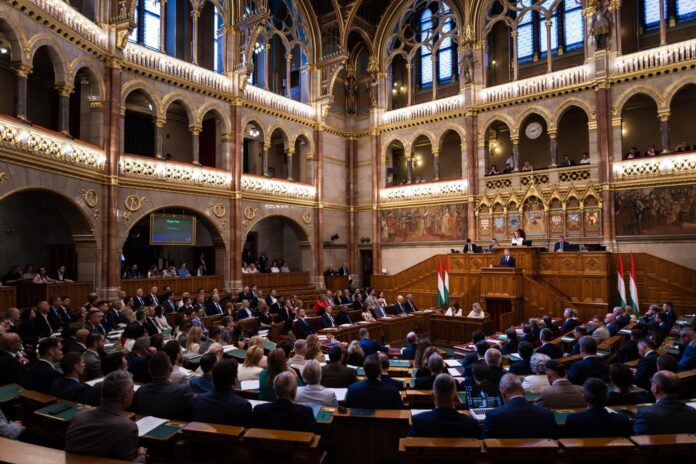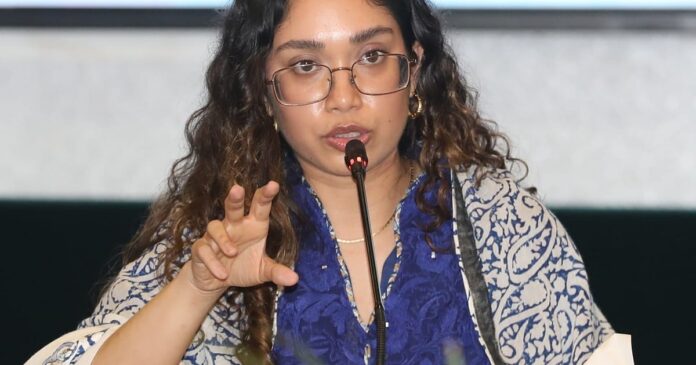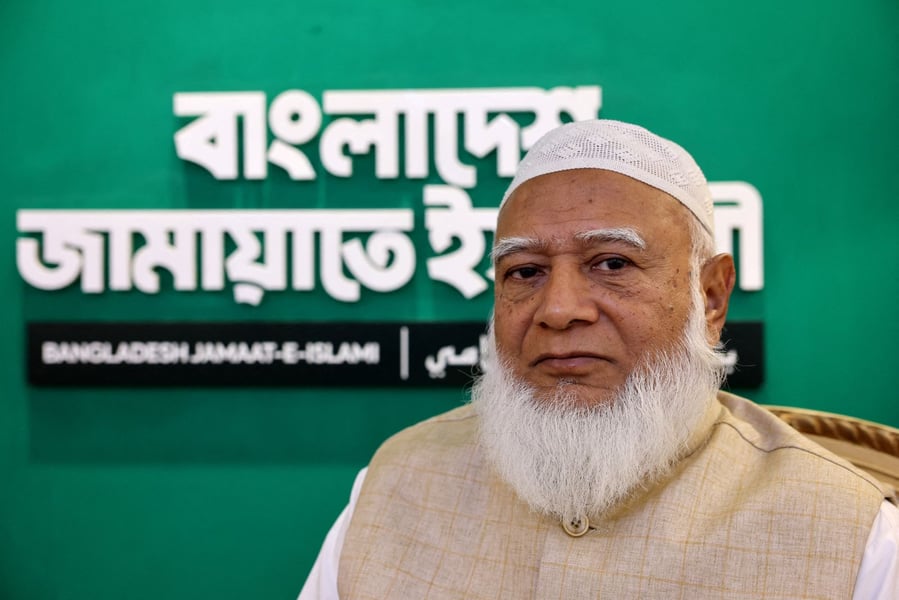

On 19 July 2025 Shafiqur Rahman was speaking to a crowd at Suhrawardy Udyan in Dhaka, the park where Bangladesh’s independence was declared, when he stopped and fell. Surgeons at United Hospital opened his chest and performed a four-vessel bypass. He was 66. Seven months later he was sworn in as Leader of the Opposition in the Jatiya Sangsad, the first person from Bangladesh Jamaat-e-Islami ever to hold the office.
That distance, from a hospital theatre to the opposition front bench in seven months, is the shortest way to describe what has happened to Shafiqur Rahman and to the party he runs. In 2019 he took charge of an organisation that was barred from the ballot, whose most senior figures had been hanged, and whose leader was arrested in the middle of the night three years later. In February 2026 that organisation won 68 seats and 31.76 per cent of the national vote, the best result in its history.
This page is a reference profile of Shafiqur Rahman: who he is, how a government doctor from Sylhet came to lead Bangladesh’s largest Islamist party, what he has actually said on the record, what he has declined to say, and where the claims about him are contested rather than settled.
| Field | Detail |
|---|---|
| Full name | Dr Shafiqur Rahman |
| Born | 31 October 1958, Bhatera, Kulaura, Sylhet district (now Moulvibazar) |
| Profession | Physician, MBBS, Sylhet MAG Osmani Medical College, 1983 |
| Party | Bangladesh Jamaat-e-Islami |
| Current office | Leader of the Opposition, Jatiya Sangsad, since 17 February 2026 |
| Constituency | Dhaka-15, won 2026 |
| Party office | 4th Ameer of Bangladesh Jamaat-e-Islami, since 12 November 2019 |
| Previously | Secretary-general 2016 to 2019; Ameer of Jamaat’s Sylhet unit from 1984 |
| Imprisonment | Arrested December 2022, released on bail after 15 months |
| Family | Married Ameena Begum, 5 January 1985; two daughters and one son |
| Biographical details are those the party and Rahman have stated publicly; Bangladesh has no compulsory candidate-disclosure audit for them. | |
Who is Shafiqur Rahman?
He was born on 31 October 1958 in Bhatera, a village in Kulaura in what was then Sylhet district and is now Moulvibazar, to Abru Mia and Khatibun. He passed his SSC at Baramachal High School in 1974 and his HSC at Murari Chand College in Sylhet in 1976, and qualified MBBS from Sylhet MAG Osmani Medical College in 1983. He married Ameena Begum on 5 January 1985. They have two daughters and a son.
The medical training is not incidental to how he is described. Al Jazeera’s profile of him calls him a soft-spoken former government doctor, and the adjective recurs in almost every account of him, including hostile ones. Ahsanul Mahboob Zubair, one of Jamaat’s assistant secretaries-general and a colleague from the Sylhet years, told Al Jazeera the party’s resurgence came from years of grassroots social work and political survival under repression rather than from any single campaign.
From student left to Islami Chhatra Shibir
The part of the biography that gets least attention is the beginning of it. Between 1973 and 1975 Rahman was in the JaSaD Chhatra League, the student wing of the Jatiya Samajtantrik Dal, a left-wing party. He moved to Bangladesh Islami Chhatra Shibir in 1977 and stayed until 1984, serving as president of its medical college branch and then of the Sylhet district branch. He joined Jamaat-e-Islami itself in 1984 and became Ameer of its Sylhet unit the same year.
| Years | Position or event | Context |
|---|---|---|
| 1973-1975 | JaSaD Chhatra League | Left-wing student politics, before any Islamist affiliation |
| 1977-1984 | Bangladesh Islami Chhatra Shibir | President of the medical branch, then of the Sylhet district branch |
| 1984 | Joins Jamaat-e-Islami; Ameer of the Sylhet unit | The regional base he built here underpins the later national rise |
| 2001 | Contests Moulvibazar-2 | Lost, 12,415 votes, 7.20 per cent |
| 2010 | Assistant secretary-general, central committee | Year Sheikh Hasina establishes the International Crimes Tribunal |
| 19 Sep 2011 | Acting secretary-general | Steps up after ATM Azharul Islam’s arrest |
| 2016 | Secretary-general | The year Motiur Rahman Nizami is executed |
| 2018 | Contests Dhaka-15 | Lost, 39,071 votes, 11.47 per cent |
| 12 Nov 2019 | Elected 4th Ameer | Re-elected 2023 and 2025 |
| Dec 2022 | Arrested on charges of supporting militancy | Held 15 months; name dropped from the accused list in March 2025 |
| 19 Jul 2025 | Collapses mid-speech at Suhrawardy Udyan | Four-bypass open-heart surgery; later discharged |
| 12 Feb 2026 | Wins Dhaka-15 | 85,131 votes, 54.20 per cent |
| 17 Feb 2026 | Leader of the Opposition | Jamaat’s first time in the role |
| Vote figures from Election Commission returns as reported by the state news agency BSS. | ||
He rose slowly and then very quickly. Assistant secretary-general in 2010. Acting secretary-general on 19 September 2011, after ATM Azharul Islam was arrested. Secretary-general in 2016, the year Motiur Rahman Nizami was hanged. Ameer on 12 November 2019, re-elected in 2023 and again in 2025.
Twice he stood for parliament and twice he lost. Moulvibazar-2 in 2001, 12,415 votes and 7.20 per cent. Dhaka-15 in 2018, 39,071 votes and 11.47 per cent. The second of those numbers matters, because he contested the same seat eight years later.

Leading a banned party
Jamaat’s legal status has been in dispute for most of Rahman’s leadership. The High Court moved against the party in 2013. The Election Commission cancelled its registration in 2018 on the ground that its constitution conflicted with the country’s, and specifically that the party had opposed independence in 1971. Sheikh Hasina’s government banned it outright on 1 August 2024. Four days later Hasina was gone, and the interim administration reversed the ban on 28 August.
The decisive ruling came on 1 June 2025, when the Appellate Division under Chief Justice Syed Refaat Ahmed ordered the Election Commission to restore Jamaat’s registration, as Al Jazeera reported at the time. Eight months later the party was the second largest in parliament.
Rahman himself was arrested in December 2022 on charges of supporting militancy and was held for 15 months before securing bail. In March 2025, after the student-led uprising had removed Hasina, his name was dropped from the list of accused. He has never been convicted of anything.
Dhaka-15 and the 2026 result
| Party | Seats | Vote share |
|---|---|---|
| Bangladesh Nationalist Party | 209 | 49.97 per cent |
| Bangladesh Jamaat-e-Islami | 68 | 31.76 per cent |
| National Citizen Party | 6 | Not separately published |
| Independents | 7 | Not separately published |
| Bangladesh Khelafat Majlish | 2 | Not separately published |
| Of 299 constituencies polled, results in 297 were declared; Chattogram-2 and Chattogram-4 were held back under court orders. Jamaat’s 68 seats rise to 77 counting coalition partners, the party’s best result in its history. | ||
Jamaat did not win. That is the first thing to say about February 2026, because the party’s own supporters had been briefed to expect more and some pre-election polling had put it level with the Bangladesh Nationalist Party. BNP took 209 seats on 49.97 per cent. Jamaat took 68 on 31.76 per cent, rising to 77 with coalition partners. The gap in seats is far wider than the gap in votes, which is what a first-past-the-post system does to a party whose support is broad but rarely locally dominant.
| Candidate | Party | Votes |
|---|---|---|
| Dr Shafiqur Rahman | Bangladesh Jamaat-e-Islami | 85,131 |
| Md Shafikul Islam Khan | Bangladesh Nationalist Party | 63,517 |
| Margin 21,614 votes, 54.20 per cent of the seat. Rahman lost the same constituency in 2018 with 39,071 votes. | ||
Rahman’s own seat went the other way. He took Dhaka-15 with 85,131 votes against 63,517 for the BNP’s Md Shafikul Islam Khan, a margin of 21,614 and 54.20 per cent of the constituency. He had lost the same seat in 2018 with fewer than half that number. He was sworn in as Leader of the Opposition on 17 February 2026. Bangladesh’s new prime minister is Tarique Rahman of the BNP, whose government we have covered in the confusion over his Delhi visit.

The manifesto: two trillion dollars by 2040
Rahman launched Jamaat’s manifesto in Dhaka on the evening of 9 February 2026, three days before the vote. Its headline promise was to quadruple Bangladesh’s gross domestic product to two trillion dollars by 2040, through investment in technology-driven agriculture, manufacturing, information technology, education and healthcare, alongside higher foreign investment and increased public spending.
Economists in Dhaka told Al Jazeera the arithmetic did not obviously work, describing the document as heavy on slogans and short on detail. That criticism is worth stating with the number rather than instead of it: two trillion dollars by 2040 implies sustained growth well above anything Bangladesh has managed for a comparable period, and the manifesto did not publish a financing path. What the manifesto was for, analysts told the same outlet, was signalling intent rather than fiscal planning.
The intent it signalled most clearly was anti-corruption. “If Jamaat is elected, we will be servants, not owners,” Rahman said, pledging that his people would refuse ministerial plots and tax-free cars. For a party that has never held national office, an untested promise of clean hands is the one asset no incumbent can match.
Jamaat and 1971: what the party did, and where Rahman was
The single most important thing to establish about Shafiqur Rahman and the liberation war is a date. He was born on 31 October 1958, which made him twelve years old when the war began in March 1971 and thirteen when it ended in December. There is no record of him playing any part in it, on either side, and none is alleged against him. He has said a cousin of his was a freedom fighter killed in the war. The case against him on 1971 is not that he opposed independence. It is that he leads, and has spent four decades building, the organisation that did.
That organisation’s record is not seriously in dispute as a matter of history, only as a matter of Jamaat’s own account of itself. Jamaat-e-Islami opposed the separation of East Pakistan from West Pakistan on the doctrinal ground that the unity of an Islamic state outweighed Bengali nationalism, and it acted on that position. Its leaders and cadres helped raise and staff the auxiliary militias that operated alongside the Pakistan Army, the Razakars from May 1971 and later Al-Badr and Al-Shams. Al-Badr in particular is associated with the killing of Bengali academics, doctors, writers and journalists in the final days of the war, an operation carried out after the military outcome was already decided.
The tribunal, and what it found
Sheikh Hasina established the International Crimes Tribunal in 2010 to try those cases. Between 2013 and 2016 it convicted the most senior generation of Jamaat’s leadership, including the man who was Ameer during the war itself.
| Name | Party role in 1971 or later | Outcome | Date |
|---|---|---|---|
| Abdul Quader Molla | Assistant secretary-general | Executed, the tribunal’s first | 12 December 2013 |
| Ghulam Azam | Ameer, 1971 and after | 90 years; died in custody aged 91 | Sentenced 15 July 2013 |
| Muhammad Kamaruzzaman | Senior assistant secretary-general | Executed at Dhaka Central Jail | 11 April 2015 |
| Ali Ahsan Mohammad Mojaheed | Secretary-general | Executed | 21 November 2015 |
| Motiur Rahman Nizami | Ameer, 2000 to 2016 | Executed for genocide, rape and orchestrating the massacre of intellectuals | 11 May 2016 |
| Mir Quasem Ali | Central executive committee; party financier | Executed at Gazipur | 3 September 2016 |
| Five Jamaat leaders were executed and one died serving a 90-year sentence. Jamaat rejects every verdict and calls the tribunal a political instrument. Human rights organisations including Amnesty International and the International Commission of Jurists criticised the trials on fair-trial grounds while not disputing that 1971 atrocities occurred. | |||
Five Jamaat leaders were executed. Ghulam Azam, the Ameer in 1971, was sentenced to 90 years in July 2013 and died in custody the following year at 91. Motiur Rahman Nizami, Ameer from 2000, was hanged at Dhaka Central Jail on 11 May 2016 after being convicted, in Al Jazeera’s account of the case, of genocide, rape and orchestrating the massacre of top intellectuals.
Two qualifications belong here and are usually omitted by whichever side is arguing. Jamaat rejects every verdict and says the tribunal was a political instrument built to destroy it, and the party is not alone in criticising the process: Amnesty International and the International Commission of Jurists raised fair-trial objections at the time, on procedure rather than on whether the atrocities happened. And the death toll most often cited for the war, around three million, is the Bangladeshi government’s official figure rather than an independently audited one; historians’ estimates vary widely below it. Neither qualification touches the underlying fact of what Jamaat’s position in 1971 was.
The 2026 law that names his party, and what he said in parliament
This history is not a settled archive in Bangladesh. It is live statute, and in April 2026 it landed on Rahman’s desk as Leader of the Opposition.
On 9 April 2026 the Jatiya Sangsad passed the Jatiya Muktijoddha Council (Amendment) Bill, moved by Liberation War Affairs Minister Ahmed Azam Khan. The law defines a Bir Muktijoddha as someone who fought or trained against the Pakistani occupation forces and their local collaborators between 26 March and 16 December 1971, and it names those collaborators in the text: the then Muslim League, Jamaat-e-Islami and Nezam-e-Islam. Rahman’s party is written into Bangladeshi law, by name, as a force that stood against the country’s independence.
He objected on the floor and demanded that Jamaat’s name be struck from the definition. Pressed on the party’s wartime conduct, he did not deny it, contest a specific charge, or offer an account. He said that Allah is the only complete witness to 1971 and that everyone else is a partial one. He also argued that the definitions had been written into law by the Awami League, which he called fascist, rather than by the governments that came immediately after independence.
That is the fullest public answer Shafiqur Rahman has given on the subject, and it is worth reading twice, because it does two things at once. It declines to contest the historical record. It also declines to accept it, by relocating the question somewhere no parliament can follow. The nearest he has come to an admission is language he has used elsewhere, acknowledging Jamaat’s “past mistakes” and asking forgiveness if the party caused harm, a formulation Al Jazeera notes is a shift from outright denial while stopping short of naming a single action or a single person responsible.
There is a reason that ambiguity is hard to read as the beginning of an accounting. On 9 May 2026, a month after the Jamuka vote, the party’s official account published a statement in his name calling on members to uphold Nizami’s ideology and complete his unfinished mission.
Asking forgiveness for unnamed past mistakes while describing an executed war criminal’s mission as unfinished are two positions that cannot both be fully sincere. Which one is the performance is the central unanswered question about Shafiqur Rahman, and nothing in the public record settles it. What can be said precisely is the distinction he has never drawn in public: he was a child in 1971, and he has spent his adult political life declining to separate himself from what the adults in his party did.
Women, the X post, and a hacking claim
On 31 January 2026, twelve days before the election, a post appeared on Rahman’s verified X account arguing that women pushed out of the home “in the name of modernity” were exposed to exploitation, moral decay and insecurity, and that this was “nothing but another form of prostitution”. The post also said women could not lead the party because “Allah did not permit this”.
The reaction was immediate. Students marched at Dhaka University and Jagannath University, and women’s rights organisations accused the party of open misogyny. The post was taken down. Rahman called the viral version false and misleading and said it reflected neither his views nor the party’s. Jamaat then said the account had been compromised in a coordinated cyberattack, that its cyber team regained control within 55 minutes, and that the intrusion had been traced to a Bangabhaban email address. An assistant programmer, Mohammad Sarwar Alam, was detained under the Cyber Security Ordinance 2025.
That account of events has not been independently established, and it should not be reported as though it has. What is on the record without dispute is what Rahman told Al Jazeera directly, in an interview, about whether a woman could lead Jamaat. “Allah has made everyone with a distinct nature,” he said. “When a mother gives birth, how will she carry out these responsibilities? It is not possible.”
The disputed post and the undisputed interview point in the same direction on the substance, which is why the hacking claim, even if true, resolves less than the party would like. The party did nominate its first Hindu candidate in its history at the same election.
The diplomats who now take his calls
The clearest measure of Rahman’s rehabilitation is his diary. Al Jazeera reports that European, Western and Indian diplomats have all sought meetings with him over the past few months, and that Bangladesh’s business elites, who previously engaged with Jamaat discreetly or not at all, now do so openly. A figure widely treated as untouchable is now, in the words of that profile, the man everyone wants to meet.
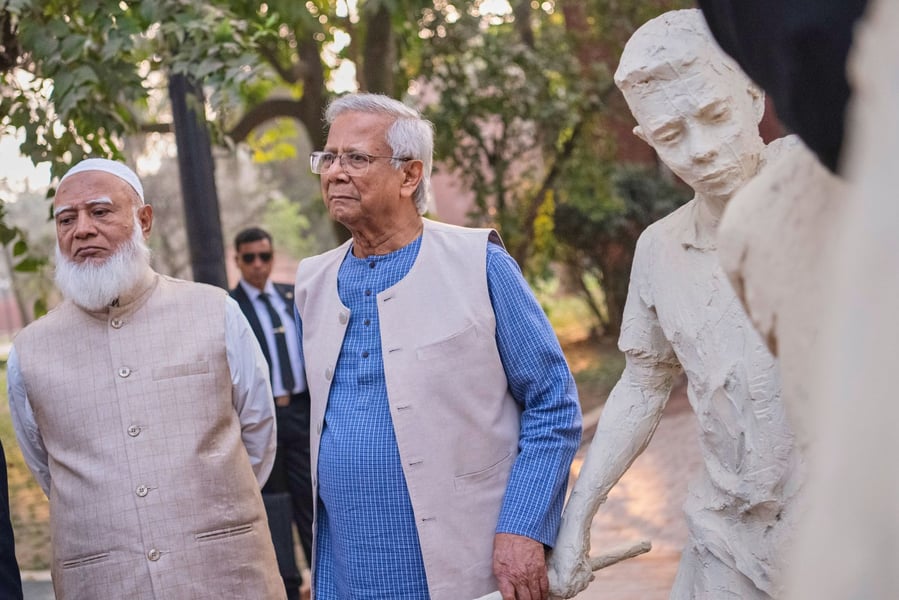
He has been photographed alongside Muhammad Yunus, the interim leader whose administration lifted the ban on his party and who now faces criminal proceedings of his own, which we set out in our report on the sedition charges against Yunus. The reordering of Bangladeshi politics since August 2024 has been fast enough that the same photograph can be read as reconciliation or as opportunism depending on the month it is viewed in.
What the record does not settle
Three things about Shafiqur Rahman are documented and not seriously contested. He built Jamaat’s electoral machine out of a Sylhet regional base over four decades. He has never been convicted of a crime. And in February 2026 he delivered his party the best result it has ever achieved, from a standing start of illegality.
Three things are not settled at all. Whether the acknowledgement of “past mistakes” is the beginning of an accounting for 1971 or a substitute for one. Whether the January X post was written by him. And whether a party that has spent fifty years in opposition, prison and prohibition can govern, which is a question the 2026 result deferred rather than answered by putting him on the opposition benches rather than the government ones.
The next national election is not due until 2031 unless the BNP government falls sooner. Rahman will be 72. On the evidence of the last seven years that is not obviously a constraint, though the bypass in July 2025 is a reminder that the calendar is not the only variable. For the wider political context in which he now operates, see our coverage of the crisis that reshaped Bangladeshi politics.
Shafiqur Rahman: frequently asked questions
Who is Shafiqur Rahman?
Dr Shafiqur Rahman is a Bangladeshi physician and politician, the fourth Ameer of Bangladesh Jamaat-e-Islami since 12 November 2019, and Leader of the Opposition in the Jatiya Sangsad since 17 February 2026. He represents Dhaka-15.
How old is Shafiqur Rahman and where was he born?
He was born on 31 October 1958 in Bhatera, Kulaura, in what was then Sylhet district and is now Moulvibazar. He turns 68 in October 2026.
Is Shafiqur Rahman a doctor?
Yes. He qualified MBBS from Sylhet MAG Osmani Medical College in 1983 and worked as a government physician before politics became full time.
How many seats did Jamaat-e-Islami win in the 2026 election?
Sixty-eight of the 297 declared seats, on 31.76 per cent of the vote, rising to 77 with coalition partners. It was the party’s best result. The BNP won 209 seats on 49.97 per cent and formed the government.
Was Shafiqur Rahman ever in prison?
Yes. He was arrested in December 2022 on charges of supporting militancy and held for 15 months before being granted bail. His name was removed from the list of accused in March 2025. He has no conviction.
Did Shafiqur Rahman oppose Bangladesh’s independence in 1971?
No, and no such allegation has been made against him. He was born on 31 October 1958 and was twelve years old when the war began. He has said a cousin of his was a freedom fighter killed in the conflict. The party he now leads, Jamaat-e-Islami, did oppose independence and sided with Pakistan, and Bangladeshi law names it as a collaborator force.
What was Jamaat-e-Islami’s role in the 1971 war?
Jamaat opposed the separation of East Pakistan from West Pakistan and its leaders and cadres helped raise the auxiliary militias that operated alongside the Pakistan Army, the Razakars and later Al-Badr and Al-Shams. Al-Badr is associated with the killing of Bengali intellectuals in the final days of the war. The Jatiya Muktijoddha Council (Amendment) Bill, passed on 9 April 2026, names Jamaat-e-Islami in statute as a collaborator force.
What has Shafiqur Rahman said about 1971?
In parliament in April 2026, opposing the law that names his party as a collaborator force, he said Allah is the only complete witness to 1971 and everyone else is a partial witness, and he demanded Jamaat’s name be removed from the definition. Elsewhere he has acknowledged Jamaat’s “past mistakes” and asked forgiveness if the party caused harm, without naming specific actions or individuals. Jamaat continues to reject the findings of the International Crimes Tribunal, which sentenced five of its senior leaders to death.
What did Shafiqur Rahman say about working women?
A post on his verified X account on 31 January 2026 described women working outside the home as “another form of prostitution” and said women could not lead the party. Rahman called the post false and misleading and Jamaat said the account had been hacked. Separately, and not in dispute, he told Al Jazeera in an interview that a woman could not lead the party because of what he described as women’s distinct nature and maternal responsibilities.
Why did Shafiqur Rahman collapse in 2025?
He collapsed while addressing a rally at Suhrawardy Udyan in Dhaka on 19 July 2025 and underwent four-vessel bypass surgery at United Hospital. He recovered and was discharged.
Is Jamaat-e-Islami legal in Bangladesh?
Yes. Its registration was cancelled in 2018 and it was banned outright on 1 August 2024. The interim government reversed the ban on 28 August 2024 and the Appellate Division ordered the Election Commission to restore its registration on 1 June 2025.
Who is the prime minister of Bangladesh?
Tarique Rahman of the Bangladesh Nationalist Party, whose party won 209 seats in the February 2026 election. Shafiqur Rahman leads the opposition to his government.